

IAP-26-007
The Agricultural Plastisphere: Environmental Reservoirs of Pathogens and Antimicrobial Resistance Under Climate Change
Bacterial pathogens and antimicrobial resistance (AMR) are increasingly recognised as environmental challenges that extend beyond infected hosts. Many bacterial pathogens persist within environmental reservoirs, including soils, water sources, organic wastes and biofilms associated with natural and anthropogenic surfaces. While natural reservoirs have received considerable attention, human-made materials are now ubiquitous components of agricultural landscapes and may provide novel habitats that facilitate pathogen persistence and dissemination. Agricultural plastics, water infrastructure, feeding equipment, housing materials and other farm-associated surfaces can support complex microbial communities whose influence on pathogen ecology remains poorly understood.
These materials differ substantially in their physical and chemical properties, influencing moisture retention, nutrient availability, ultraviolet exposure and biofilm development. As a result, they may vary considerably in their capacity to accumulate, maintain and transmit bacterial pathogens and AMR determinants. Environmental microbial communities may further modify reservoir function, either suppressing invading pathogens through competition and antagonism or facilitating persistence through protective biofilms and resource sharing.
Climate change is likely to alter these dynamics by modifying temperature, moisture availability, drying-rewetting cycles and the frequency of extreme weather events. Such changes may influence pathogen persistence, transmission opportunities, virulence and the maintenance of AMR within environmental reservoirs. Agricultural ecosystems are particularly relevant in this context because livestock interact continuously with both natural and anthropogenic environmental materials, creating opportunities for microorganisms to circulate among animals, environmental reservoirs and wildlife. However, the factors that determine why some environmental materials become important pathogen reservoirs while others suppress pathogen survival remain poorly understood.
Addressing this knowledge gap is essential for predicting how climate-driven environmental change will reshape pathogen persistence, disease emergence and AMR dissemination across agricultural ecosystems. It will also provide the evidence needed to develop biosecurity strategies that target environmental reservoirs and improve the resilience of agricultural systems to future climatic change.
Aims
The overarching aim of this project is to determine how anthropogenic and natural environmental materials influence the persistence, transmission and dissemination of bacterial pathogens and AMR within agricultural ecosystems under current and future climate conditions. By identifying the physical, ecological and microbiological factors that determine reservoir capacity, the project will reveal why certain environmental materials act as sources of pathogen transmission while others function as pathogen-suppressive environments. Ultimately, the findings will inform the development of climate-resilient biosecurity strategies for livestock production systems.
Research objectives
1. Through comprehensive temporal surveying, identify natural and anthropogenic environmental materials that act as reservoirs of bacterial pathogens and AMR across agricultural systems.
2. Quantify how material properties, environmental conditions and microbial community composition influence pathogen persistence and reservoir capacity.
3. Using microbiological, molecular and genomic approaches, investigate connectivity among livestock, environmental reservoirs and wildlife-associated environmental compartments.
4. Experimentally quantify how projected climate scenarios alter pathogen survival, virulence, biofilm formation and AMR dynamics across contrasting environmental materials.
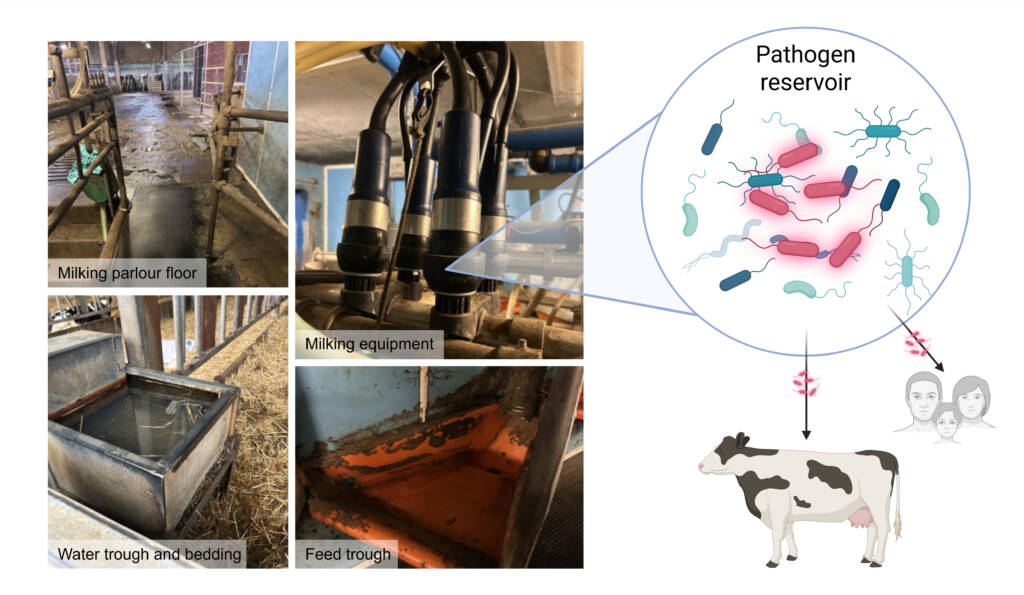
Click on an image to expand
Image Captions
On farm pathogen reservoirs
Methodology
This research will combine field-based investigation of environmental reservoirs with controlled laboratory experimentation at the University of Glasgow (UoG) and the University of Stirling (UoS). Fieldwork will be undertaken at UoG’s livestock research farms, including Cochno and Melrose, which encompass a range of agricultural environments, management systems and anthropogenic infrastructure. These sites provide an ideal opportunity to investigate how natural and human-made materials influence the persistence and dissemination of bacterial pathogens and AMR within agricultural ecosystems.
The student will conduct monthly sampling over a 12-month period to capture seasonal variation in pathogen persistence and reservoir function. Sampling will target natural reservoirs, including soils, sediments, bedding, manure and water sources, alongside anthropogenic materials such as water troughs, feeding equipment, fencing, concrete surfaces, drainage infrastructure and agricultural plastics. Environmental samples will be collected alongside livestock faecal samples to assess the distribution of bacterial pathogens and AMR determinants between animals and environmental reservoirs. Where feasible, evidence of wildlife activity will also be incorporated to investigate livestock-wildlife-environment transmission pathways.
Environmental variables, including temperature, rainfall and moisture levels, will be monitored throughout the study to determine how climatic conditions influence pathogen persistence and reservoir capacity. Emphasis will be placed on identifying material characteristics associated with enhanced pathogen survival, including moisture retention, weathering and biofilm formation potential.
To investigate the mechanisms underpinning reservoir function, representative field-derived materials will be examined under controlled laboratory conditions at UoS. Utilising Stirling’s specialised climate-controlled mesocosm experimental facilities, controlled exposure trials will simulate extreme weather events and seasonal fluctuations. Microcosm experiments will compare pathogen survival, biofilm development and AMR persistence across natural and anthropogenic materials exposed to both current and projected climate scenarios, including increased temperatures and altered moisture regimes.
Target bacterial pathogens, principally model organisms such as Escherichia coli and Salmonella spp. and key AMR determinants will be recovered from samples and characterised using phenotypic antimicrobial susceptibility testing. Selected isolates will undergo whole-genome sequencing (WGS) to resolve transmission connectivity among livestock, environmental reservoirs, and wildlife, while high-throughput 16S rRNA gene amplicon sequencing will profile resident microbial communities to evaluate competitive or supportive interactions within biofilms. By integrating field observations, climate data, and genomic results using multivariate statistical modelling and spatial network analyses, the project will identify the physical and ecological drivers that distinguish pathogen-amplifying materials from pathogen-suppressive materials. The resulting evidence will support predictive frameworks for understanding how climate change may influence disease risk and AMR dissemination within agricultural systems and will inform climate-resilient biosecurity and antimicrobial stewardship strategies.
Project Timeline
Year 1
Months 1-6 will focus on literature review, training in environmental microbiology and molecular techniques, and development of sampling protocols. Field visits to Cochno and Melrose research farms will establish sampling locations and pilot studies will optimise pathogen recovery, AMR characterisation and environmental monitoring methods. From Months 7-12, monthly sampling will commence alongside preliminary laboratory experiments investigating pathogen persistence, biofilm formation and reservoir capacity across contrasting environmental materials.
Year 2
Monthly field sampling and laboratory analyses will continue to capture seasonal variation in pathogen persistence and AMR dynamics. The student will characterise bacterial isolates and investigate relationships among material type, environmental conditions and reservoir capacity. Controlled experiments will assess the influence of material properties and environmental conditions on pathogen survival, biofilm formation and AMR maintenance. Initial manuscript and thesis chapter preparation will begin.
Year 3
Data collection will be completed and integrated analyses undertaken to identify the factors associated with pathogen-amplifying and pathogen-suppressive materials. Climate simulation experiments will quantify the effects of future environmental conditions on pathogen persistence and AMR dynamics. Findings will be translated into risk-assessment frameworks and evidence-based biosecurity recommendations, while manuscript preparation and publication activities continue.
Year 3.5
The final six months will focus on thesis completion, manuscript submission and stakeholder engagement. Results will be disseminated through publications, conference presentations and engagement with farmers, veterinarians, policymakers and industry stakeholders. Final outputs will include recommendations for climate-resilient biosecurity and antimicrobial stewardship within agricultural systems.
Training
& Skills
This studentship will provide interdisciplinary training in environmental microbiology, One Health, disease ecology and AMR. The student will receive comprehensive field and laboratory training through the University of Glasgow One Health Research in Bacterial Infectious Diseases (OHRBID) group and supervisory team, gaining expertise in environmental sampling, microbiology, antimicrobial susceptibility testing, biofilm analysis, molecular biology and genomic approaches for studying bacterial pathogens and AMR.
Specialist training in the safe handling of Hazard Group 2 microorganisms will be provided by the University of Glasgow and University of Stirling. The student will also develop skills in bioinformatics, statistical analysis, R programming and data visualisation to integrate environmental, microbiological and climatic datasets.
Additional training opportunities through the IAPETUS Doctoral Training Partnership will provide experience in quantitative ecology, environmental monitoring, science communication and stakeholder engagement. Collectively, these experiences will equip the student with a highly transferable skillset spanning environmental science, microbiology, bioinformatics and data analysis, preparing them for careers in academia, government, industry and the wider One Health sector.
References & further reading
Larsson et al. 2023. DOI: 10.1038/s41564-023-01351-9
Larsson & Flach 2022. DOI: 10.1038/s41579-021-00649-x
Djordjevic et al. 2024. DOI: 10.1038/s41576-023-00649-y
Flores-Vargas et al. 2021. DOI: 10.3389/fmicb.2021.766242
Ormsby & Quilliam 2026. DOI: 10.1038/s41579-026-01301-2
