

IAP-26-008
Numerical modelling of anisotropic ice flow in West Antarctica
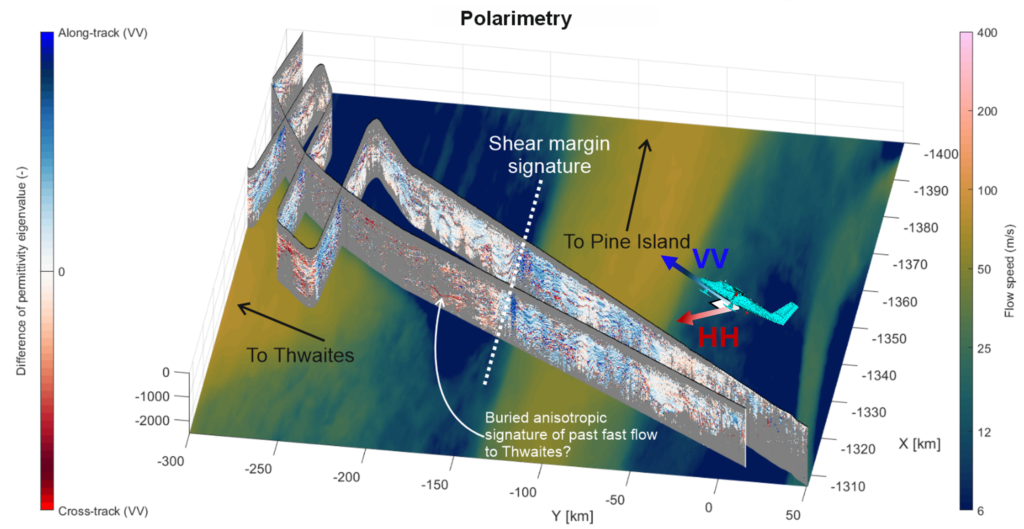
Ice-sheet models are essential for understanding the future evolution of Antarctica and its contribution to sea-level rise. However, modelling an entire ice sheet over decades to centuries is computationally demanding, meaning that assumptions are required about both the physics of ice flow and the equations used to represent it, resulting in a large range in sea-level projections across models (Seroussi et al., 2024). Two assumptions are made in many large-scale models: (1) that the ice softness is fixed in time, and (2) that the viscosity (internal friction) of ice is independent of direction. However, in reality, the crystal structure of ice means that it is highly anisotropic (Fig. 1). In other words, the orientation of individual ice crystals evolves as the ice deforms, causing it to flow more easily in some directions than others (ice fabric, Fig. 2). This has an important influence on fast-flowing ice streams, shear margins and ice shelves, all of which affect the sea level. Despite its importance, ice fabric has not yet been widely incorporated into large-scale ice-sheet simulations because of (1) limited observations with which to constrain the models, (2) uncertainty in how best to represent anisotropic flow, and (3) significant computational and mathematical challenges.
Recent advances make it possible to address these limitations. New radar data collection and processing techniques (Young et al., 2021) provide spatially varying information about ice-crystal orientation, overcoming the expensive limitations of ice-coring. At the same time, model advances have made simulating ice fabric on large scales more feasible, including
representing ice fabric using spherical harmonics (Richards et al., 2021; Rathmann et al., 2021) and numerical stabilisation techniques that allow greater numerical stability and larger stable time steps to be taken in ice-flow simulations (Lofgren et al., 2022; Henry et al., 2026). Together, these developments provide an opportunity to determine how fabric can be represented accurately in large-scale simulations while remaining computationally efficient.
The PhD student will build on existing anisotropic ice-flow and numerically stabilised modelling frameworks to investigate how the effects of ice-crystal orientation can be incorporated into models suitable for large Antarctic catchments. The student will investigate a hierarchy of modelling approaches and determine which physical processes and parameters are required to reproduce the influence of fabric on ice flow. Initial experiments will use idealised benchmark geometries to quantify the sensitivity of grounding-line position, ice-stream velocity, ice fluxes and buttressing (upstream forces) to an anisotropic rheology. The next step will be to compare ice-sheet models of varying physical complexity to establish when computationally cheaper approximations can reproduce the behaviour of more complete models.
The project will then move from idealised experiments to a major West Antarctic drainage basin such as Thwaites Glacier or Rutford Ice Stream, where changes in ice dynamics have important implications for future sea level. The student will investigate how including ice fabric changes simulated flow, grounding-line dynamics and ice discharge, while comparing modelled fabric with available observations of crystal orientation. Depending on the student’s interests, the project could additionally explore computational optimisation, experiments using future climate forcings or machine learning techniques. The overall aim is to contribute to a new generation of ice-sheet models that combine improved physical accuracy with novel numerical stabilisation schemes that allow computationally efficient simulations of future changes in the Antarctic Ice Sheet.

Click on an image to expand
Image Captions
Figure adapted from Llorens et al., 2022.,Figure provided by Álvaro Arenas-Pingarrón
Methodology
The PhD student will investigate the coupling of the momentum equation, the mass conservation equation and the crystal orientation equation in the context of idealised ice-sheet model domains with the novel numerical stabilisation schemes. The student will also apply the model to the Thwaites Glacier or Rutford Ice Stream, highly dynamic regions in Antarctica that are predicted to become unstable under a warming climate. The student will implement, and test the robustness and accuracy of the numerically-stabilised anisotropic model. The model will be built on existing Firedrake finite element software (Ham et al., 2023), which allows quick model prototyping. The simulations of Thwaites Glacier or Rutford Ice Stream will be constrained using radar data of ice fabric, which will aid in the interpretation of ice dynamics. The radar comparisons will be made in collaboration with Dr TJ Young at the University of St Andrews and Dr Álvaro Arenas-Pingarrón at the British Antarctic Survey.
The PhD student will be situated at BAS, with project collaborators at the University of St Andrews. At BAS, the student will be part of a team of ice-sheet modellers, who work on the physical and numerical development of ice-sheet models, as well as machine learning techniques. Numerous seminars in Cambridge will be accessible including at BAS, at the Department of Applied Mathematics and Theoretical Physics and the Scott Polar Research Institute.
Project Timeline
Year 1
Familiarisation with the coupled system of PDEs for anisotropic ice flow and the finite element method. Perform simulations of idealised model domains and undertake a literature review of anisotropic ice-flow modelling and finite element theory.
Year 2
Further numerical experiments across models of varying complexity, interpretation of results and write up of the first paper.
Year 3
Apply the model to the Thwaites Glacier or Rutford Ice Stream using Firedrake. Solve for the ice fabric under various scenarios to allow interpretation of existing fabric observations. Write up of the second paper.
Year 3.5
Completion of the last paper and write up of the thesis.
Training
& Skills
The student will:
● Develop expertise in ice-flow modelling, including boundary conditions and grounding-line contact problems.
● Learn numerical stabilisation techniques and finite element theory.
● Explore ice microphysics through modelling and radar data analysis.
This PhD project offers training in advanced computational modelling and glaciology, equipping the student with a multidisciplinary skillset highly relevant to climate science and numerical geophysics. The research integrates computational fluid dynamics, numerical analysis, ice microphysics, applied mathematics, and geophysical methods, with an emphasis on high-performance computing. The student will gain hands-on experience with state-of-the-art modelling tools, including:
● Firedrake, a Python-based finite element software for model development
● Data assimilation and post-processing of complex 3D simulation outputs
Training will be complemented by attendance at a glaciology summer school, and courses in scientific writing, data management, advanced programming and GIS. They will conduct time-dependent simulations to investigate grounding line dynamics, a key controlling mechanism in ice sheet dynamics. Optional training in radar data processing (quad-polarimetric) will be available, supported by experts at BAS and the University of St Andrews.
The student will present their work at:
● Institutional seminars (BAS, University of St Andrews),
● National conferences (e.g., International Glaciological Society British Branch Meetings),
● International meetings (e.g., ECCOMAS, EGU).
They will also benefit from networking and professional development opportunities through the IAPETUS Doctoral Training Partnership, fostering collaboration across UK research institutions.
The student will benefit from the experience of working as part of a larger team spanning several institutions.
The project will use supercomputing facilities.
Informal enquiries are welcome by contacting Dr Clara Henry (clara.henry@bas.ac.uk), Dr Daniel Richards (dancha@bas.ac.uk), or Dr Carlos Martín (cama@bas.ac.uk).
References & further reading
Seroussi, H., Pelle, T., Lipscomb, W. H., Abe-Ouchi, A., Albrecht, T., Alvarez-Solas, J., et al. (2024). Evolution of the Antarctic Ice Sheet over the next three centuries from an ISMIP6 model ensemble. Earth’s Future, 12, e2024EF004561. https://doi.org/10.1029/2024EF004561
Löfgren, A., Ahlkrona, J., Helanow, C. (2022). Increasing stable time-step sizes of the free-surface problem arising in ice-sheet simulations. Journal of Computational Physics: X, 16, 100114. https://doi.org/10.1016/j.jcpx.2022.100114
Llorens, M.-G., Griera, A., Bons, P. D., Weikusat, I., Prior, D. J., Gomez-Rivas, E., de Riese, T., Jimenez-Munt, I., García-Castellanos, D., and Lebensohn, R. A. (2022). Can changes in deformation regimes be inferred from crystallographic preferred orientations in polar ice?, The Cryosphere, 16, 2009–2024, https://doi.org/10.5194/tc-16-2009-2022
Richards, D. H., Pegler, S. S., Piazolo, S., & Harlen, O. G. (2021). The evolution of ice fabrics: A continuum modelling approach validated against laboratory experiments. Earth and Planetary Science Letters, 556, 116718. https://doi.org/10.1016/j.epsl.2020.116718
Rathmann N.M., Hvidberg C.S., Grinsted A., Lilien D.A., Dahl-Jensen D. (2021). Effect of an orientation-dependent non-linear grain fluidity on bulk directional enhancement factors. Journal of Glaciology. 67(263):569-575. https://doi.org/10.1017/jog.2020.117
Henry, A. C. J., Zwinger, T., and Ahlkrona, J. (2026) Grounding-line dynamics in a Stokes ice-flow model (Elmer/Ice v9.0): Improved numerical stability allows larger time steps, EGUsphere [preprint], https://doi.org/10.5194/egusphere-2025-4192
Young, T.J., et al. (2021). Rapid and accurate polarimetric radar measurements of ice crystal fabric orientation at the Western Antarctic Ice Sheet (WAIS) Divide ice core site. The Cryosphere 15.8, 4117-4133. https://doi.org/10.5194/tc-15-4117-2021
Ham, D., et al. (2023). Firedrake User Manual, First edition. https://doi.org/10.25561/104839
