

IAP-26-006
Exploring Holocene Antarctic Ice Sheet dynamics using a data-modelling approach
The dynamics of ice sheets (such as thickness, flow, and the change in these over time and space) during periods of ice mass loss, such as in the present day, are currently not well constrained and are a major limiting factor in the reliability of predictions of sea level rise in our warming climate. The aim of this PhD project is to use new and existing high-resolution palaeoclimate records from Antarctica to model periods of ice sheet loss in the past and improve our understanding of how the Antarctic Ice Sheet behaves. It will focus in particular on observed periods of rapid ice mass reduction in the Holocene (the last ~11,000 years). The goal is to improve model-data agreement of West Antarctic Ice Sheet (WAIS) retreat on regional scales and enhance our understanding of the order of events between inland and coastal ice-mass loss, and thus the mechanisms driving both rapid and longer-term dynamics during deglaciation.
Recently developed ice core proxies for Antarctic ice sheet (AIS) elevation and ice sheet dynamics (for example, ice core records of total air content and nitrogen isotopes) record the history of ice mass loss throughout the Holocene at exceptional temporal resolution and unrivalled chronological accuracy, providing direct evidence of changes in the ice sheet at centennial resolution for the first time. Combining these new proxies with existing terrestrial and marine sourced paleoclimate archives to validate high resolution ice sheet models has the potential to greatly reduce uncertainties on the timing and style of rapid ice mass loss during the Holocene, and therefore the potential future deglaciation of the AIS.
The student undertaking this project will produce a comprehensive updated compilation of available palaeoclimate archives for Antarctic ice sheet extent and retreat, an important future asset to the wider ice sheet community. Under the guidance of experienced ice sheet modellers at BAS, the student will use this new compilation to constrain and validate high-resolution ice-sheet modelling experiments by running the Utrecht Finite Volume Ice Sheet Model (UFEMISM) in a series of experiments to understand the patterns, timings, and drivers of WAIS response to climate evolution since the Last Glacial Maximum, with a particular focus on the Holocene. There will be opportunities for the student to be involved in ongoing ice core analytical projects, working alongside BAS ice core scientists to gain hands-on experience in collecting the records used in the model, as well as receiving both theoretical and practical training in glaciology at international summer schools/workshops. The student will identify both the most useful current palaeoclimate proxies for ice sheet reconstruction and critical missing gaps in our existing datasets to target for future palaeoclimate archive retrieval.
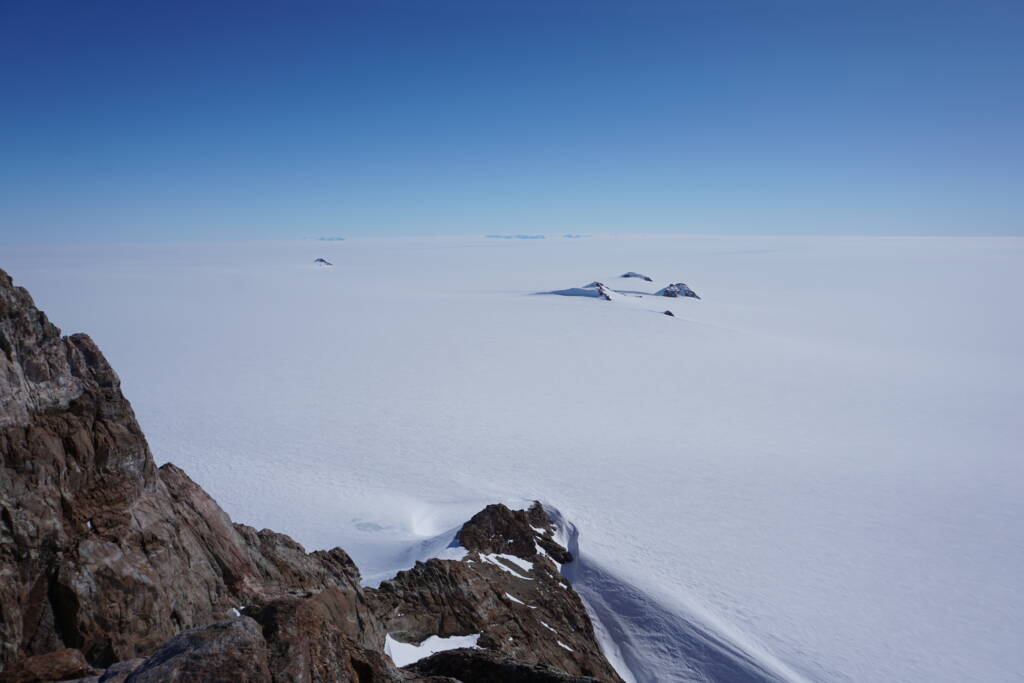
Click on an image to expand
Image Captions
Photo by Martim Mas e Braga, Antarctica, 2024
Methodology
The student will:
– Produce a comprehensive review and updated compilation of available terrestrial and marine palaeoclimate archives for Antarctic ice sheet extent and retreat, appropriately formatted for use by the wider ice-sheet modelling community.
– Set up and use the Utrecht Finite Volume Ice Sheet Model (UFEMISM) numerical ice sheet model for ensemble simulations of the last deglaciation, testing different available climate forcings, sea-level reconstructions, and uncertain model parameters.
– Depending upon the interest of the student, assist with ongoing ice core analytical campaigns at BAS to gain practical experience and understanding of analyses involved in producing the records being used in the model, and/or gain experience in marine sediment core analysis through an extended visit to Durham University.
– Determine the most plausible climate drivers and glaciological/model parameter combinations according to the paleoclimate archives, by comparing these archives with ensembles of model simulations.
– Identify regions of WAIS with higher uncertainty in model ensembles for which no data are currently available, or where the currently available data are not sufficient to improve our model results (e.g., because they have low spatial density, and/or large uncertainties)
– Identify model parameters/processes to which simulations are highly sensitive and are not properly constrained by the compiled archives.
– Explore potential sites for future ice core drilling and target analysis for most powerful proxies.
Project Timeline
Year 1
– Literature review of current understanding of West Antarctic Ice Sheet history through the Holocene, modelling techniques, and analytical techniques used in the production of proxy records. (Chapter 1 – Intro)
– Compilation of existing and new palaeoclimate archives in a format suitable for widespread use by ice-sheet modellers. (Chapter 2)
– Training in use of the high-resolution ice sheet model, UFEMISM, at BAS.
– Identify samples in the BAS ice core repository that would help to fill missing data gaps in the compilation.
– Undertake theoretical training course in glaciology and ice sheet principles, for example Karthaus Summer School and/or University Centre in Svalbard (UNIS) PhD course in Glaciology.
– First year report
Year 2
– Publication 1: Data compilation
– Full set-up and running of model experiments for the target time-period, examining and optimising model sensitivities. (Chapter 3)
– Opportunities to assist in ongoing ice core analytical campaigns at the British Antarctic Survey or marine sediment analyses at Durham University to gain practical experience and understanding of analyses involved in producing the records being used in the model.
– Practical training course in glaciological fieldwork and applied skills.
Year 3
– Publication 2: Model set-up
– Constrain model ensemble with compiled dataset, incorporating any updated or newly analysed data, to refine our estimates of ice sheet history and review outputs. (Chapter 4)
– Identify key data gaps and make recommendations for future palaeoclimate archive collection and analysis. (Chapter 5 – conclusions)
– Focus on publication of work and presentation to the wider community at an international conference (for example, EGU General Assembly).
Year 3.5
– Publication 3: Model outputs for ice sheet retreat scenarios in the Holocene
– Final thesis report writing
Training
& Skills
The student will learn to independently run a high-resolution ice sheet model, the Utrecht Finite Volume Ice Sheet Model (UFEMISM) (https://doi.org/10.5194/gmd-18-3635-2025).
They will develop skills in the collation and interpretation of a wide range of palaeoclimate datasets, both marine and terrestrial.
The student will have the opportunity to take part in ongoing ice core or marine sediment analytical campaigns at the British Antarctic Survey or Durham University, developing an understanding of the analyses behind the palaeoclimate records being input to the models.
They will have opportunities to join international summer schools/workshops and courses in glaciology, ice sheets and ice cores, both theoretical and practical.
The student will develop their scientific writing through reports and submissions to peer reviewed journals.
The student will further benefit from a range of training offered by the Doctoral Training Programme.
References & further reading
King, A. C. F., et al. Ice core nitrogen isotopes archive dramatic changes in West Antarctic Ice Sheet thinning, Clim. Past, 22, 1291–1304, https://doi.org/10.5194/cp-22-1291-2026, 2026.
Mas e Braga, M., et al. Nunataks as barriers to ice flow: implications for palaeo ice sheet reconstructions, The Cryosphere, 15, 4929–4947, https://doi.org/10.5194/tc-15-4929-2021, 2021.
Johnson, J.S., et al. Synchronous Holocene thinning of Pine Island Glacier and its tributaries influenced by ice-shelf unpinning. Nat Commun. https://doi.org/10.1038/s41467-026-76244-6, 2026.
Mawbey, E. M., Smith, J. A., Hillenbrand, C., Hendry, K. R., McClymont, E. L., Greaves, M. J., Klages, J. P., Kuhn, G., Radionovskaya, S., Spencer-Jones, C. L., Larter, R. D., Wellner, J. S., & Dutrieux, P. Ocean heat forced West Antarctic Ice Sheet retreat after the Last Glacial Maximum. Nature Communications, 17(1), Article 2079. https://doi.org/10.1038/s41467-026-68949-5, 2026
Grieman, M. M. et al. Abrupt Holocene ice loss due to thinning and ungrounding in the Weddell Sea Embayment. Nat. Geosci. 17, 227–232, https://doi.org/10.1038/s41561-024-01375-8, 2024.
Bentley, M., et al. A community-based geological reconstruction of Antarctic Ice Sheet deglaciation since the Last Glacial Maximum, Quat. Sci. Reviews. 100, 1-9, https://doi.org/10.1016/j.quascirev.2014.06.025, 2014.
Suganuma, Y., et al. Regional sea-level highstand triggered Holocene ice sheet thinning across coastal Dronning Maud Land, East Antarctica. Commun Earth Environ 3, 273, https://doi.org/10.1038/s43247-022-00599-z, 2022.
Davis, H. J., et al. Assessing the potential for an ice core in the southern Antarctic Peninsula to elucidate Holocene climate history, The Cryosphere, 20, 2735–2756, https://doi.org/10.5194/tc-20-2735-2026, 2026.
