

IAP-26-045
The adaptive role of symbiotic diversity in montane lichens
Variation in the composition of symbiotic associations has been suggested to be an important determinant of ecological tolerances of individual species, with examples of iconic symbiotic systems like corals and lichens clearly suggesting evidence of widespread heterogeneity within and among individuals (Grajales et al. 2016; Stanton and Meyer 2026; Allen and Lendemer 2022). For example, discrete lichen thalli of a single fungal genotype have been shown to consistently associate with two different strains of symbiotic algae even within single branches; these two algal strains have different ecologically tolerances, inferred to allow for exploitation of a wider environmental range for the lichen as a whole (Casano et al. 2014). We currently have little understanding of the prevalence of such symbiotic patterns of association, but if this situation is common, it has important implications for tolerance of changing environmental conditions, particularly in the rapidly changing boreal and arctic zones.
The scale of symbiotic associations within and among symbionts has rarely been examined in northern systems, with few studies exploring flexibility within individuals. In addition, algal symbionts derived from local sources are accessible across co-occurring communities leading to different fungi associating with the same algal partners. This study aims to test the multiple scales of variation within and among co-occurring lichen symbioses as a model system for the ability of symbiotic communities to tolerate and potentially respond to changing environmental conditions. The effects of symbiotic interactions on macroevolutionary patterns also allow a test of a major hypothesis in mutualism evolution: the expectation that highly specialized mutualisms put species at higher risk of extinction due to restricted distributions.
Study system
Montane lichens are biodiverse and important in nutrient cycling, fixing both carbon and atmospheric nitrogen (Porada et al 2014). The family Lecideaceae is a conspicuous, important and biodiverse family in montane, arctic and alpine systems (Ruprecht et al. 2020; Fryday et al 2025), particularly occurring as long-lived, rock-dwelling lichens with green algal symbionts in the genus Trebouxia (Ruprecht et al 2020; Sanders and Matsumoto 2021), often covering large rock surfaces in complex communities. In the northern latitudes, fungal species with intercontinental geographic distributions are found alongside a diversity of more habitat specialists with smaller ranges. Within the family, several large clades, including the Haplocarpon and Amygdalaria clades (Buschbom and Mueller 2004; Fryday et al 2025), are known to include at least 10 species each in the northern hemisphere, providing species groups with shared evolutionary histories within which to compare patterns of association and distributions.
Our Research Questions
Is there evidence of heterogeneity of algal symbionts within individuals from different clades? We will focus initially on the Haplocarpon and Amygdalaria clades.
Does a generalist symbiotic strategy lead to long-term resilience to change? Specifically, do species distribution patterns correlate with patterns of specificity among symbiotic partners?
Is there evidence of community-scale patterning in photobiont partners of montane Lecideaceae, corresponding to ecological gradients of latitude and altitude?
Click on an image to expand
Image Captions
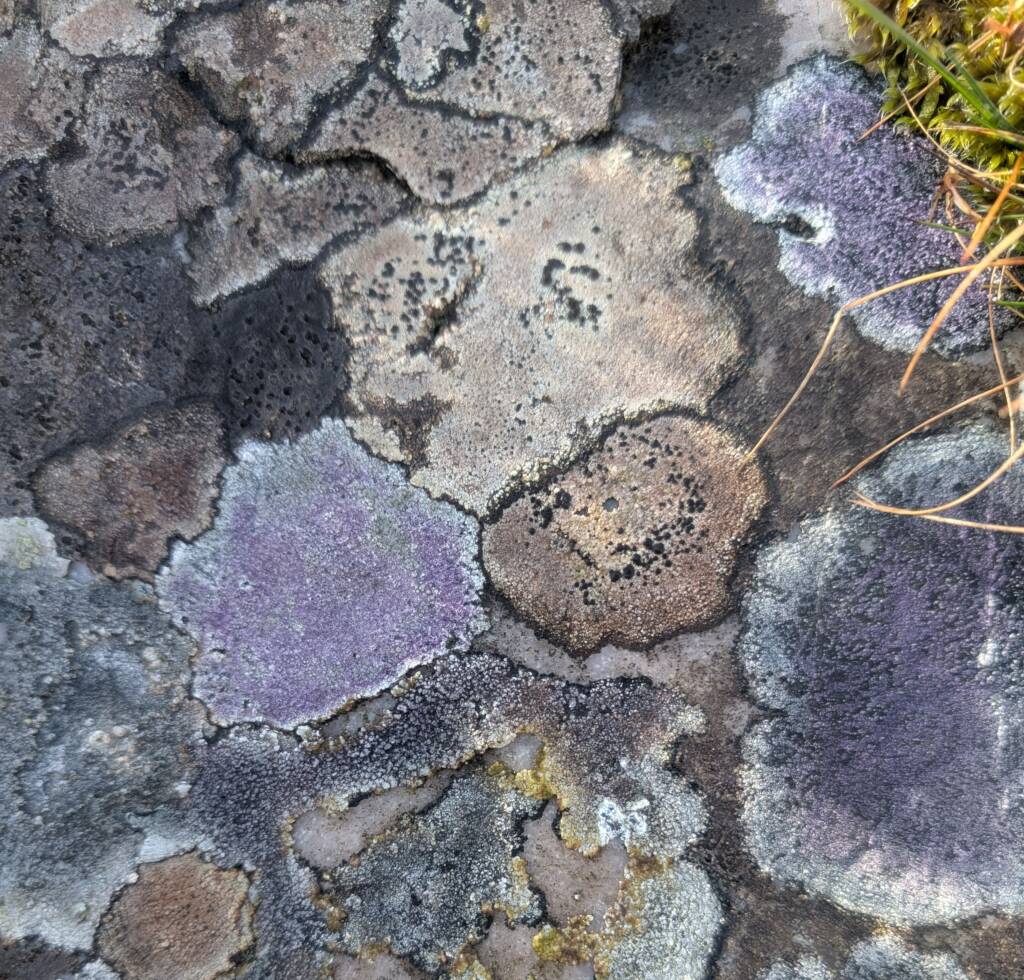
A mosaic of mountain lichens. Which partner drives the distribution?
Methodology
A literature review of symbiotic specificity across organism groups will be undertaken to identify knowledge gaps and a theoretical background for the study. Groundwork to establish the species pairs for testing will be completed by examining and adding to recent phylogenetic studies, allowing for selection of species for study from the Haplocarpon and Amygdalaria groups.
Q1. Several spatially separated replicate samples from within individual lichen thalli will be collected from a range of species and ecological conditions to test for the presence of symbiont diversity within individuals and the effects of fungal species identity versus ecological conditions on symbiont associations. Metabarcoding will be used to examine the nature of an individual, with symbionts determined by qPCR, and full intrathalline algal symbiont communities described as a background to test the null hypothesis that lichen thalli will be dominated by a single algal type versus having variable algal symbionts corresponding to altitudinal or latitudinal variation.
Q2. Algal diversity among species in the Haplocarpon and Amygdalaria lineages will be examined by selecting study species to encompass sister species with contrasting ranges. First, a review of existing specimens in natural history collections will be conducted to establish plausible distribution ranges. Loans will be requested and important collections will be visited to sample collections for DNA extraction. A metabarcoding approach using fungal and algal-specific ITS1 and ITS2 regions separately will be employed to maximize recovery of historic fungal and algal DNA. Fresh collections will be used for balanced sampling from both lineages from across elevational or latitudinal gradients for pairs of sister species to test whether species distribution sizes are correlated with algal symbiont diversity or with geographic or evolutionary patterns rather than symbiotic associations.
Q3. Intraspecific algal symbiont diversity will be sampled by intensive sampling of co-occurring members of Lecideaceae across ecological gradients, including test species in addition to co-occurring members of the family and other co-occurring lichens with dominant Trebouxioid photobionts. These data can be used to test whether symbiotic communities of algae are shared among co-occurring species of lichenised fungi and the related hypothesis that photobionts of asexually-reproducing species are sources for symbionts of sexual species and are shared within ecological guilds.
Project Timeline
Year 1
Performing literature review; arranging loans of specimens from major herbaria; selecting relevant ecological gradients for study; sampling and analysis of intrathalline diversity. Training in metabarcoding, field sampling and design and scientific writing.
Year 2
Draft short communication on intrathalline diversity; fieldwork sampling along ecological gradient and community sampling; metabarcoding labwork on fungal and algal composition. Training in wet lab methods, R and bioinformatics.
Year 3
Analysis of symbiotic association within sampled gradients at species and community level associations at OTU level. Draft manuscripts. Training in quantitative ecology and statistics, version control and FAIR data.
Year 3.5
Harmonize OTUs with fungal taxonomy; thesis writing.
Training
& Skills
1. Lichen symbiosis and field ecology
Lichen biology, ecological gradients and sampling design.
2. Molecular ecology and metabarcoding
DNA extraction, marker choice, PCR, sequencing and quality control.
3. Bioinformatics and reference databases
Sequence processing, taxonomic assignment and reference coverage.
4. Quantitative ecology and statistics
Diversity, turnover, environmental modelling and spatial effects.
5. Reproducible research and data management
R, version control, workflows and open data.
6. Researcher development
Writing, presentations, collaboration and career development.
References & further reading
Allen, J.L. and Lendemer, J.C., 2022. A call to reconceptualize lichen symbioses. Trends in Ecology & Evolution, 37(7), pp.582-589.
Fryday, A.M., Ruprecht, U., Götz, A. and Kantvilas, G., 2025. Aurantiothallia and Hertelaria, two new genera of porpidioid Lecideaceae (Ascomycota, Lecanoromycetidae, Lecideales), and other new porpidioid taxa from Tasmania. The Lichenologist, 57(6), pp.256-277.
Grajales, A. and Sánchez, J.A., 2016. Holobiont assemblages of dominant coral species (Symbiodinium types and coral species) shape Caribbean reef community structure. Revista de la Academia Colombiana de Ciencias Exactas, Físicas y Naturales, 40(155), pp.300-311.
Porada, P., Weber, B., Elbert, W., Pöschl, U. and Kleidon, A., 2014. Estimating impacts of lichens and bryophytes on global biogeochemical cycles. Global Biogeochemical Cycles, 28(2), pp.71-85.
Ruprecht, U., Fernández-Mendoza, F., Türk, R. and Fryday, A.M., 2020. High levels of endemism and local differentiation in the fungal and algal symbionts of saxicolous lecideoid lichens along a latitudinal gradient in southern South America. The Lichenologist, 52(4), pp.287-303.
Sanders, W.B. and Masumoto, H., 2021. Lichen algae: the photosynthetic partners in lichen symbioses. The Lichenologist, 53(5), pp.347-393.
Stanton, D.E. and Meyer, A.R., 2026. What is an ‘individual’ in lichen symbioses? An overview of alternative perspectives. The Lichenologist, pp.1-7.
