

IAP-26-016
Molecular archives of environmental change: reconstructing Late Quaternary ecosystems from Paisley Caves
Understanding how ecosystems responded to rapid environmental change in the past provides essential long-term context for understanding ecological resilience under future climate change. Yet many conventional environmental archives provide spatially or temporally averaged signals that make it difficult to reconstruct ecological change at the scale experienced by individual animals and people. The Paisley Caves, Oregon, preserve an exceptional Late Pleistocene and Holocene sequence containing abundant stratified deposits of packrat and bat faeces. Previous pollen research has demonstrated their potential as palaeoenvironmental archives, while also showing that coprolites can record short-term, local ecological information distinct from the more regional signal preserved in surrounding lake sediments. The caves also preserve occasional human coprolites and have been the focus of previous integrated research combining sediment micromorphology and lipid biomarkers to investigate stratigraphy, site formation and the earliest human occupation of North America. This project will exploit a unique archive of resin-impregnated sediment blocks from Paisley Caves to reconstruct changing vegetation, animal ecology and environmental conditions through this sequence. It will integrate soil and sediment micromorphology, lipid biomarkers, ancient/environmental DNA and tephrochronology, asking how molecular signals preserved in discrete faecal-rich layers reflect environmental change at different spatial and temporal scales. A major methodological objective will be to determine whether molecular palaeoenvironmental information can be recovered reliably from archived resin-impregnated sediments. If successful, this could unlock new research potential in legacy micromorphology collections worldwide, allowing existing samples to address questions unforeseen when they were collected.
The project will address three questions:
1. How did vegetation and animal ecology change through major Late Quaternary environmental transitions at Paisley Caves?
2. What different environmental information is recorded by packrat faeces, bat guano and surrounding sediments, and at what spatial and temporal scales?
3. Can molecular and tephrochronological analyses be integrated with microstratigraphy to transform resin-impregnated sediment archives into high-resolution records of environmental change?
Click on an image to expand
Image Captions
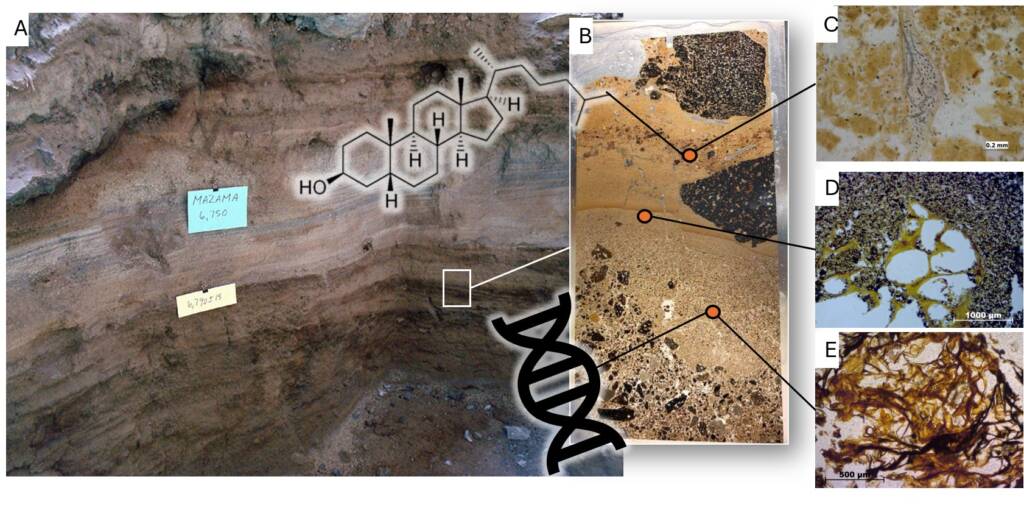
A. Paisley Caves stratigraphy B. Thin section slide C-E. Micrographs showing various micro-components within sediments.
Methodology
The project will develop a multi-proxy molecular and microstratigraphic approach centred on the extensive existing archive of resin-impregnated blocks from Paisley Caves. Earlier work has already demonstrated the value of integrating micromorphology and biomarkers at the site and provides an established stratigraphic and methodological framework on which the studentship can build.
1. Archive characterisation and microstratigraphy: Existing blocks and thin sections will first be mapped against the Paisley Caves stratigraphic and chronological framework. Soil and sediment micromorphology will characterise individual faecal deposits, sedimentary context, depositional processes and post-depositional alteration. High-resolution digital microscopy and complementary imaging will be used to identify sampling locations while minimising destructive analysis. This provides a critical taphonomic control; molecular results will be interpreted in relation to demonstrably intact microstratigraphic contexts rather than bulk sediment samples.
2. Lipid biomarker analysis: Targeted microsamples will be analysed for lipid biomarkers indicative of faecal inputs, vegetation and environmental conditions. Lipid analysis is particularly well suited to this project because previous research at Paisley has demonstrated the preservation and analytical value of faecal biomarkers. Lipid distributions will be compared between packrat, bat and sediment-rich layers to investigate whether different depositional agents record different components or spatial scales of the surrounding ecosystem.
3. Ancient and environmental DNA: Selected stratigraphic horizons will be targeted for ancient/environmental DNA analysis to identify preserved plant and animal signals and reconstruct changes in ecological communities through time. An initial experimental phase will assess DNA preservation and the effects of resin impregnation, alongside appropriate blanks and contamination controls. DNA and lipid results will subsequently be compared to determine where independent molecular proxies corroborate one another and where they provide complementary ecological information.
4. Tephrochronology. Selected blocks will be screened for microscopic volcanic ash layers or cryptotephra, providing the potential for independent chronological markers that connect Paisley Caves with wider regional environmental records. This strand will draw on Helen Mackay’s expertise in North American cryptotephrochronology. Her work has developed cryptotephra frameworks for North America and demonstrated their potential to link geographically separated palaeoenvironmental archives.
5. Multi-proxy integration: Micromorphological, DNA, lipid and tephra evidence will be integrated with existing chronological and palaeoenvironmental records, particularly published pollen data. Paisley Caves already has pollen sequences covering Late Glacial and Early Holocene environmental change, providing an unusually strong independent dataset against which the new molecular record can be evaluated.
Project Timeline
Year 1
Year 1: Framework, method development and pilot analysis
Literature review and training in Quaternary palaeoecology, micromorphology, molecular proxies and research data management. Catalogue and digitally map the Paisley archive against existing stratigraphy and chronology. Undertake micromorphological characterisation and develop a sampling strategy. Conduct pilot lipid and DNA analyses to evaluate biomolecular preservation in resin-impregnated material, including appropriate experimental controls. Screen selected sequences for cryptotephra.
Year 2
Year 2: Main analytical programme
Complete systematic sampling across selected environmental transitions. Undertake lipid biomarker and ancient/environmental DNA analyses and expand cryptotephra screening across key parts of the sequence. Characterise differences between packrat, bat and associated sedimentary deposits. Undertake specialist placement/training in molecular analysis and bioinformatics. Present initial findings at a national/international conference and prepare the first methodological paper on molecular analysis of archived resin-impregnated sediments.
Year 3
Year 3: Environmental reconstruction and integration
Integrate DNA, lipid, micromorphological and tephrochronological datasets with existing pollen and chronological evidence. Reconstruct changes in vegetation and animal ecology and investigate relationships with major Late Pleistocene-Early Holocene environmental transitions. Undertake targeted analysis of human-associated horizons where appropriate. Compare the environmental scales represented by different faecal and sedimentary archives. Complete key analytical chapters/papers and present results internationally.
Year 3.5
Final six months: Synthesis and completion
Complete synthesis of the multi-proxy sequence, finalise publications and thesis, archive datasets and analytical protocols, and communicate results to scientific and wider audiences. Particular emphasis will be placed on the broader applicability of the methodology to legacy sediment archives.
Training
& Skills
The student will develop an interdisciplinary skill set spanning Quaternary environmental science, geoarchaeology and molecular palaeoecology, with specialist training in sediment micromorphology, lipid biomarkers, ancient/environmental DNA and tephrochronology. They will develop skills in multi-proxy data integration, quantitative analysis, bioinformatics and reproducible research, alongside broader training in research design, data management, scientific writing and communication. A specialist laboratory placement and collaboration with US partners will provide experience of molecular methods, international research and collection-based science. IAPETUS training will complement project-specific training and support the student’s wider professional and career development.
References & further reading
Beck, C.W., Bryant, V.M. and Jenkins, D.L. (2020) ‘Comparison of Neotoma (packrat) feces to associated sediments from Paisley Caves, Oregon, U.S.A.’, Palynology, 44(4), pp. 723-741. https://doi.org/10.1080/01916122.2019.1702118.
Blong, J.C., Adams, M.E., Sanchez, G., Jenkins, D.L., Bull, I.D. and Shillito, L.-M. (2020) ‘Younger Dryas and early Holocene subsistence in the Northern Great Basin: multiproxy analysis of coprolites from the Paisley Caves, Oregon, USA’, Archaeological and Anthropological Sciences, 12, 224. https://doi.org/10.1007/s12520-020-01160-9
Mackay, H., Hughes, P.D.M., Jensen, B.J.L., Langdon, P.G., Pyne-O’Donnell, S.D.F., Plunkett, G., Froese, D.G., Coulter, S. and Gardner, J.E. (2016) ‘A mid to late Holocene cryptotephra framework from eastern North America’, Quaternary Science Reviews, 132, pp. 101-113. https://doi.org/10.1016/j.quascirev.2015.11.011.
Massilani, D., Morley, M.W., Mentzer, S.M., Aldeias, V., Vernot, B., Miller, C., Stahlschmidt, M., Kozlikin, M.B., Shunkov, M.V., Derevianko, A.P., et al. (2022) ‘Microstratigraphic preservation of ancient faunal and hominin DNA in Pleistocene cave sediments’, Proceedings of the National Academy of Sciences, 119(1), e2113666118. https://doi.org/10.1073/pnas.2113666118
McClymont, E.L., Mackay, H. et al. (2023) ‘Biomarker proxies for reconstructing Quaternary climate and environmental change’, Journal of Quaternary Science, 38(7), pp. 991-1024.
Saban, C.V., Herring, E.M., Jenkins, D.L. and Gavin, D.G. (2023) ‘Late glacial through Early Holocene environments inferred using pollen from coprolites and sediments recovered from Paisley Caves, Oregon’, Quaternary Research, 116, pp. 78-95.
Shillito, L.-M., Blong, J.C., Jenkins, D.L., Stafford, T.W., Whelton, H.L., McDonough, K. and Bull, I.D. (2018) ‘New research at Paisley Caves: applying new integrated analytical approaches to understanding stratigraphy, taphonomy, and site formation processes’, PaleoAmerica, 4(1), pp. 82-86. https://doi.org/10.1080/20555563.2017.1396167.
Shillito, L.-M., Whelton, H.L., Blong, J.C., Jenkins, D.L., Connolly, T.J. and Bull, I.D. (2020) ‘Pre-Clovis occupation of the Americas identified by human fecal biomarkers in coprolites from Paisley Caves, Oregon’, Science Advances, 6(29), eaba6404.
