

IAP-26-015
Transforming landscapes: the role of large herbivores in Holocene ecosystem dynamics
Large herbivores play a significant role in Earth System function and late Quaternary extinction of megaherbivores has had wide-ranging impacts on ecosystem function (Mahli et al. 2016). By contrast, in long-settled regions like NW Europe, large herbivores – wild and domesticated – are often implicated in Holocene landscape transformation (Fyfe et al. 2015), but we lack a clear understanding of their role in ecosystem function and how this has altered over the long timescales involved in vegetation development or climate change.
This gap matters for ecology and conservation (e.g. setting baselines for a ‘wilder’ landscape), as well as archaeology and history (e.g. how transitions between wild and domesticated grazing regimes affect biodiversity). These issues are particularly relevant to the Scottish Highlands, the focus for this project, because this is a landscape in flux: animals have been an influential component since prehistory, were instrumental to socio-economic and ecological transitions in the historic past (Hanley et al. 2008) and remain a source of tension in contemporary management. The extent to which climate has constrained or facilitated tree growth alongside dynamic grazing regimes also remains unclear and is highly relevant to future woodland resilience.
Palynology (pollen analysis) has been the most widely used proxy for studying herbivory over long timescales but is an imperfect tool: using pollen to identify grazing disturbance and its effects on plant communities adds potential circularity to causal arguments, and pollen cannot be used to infer which animals were present. Innovations in palaeoenvironmental and archaeological science mean that additional proxies can help are available alongside pollen data to address these gaps, notably using dung fungi to identify major shifts in herbivore abundance (Baker et al. 2013) and faecal biomarkers to discriminate between animal species (McClymont et al. 2023). Independent records of climate change can also be extracted from the biomarker signal. To date only a few studies have combined these proxies (Davies et al. 2022, Brown et al. 2022). Integrating these methods can address Scotland-specific and broader long-term ecological questions. For example, using dung fungi and pollen, Jeffers et al. (2018) found little evidence that herbivore disturbance regulated plant communities during the early-mid Holocene, while Kunes et al. (2019) used pollen data to suggest that the relationship between disturbance and plant diversity changed during the later Holocene due to intensified disturbance, but they did not explicitly examine the role of herbivores. As a result, much remains to be understood about the extent to which large herbivores acted as ‘ecosystem engineers’ and how this altered through the Holocene.
The project will focus on the Cairngorms, NE Scotland, as an area with active natural and cultural heritage management, including long-term visions that exceed most ecological datasets and a strong interest in rewilding, which raises questions about what dynamics we expect in a ‘wilder’ landscape. Using pollen, dung fungi and faecal biomarkers, this project aims develop a palaeo-grazing toolkit to evaluate the role of large herbivores in Holocene vegetation transitions. It will examine the following research questions:
– How does the sensitivity of the grazing signal vary between proxies and sediment types (peat, lake)?
– How does the relationship between pollen records of land cover and herbivore proxies vary between sites and over time (e.g. between periods with contrasting large herbivore assemblages)?
– How can palaeoecology contribute to contemporary discussions about future ‘natural’ or ‘wilder’ grazing regimes?
Click on an image to expand
Image Captions
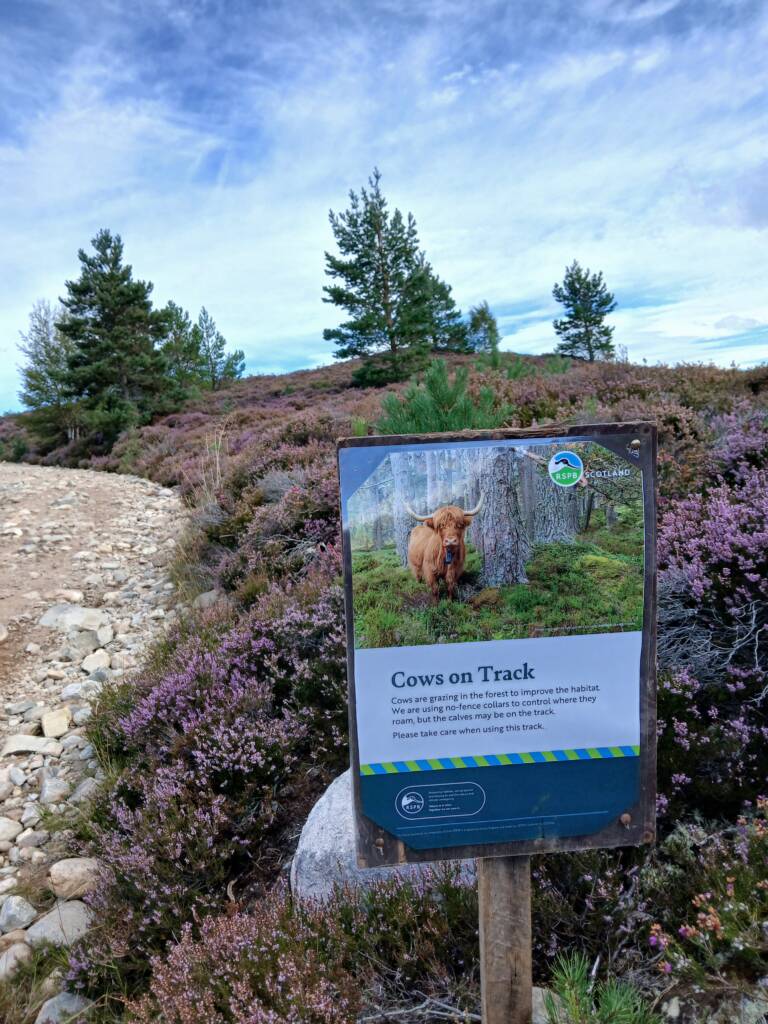
Herbivores are central to future visions for the UK uplands, but we lack a strong evidence-base for the long-term dynamics of grazing-driven ecosystems. This creates a need for better palaeoenvironmental grazing toolkits that can be compared with contemporary narratives and experiments, like the managed disturbance strategy pictured here. © Althea Davies
Methodology
The research student will receive full training in the methods proposed through the supervisory team and visits to their laboratories.
Objective 1. Assess how the sensitivity of each grazing proxy varies with animal density and sedimentary environment using ecological experiments.
Conservation management and grazing experiments in the Cairngorms over the last 30 years provide an opportunity to test the sensitivity of palaeo techniques by studying how proxies from surface samples and short lake/peat cores compare with known changes in grazing regimes over recent decades (Davies et al. 2022).
Objective 2. Investigate the role of grazing as a driver of change during periods of Holocene landscape transition.
This grazing toolkit will be applied to a network of sites to reconstruct when and how animals engineered landscapes. Potential focal time periods include the establishment and expansion of upland farming in the Neolithic and Bronze Ages (transition from wild to domesticated regime), and the transformation of rural land-use in the late eighteenth and nineteenth centuries (displacement of farming communities by extensive sheep farms and sporting estates). Both include climate shifts which may affect vegetation sensitivity to grazing.
Objective 3. Connect grazing palaeoecology and conservation grazing.
Palaeoecologists frequently argue that long-term evidence can inform conservation yet palaeoenvironmental diagrams remain challenging for non-specialists to read and interpret, while palaeo-scientists may also have limited insight into the priorities or challenges facing conservation and heritage managers. To bridge this gap, the student will explore how to make palaeo-archives more accessible and applicable using their choice of approaches to engage with conservation professionals and land managers in the study area. This could involve generating ecological timeseries to explore interactions and hypotheses, for instance, using geochemical proxies and stable isotopes (e.g. C, N, δ13C and δ15N) alongside pollen, fungal spores and faecal biomarkers to test whether centuries of extensive sheep or deer grazing have depleted soil nutrients and altered lake productivity (Marrs et al. 2020). Alternatively, palaeo-data could be used to develop visualisations and narratives that compare past wild and cultural landscapes with current and future visions using archaeological, historic and ethnographic evidence. This provides an opportunity to develop strong networks with natural and/or cultural heritage professionals, including via Dr Daniel Rhodes, project advisor from the National Trust for Scotland.
Project Timeline
Year 1
Literature review and research design. Begin work on Objective 1 including full training in laboratory methods with supervisory team. Network building to establish when Objective 3 meetings and events are most appropriate for student and wider actors.
Year 2
Complete Objective 1 and write up findings as chapter and/or paper for submission, commence Objective 2 and continue Objective 3.
Year 3
Complete Objectives 2 and 3.
Year 3.5
Write up thesis
Training
& Skills
While some previous laboratory, ecological and/or palaeoecological experience is strongly preferred, the student will develop the skills necessary to undertake the data collection and analyses through in-house training (pollen, dung fungi) and by spending time in Durham (biomarkers), with opportunities to attend external training courses (e.g. data analysis and visualisation, science communication). The project will involve periods of time in the field as well as the lab. Further training in transferable skills, including project management, oral and written presentation and media and outreach engagement is available through the Centre for Educational Enhancement and Development (CEED) at the University of St Andrews. The student will be expected to present their work at appropriate national and international conferences throughout their PhD. They will join an active palaeoecology research group, including multiple PhD students, at St Andrews.
References & further reading
Baker et al. (2013) Do dung fungal spores make a good proxy for past distribution of large herbivores? Quaternary Science Reviews 62: 21–31.
Brown et al. (2022) New integrated molecular approaches for investigating lake settlements in north-western Europe. Antiquity 96: 1179-1199.
Davies et al. (2022) A multiproxy approach to long-term herbivore grazing dynamics in peatlands based on pollen, coprophilous fungi and faecal biomarkers. Palaeogeography, Palaeoclimatology, Palaeoecology 598: 111032.
Fyfe et al. (2015) From forest to farmland: pollen-inferred land cover change across Europe using the pseudobiomization approach. Global Change Biology 21: 1197-1212.
Hanley et al. 2008. Economic determinants of biodiversity change over a 400 year period in the Scottish uplands. J. of Applied Ecology 45: 1557–1565.
Jeffers et al. (2018) Plant controls on Late Quaternary whole ecosystem structure and function. Ecology Letters 21: 814-825.
Kuneš et al. (2019) Changing disturbance-diversity relationships in temperate ecosystems over the past 12000 years. J. Ecology 107: 1678–1688.
Malhi et al. (2016) Megafauna and ecosystem function from the Pleistocene to the Anthropocene. Proceedings of the National Academy of Sciences 113: 838-846.
Marrs e al. (2020) Release from sheep-grazing appears to put some heart back into upland vegetation: A comparison of nutritional properties of plant species in long-term grazing experiments. Annals of Applied Biology 177:152-162.
McClymont et al. (2023) Biomarker proxies for reconstructing Quaternary climate and environmental change. J. Quaternary Science 38: 991-1024.
