

IAP-26-031
LCT pegmatites of the Orange River, South Africa: A geochronological and isotopic study of the source of the rare metal mineralisation
Rare metal granites and pegmatites (RPMGs) are small-volume intrusions characterised by profound metal enrichment (Gardiner et al., 2024a) and are the main sources of battery-grade lithium as well as tantalum and tin. Yet, the geological processes that concentrate these rare metals into economically significant deposits remain poorly understood, and their scarcity implies that specific, unresolved, geological conditions are required for mineralisation. South Africa contains abundant RMGPs located in several well-exposed and highly prospective regions but which remain underexplored. These deposits provide an exceptional opportunity to investigate the crustal processes responsible for rare metal enrichment and mineralisation.
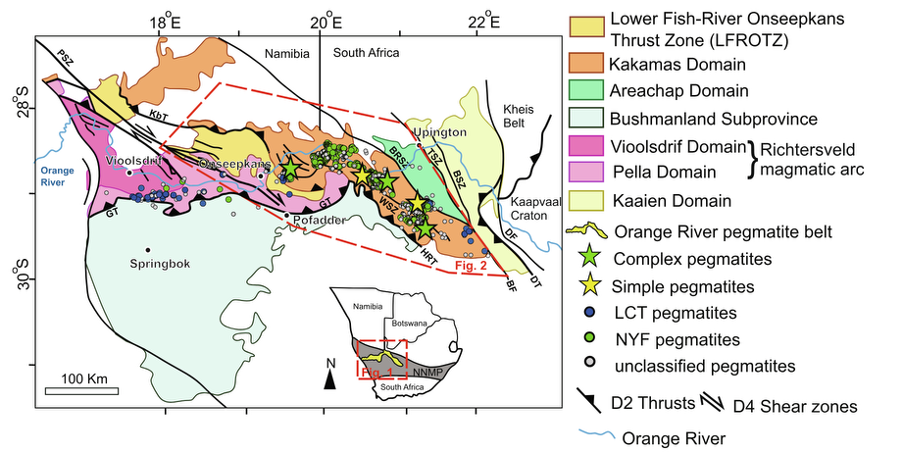
The 450km-long Orange River Pegmatite Belt (ORPB) lies in the Northern Cape, and is hosted by the ca. 1.3–1.0 Ga Namaqua-Natal Metamorphic Province (NNMP) (Ballouard et al., 2020). Approximately 30,000 rare metal-bearing granites and pegmatites have intruded this orogeny (Fig. 1). The eastern and western extremities of the ORPB host numerous lithium-caesium-tantalum (LCT)-type pegmatites (Minnaar and Theart, 2006; Thomas et al, 2026), whereas the central Kakamas Domain is dominated by niobium-yttrium-fluorine (NYF)-type and barren pegmatite bodies (Maphumulo et al., 2025). This provides an ideal location for the juxtaposition of mineralised pegmatite end members with barren examples, to develop pegmatite metallogenic models.
Granites are formed via remelting of older continental crust, however the exact nature of this crust, and its degree of metal pre-enrichment, is poorly constrained. Possible models include incorporation of metal-enriched sedimentary material; multi-cycle crustal recycling of juvenile continental crust (TTG) or granites; or even a deeper mantle origin (e.g. Koopmans et al. 2024, Smithies et al. 2025). The RMGPs of the ORPB are intruded into a thick package of variably metamorphosed bimodal volcanic supracrustal rocks and gneisses alongside numerous S-, I- and A-type granitoids, providing a heterogeneous crustal architecture comprising both fertile and infertile protoliths.
This PhD will use isotopic and geochemical tools to tackle the issue of the crustal source(s) to mineralised pegmatites of the Orange River, specifically to investigate differences in source between LCT- and NYF-type. The candidate will deploy non-traditional mineral-based isotopic tools such as Sr isotopes in apatite or Pb isotopes in feldspar coupled with geochronometers e.g. U-Pb in apatite and cassiterite. They will compare both selected mineralised and barren examples to surrounding continental crust. These data will be integrated with detailed mineralogical, petrographic and textural characterisation, together with thermodynamic melt modelling using representative barren and mineralised samples from across the belt, to constrain RMPG source composition and conditions of melting. In doing this, it will aim to develop a metallogenic model for rare metal enriched pegmatites along the Orange River of South Africa, and translate the model into source- and fertility-based vectors for pegmatite exploration – providing a transferable framework for predictive targeting of LCT (± NYF) systems.
The project builds on recent work by the supervisory team and the establishment of new analytical techniques at the University of St Andrews. The project is in partnership with the University of the Witwatersrand, who will provide assistance for fieldwork and samples.
Click on an image to expand
Image Captions
A geological map of the Orange River Pegmatite Belt. From Maphumulo et al., 2025.
Methodology
The project will involve fieldwork in the Western Cape, analytical work, and thermodynamic modelling.
Project Timeline
Year 1
Fieldwork to RSA, and petrological characterisation of samples. Lit review.
Year 2
Geochemical data analysis for whole rock and selected elements. Mineral separation and geochron/isotope analysis. Draft of manuscript, presentation at a national conference e.g. Mineral Deposits Studies Group.
Year 3
Build holistic mineral systems model, integrating melt modelling and empirical data. Second manuscript for submission and international conference (e.g. SEG, Goldschmidt)
Year 3.5
Finalising manuscript submission, and finishing PhD thesis
Training
& Skills
The PhD will gain experience in geochemical analysis including LA-ICPMS, thermodynamic melt modelling, data management, fieldwork, and in multi-disciplinary research. They will work with leading experts in the field, present at several international conferences, and benefit from training and support offered by UStA’s Academic Skills Project led by the Centre for Educational Enhancement and Development team (alongside training provided by the Iapetus DTP). They will become part of a vibrant research culture in the School of Earth and Environmental Sciences, with MSc, PhD and postdocs working on a range of research projects in the PALS (Pegmatites and Laser) and PaStA (Petrology at St Andrews) research groups. It is anticipated a number of publications will arise from this study, and training in scientific manuscript preparation and presentation will be given.
References & further reading
Ballouard, C., Elburg, M.A., Tappe, S., Reinke, C., Ueckermann, H., Doggart, S., 2020. Magmatic-hydrothermal evolution of rare metal pegmatites from the Mesoproterozoic Orange River pegmatite belt (Namaqualand, South Africa). Ore Geology Reviews 116, 103252. https://doi.org/10.1016/j.oregeorev.2019.103252
Gardiner, N.J. et al. 2024b. On tin and lithium granite systems: A crustal evolution perspective. Earth-Science Reviews 258, 104947. https://doi.org/10.1016/j.earscirev.2024.104947
Koopmans L, Martins T, Linnen R, Gardiner NJ, Breasley C, Palin R, Groat L, Silva D, Robb L. 2024. The formation of lithium-rich pegmatites through multi-stage melting. Geology 52(1) 7-11
Maphumulo, M.S., Ballouard, C., Elburg, M.A., 2025. Age and origin of NYF pegmatites from the Mesoproterozoic Orange River pegmatite belt (Namaqualand, South Africa): insights from monazite and titanite U-Pb geochronology and Nd isotope systematics. Lithos 510–511, 108110. https://doi.org/10.1016/j.lithos.2025.108110
Minnaar, H., Theart, H.F.J., 2006. The exploitability of pegmatite deposits in the lower Orange River area (Vioolsdrif – Henkries – Steinkopf). South African Journal of Geology 109, 341–352. https://doi.org/10.2113/gssajg.109.3.341
Smithies, R.H. et al., 2025. Giant lithium-rich pegmatites in Archean cratons form by remelting refertilised roots of greenstone belts. Communications Earth & Environment 6, 630. https://doi.org/10.1038/s43247-025-02622-5
