

IAP-26-030
Deciphering the fate of carbon across the land-ocean interface
The land-ocean interface is one of the most dynamic and least constrained components of the global carbon cycle (Regnier et al., 2022). Rivers, estuaries and coastal waters play a critical role in regulating the transport and storage of organic carbon, yet substantial uncertainties remain regarding the processes that determine its ultimate fate. Environmental change is altering both the quantity and composition of carbon delivered to aquatic systems (Sun et al., 2025). Shifts in precipitation patterns, increasing frequency of extreme events, land-use change, peatland degradation, river regulation and rising temperatures are influencing how carbon is mobilised, transported and processed as it moves from land to ocean. However, our understanding of how these changes affect carbon transfer efficiency and long-term carbon storage remains limited.
This project will investigate the pathways, transformations and fate of organic carbon across interconnected riverine, estuarine and coastal environments. Using a source-to-sink framework, the research will examine how the composition, reactivity and persistence of organic carbon evolve along the aquatic continuum, identifying the biological, chemical and physical processes that govern carbon processing and transport. Particular emphasis will be placed on understanding the efficiency with which carbon is transferred through aquatic systems and the mechanisms that determine whether carbon is remineralised and returned to the atmosphere or preserved within long-term coastal sedimentary sinks (Arndt et al., 2013).
The research will evaluate the role of rivers and estuaries as both conduits and reactors within the carbon cycle, while determining the environmental conditions that promote carbon preservation and burial in coastal sediments. In doing so, the project will address a major uncertainty in the global carbon cycle: what controls the balance between carbon loss and long-term sequestration across the land-ocean interface. The findings will provide new insights into carbon-climate feedbacks and improve our ability to predict how environmental change may alter carbon cycling and storage across the land-ocean continuum in the future.

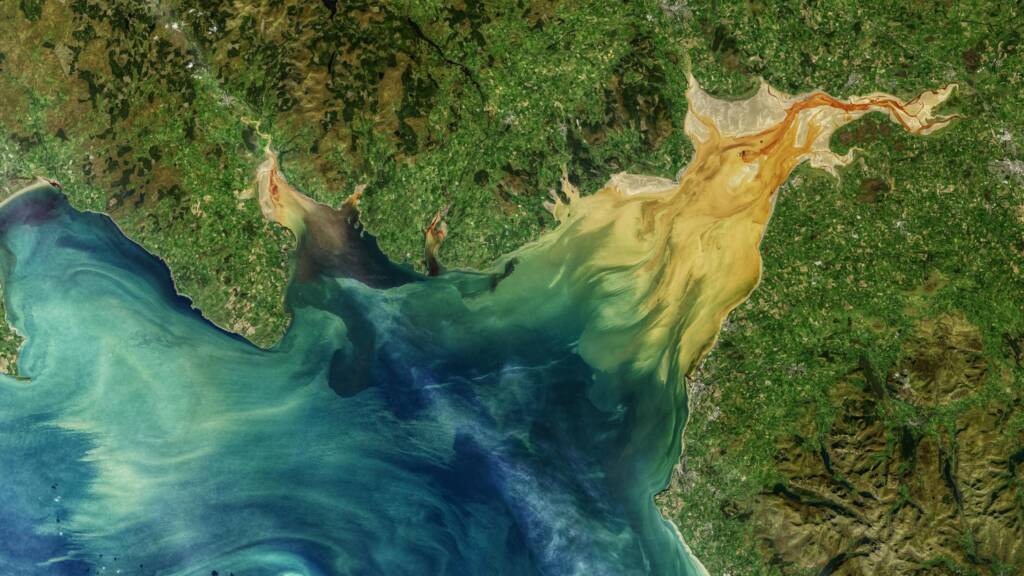
Click on an image to expand
Image Captions
Figure 1. Present day land-ocean-aquatic-continuum carbon fluxes. One long-range carbon loop (grey) connecting land ecosystems to the open ocean, and two short-range carbon loops respectively connecting land ecosystems to inland waters in the upstream portion of the LOAC (green), and tidal wetlands and shelf waters to the open ocean in the downstream portion of the LOAC (blue). Adapted from Regnier et al. 2022.,Figure 2. Terrestrial export across the Solway Firth (ESA)
Methodology
Sampling
The project will adopt a source-to-sink approach to investigate carbon cycling across the land-ocean interface. Seasonal sampling campaigns will be undertaken along a freshwater-estuarine-coastal continuum to capture temporal and spatial variability in carbon transport and processing. Water samples will be collected throughout the study system for the analysis of dissolved organic carbon (DOC), particulate organic carbon (POC) and associated biogeochemical parameters. In addition, sediment cores will be collected from key depositional environments within estuarine and coastal systems to investigate the accumulation and preservation of organic carbon within long-term sedimentary sinks.
Biogeochemical Analysis
Water and sediment samples will be analysed to characterise the sources, age, reactivity and preservation of organic carbon across the aquatic continuum. Source apportionment will be investigated using stable isotope analyses and bulk elemental measurement (C/N ratios), will be used to assess variations in organic matter composition and origin. Radionuclide dating (210Pb, 137Cs) will be used establish sediment accumulation and carbon burial rates, allowing quantification of long-term carbon storage within estuarine and coastal sediments (Smeaton et al., 2021). To investigate organic matter stability and degradation potential, thermal characterisation techniques will be applied to both particulate and sedimentary organic matter, providing information on carbon reactivity and preservation. The student will also have the opportunity to collaborate with the NERC Radiocarbon Facility to undertake bulk radiocarbon (14C) analyses, enabling assessment of the age and turnover of organic matter transported through the aquatic continuum (Garnett et al., 2026). Additional opportunities may exist to apply ramped oxidation radiocarbon techniques to selected POC and sediment samples, providing unique insights into the age structure and compositional heterogeneity of organic matter pools and the mechanisms controlling carbon transfer and preservation across the land-ocean interface.
Modelling and Data Analysis
Laboratory and field observations will be integrated using statistical, spatial and process-based modelling approaches to quantify carbon transfer efficiency across the land-ocean interface. Geospatial analyses will be undertaken using GIS to identify environmental controls on carbon transport and storage and to scale observations across the wider study region. Simple diagenetic models (Hulse et al., 2018) will be applied to sediment core records to assess rates of carbon degradation, burial and preservation, providing insight into the processes controlling long-term carbon sequestration within coastal sediments. Together, these approaches will provide a quantitative framework for understanding the fate of carbon from source waters to its ultimate storage within coastal sedimentary sinks.
Project Timeline
Year 1
Conduct a comprehensive literature review and develop a detailed understanding of the biogeochemical processes governing carbon cycling across the land-ocean interface. Receive training in field and laboratory techniques, establish data management and analysis protocols, and develop the sampling strategy. Undertake the initial phase of field sampling across riverine, estuarine and coastal environments and begin laboratory analyses of collected samples.
Year 2
Continue field and laboratory investigations, including completion of the main sampling campaigns and associated analytical work. Begin data integration, statistical analyses and modelling activities to investigate patterns and controls on carbon transfer and transformation. Present initial findings at a national conference (Challenger Society Conference or MASTS Annual Science Meeting) and begin drafting thesis chapters and peer-reviewed manuscripts.
Year 3
Complete all laboratory analyses and finalise data processing and interpretation. Integrate datasets to develop a source-to-sink understanding of carbon cycling across the aquatic continuum and prepare manuscripts for publication. Continue writing thesis chapters and present findings at an international conference (e.g. EGU, Goldschmidt, AGU or ASLO).
Year 3.5
Write up and submit thesis. Finalise manuscripts for publication and archive data.
Training
& Skills
The student will receive comprehensive project specific training through the supervisory team, which will cover field sampling across riverine, estuarine and coastal environments, laboratory-based biogeochemical and geochemical analyses, environmental data processing, statistical analysis and geospatial analysis. An annual training needs assessment will identify additional technical and transferable skills required to support both the research programme and the student’s longer-term career development.
Additional opportunities will be provided through IAPETUS, which offers advanced specialist courses, cohort-building activities, annual student conferences and interdisciplinary workshops. The student will also benefit from training and placement opportunities at CEFAS, including laboratory-based training, policy-focused activities and potential participation in research cruises aboard the Cefas Endeavour.
Transferable skills, including scientific communication, project management, leadership and stakeholder engagement, will be further developed through IAPETUS and the University of St Andrews’ International Education and Lifelong Learning Institute.
References & further reading
Arndt, S., Jørgensen, B.B., LaRowe, D.E., Middelburg, J.J., Pancost, R.D. and Regnier, P., 2013. Quantifying the degradation of organic matter in marine sediments: A review and synthesis. Earth-science reviews, 123, pp.53-86. https://doi.org/10.1016/j.earscirev.2013.02.008
Garnett, M.H., Harman, N., Murdoch, I., Taylor, C. and Ascough, P., 2026. Processing of samples by ramped oxidation at the NEIF Radiocarbon Laboratory, SUERC: Recent technical advances. Radiocarbon, 68(4), pp.876-886. https://doi.org/10.1017/RDC.2025.10155
Hülse, D., Arndt, S., Daines, S., Regnier, P. and Ridgwell, A., 2018. OMEN-SED 1.0: a novel, numerically efficient organic matter sediment diagenesis module for coupling to Earth system models. Geoscientific Model Development, 11(7), pp.2649-2689. https://doi.org/10.5194/gmd-11-2649-2018
Regnier, P., Resplandy, L., Najjar, R.G. and Ciais, P., 2022. The land-to-ocean loops of the global carbon cycle. Nature, 603(7901), pp.401-410.. https://doi.org/10.1038/s41586-021-04339-9
Smeaton, C., Yang, H. and Austin, W.E., 2021. Carbon burial in the mid-latitude fjords of Scotland. Marine Geology, 441, p.106618. https://doi.org/10.1016/j.margeo.2021.106618
Sun, X., Tian, L., Fang, H., Walling, D.E., Huang, L., Park, E., Li, D., Zheng, C. and Feng, L., 2025. Changes in global fluvial sediment concentrations and fluxes between 1985 and 2020. Nature Sustainability, 8(2), pp.142-151. https://doi.org/10.1038/s41893-024-01476-7
