

IAP-26-029
Tracing Ash to the Ends of the Earth: New Ice-Core Constraints on Long-Range Volcanic Ash Transport
Volcanic ash is one of the most far-reaching and disruptive volcanic hazards. Fine ash particles generated during explosive eruptions can be transported hundreds to thousands of kilometres from their source, affecting aviation, critical infrastructure, water supplies, agriculture, ecosystems, and human health (Wilson et al., 2015). A key example is the 2010 eruption of Eyjafjallajökull (Iceland) which led to widespread airspace closures and economic losses on the order of $1–5 billion USD. Such ash-rich eruptions have recurrence rates of 10–100 years and in the UK and Europe we are at risk not only from Icelandic volcanoes, but also the major volcanic arcs of the North Pacific.
Ash dispersal models are critical for assessing hazards of future eruptions and play a vital role in hazard assessment during volcanic crises (Engwell et al., 2024). Eruption source parameters are key inputs to these models, and include plume height, eruption timing, location and grain size distribution. The size and shape of ash particles is particularly important for these models but as these cannot be directly measured during an eruption, we must rely on examples from past eruptions. Unfortunately, detailed particle size and shape data for volcanic deposits are sparse (Saxby et al., 2020a, 2020b), and heavily skewed to deposits near source. As a result, we have limited understanding of the size and shape parameters for ultra-distal ash particles (>1000 km from source), how these parameters change as a function of distance, and how this affects atmospheric lifetime and long-range impacts.
Polar ice cores provide one of the finest archives of past volcanism (Plunkett et al., 2023). Volcanic ash particles are preserved as microscopic crytoptephra within ice layers and allow precise source attribution through geochemical fingerprinting (Hutchison et al., 2025). Recent advances in ice core cryptotephra detection (Innes et al., 2024; Smith et al., 2026) have revealed that even moderate magnitude eruptions transport large quantities of ash (with hundreds of shards preserved in individual samples). Despite this, no study has systematically investigated ash grain size and morphology in ice core records.
The overarching goal of this project is to provide a systematic physical characterisation of ultra-distal cryptotephra deposits to understand which eruption parameters favour long range tephra transport and use these to predict the length-scales and longevity of fine ash in the atmosphere following large volcanic events.
The project is divided into three main objectives (O):
O1: Quantify the size, shape and morphology of ice core ash particles for a suite of eruptions. We will target events where ice core tephra has already been identified (e.g., 1912 CE Katmai, USA; 1667 CE Tarumae, Japan; 687 CE Newberry Pumice, USA; 431 CE Tierra Blanca Joven eruption, El Salvador and the ~5700 BCE Mount Mazama eruption, USA).
O2: Determine large-scale spatial variations in tephra morphology and grain size across proximal, distal and ultra-distal settings. We envisage a field study in North America to acquire proximal samples and cryptotephra identified in peat bogs and would also work on marine cores that capture the Tierra Blanca Joven eruption.
O3: Use our measurements in O1 and O2 to calibrate and validate volcanic ash dispersal modelling and constrain the lifetime and transport pathways of ash in the atmosphere.
The project will yield a valuable new grain size and shape database that will be used to better understand eruptive source parameters and test ash dispersal model output. We expect the project to be of wide significance to volcanology, eruption hazard and ice core communities. Given the wide range of societal impacts that ash dispersal can have, it is anticipated that these data and findings would have implications for disaster management and policy.

Click on an image to expand
Image Captions
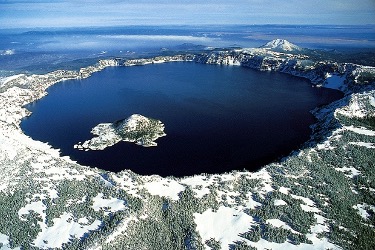
Scanning electron microscopy will be used to identify and image cryptotephra and quantify their morphology,The ~5700 BCE Mount Mazama eruption (USA) will a target for detailed proximal to distal to ultra-distal tephra characterisation.
Methodology
• Optical and scanning electron microscopy of ice core ash shards to quantify their size and shape parameters. Most samples are already available, if additional materials are required we shall request and sample ice from Greenland cores (stored in Copenhagen)
• Fieldwork and physical volcanology to collect and carefully characterize tephra samples (the project will include at least one dedicated field campaign North America to sample proximal deposits in situ and distal deposits in peat cores)
• Particle size and morphometric analysis using a laser particle-size analyzer and automated flow imaging microscopy (FlowCam)
• Ash dispersion modelling (using Ash3d) to simulate particle transport and estimate ash longevity and transport pathways.
Project Timeline
Year 1
Conduct a literature review. Begin optical microscope and scanning electron microprobe analysis of ice core ash horizons for suite of eruptions. Training in laboratory methods for extracting, imaging and chemically analysing cryptotephra. Conduct field work in North America.
Year 2
Conduct particle size and morphometric analysis on samples collected during field work. Begin training in ash dispersal modelling at BGS. Complete all analysis of ice core tephra and draft initial paper(s).
Year 3
Ash dispersion modelling to simulate spatial distribution of fine ash from a range of eruption scenarios, carefully calibrating and validating the outputs against the grain size information gained in years 1 and 2. Finalize written manuscripts and write thesis.
Year 3.5
Finalize written manuscripts and complete thesis.
Training
& Skills
The student will gain significant new expertise in physical volcanology, ice core science, electron microscopy and computer modelling, working with experts in these field, e.g. (Brown et al., 2023; Engwell et al., 2024; Hutchison et al., 2025)). They will be trained in all key technical areas (SEM, EPMA, automated grain size methods, and modelling). They will also gain transferable skills such as scientific writing, statistics and data analysis, and problem-solving, as well as time management and working towards a long-term goal.
This project would suit a student with an excellent BSc/Msci geoscience background and interests in volcanic processes and hazards. Previous laboratory, field work and computational modelling experience is advantageous but not essential.
The student will join the burgeoning St Andrews Volcanic Eruptions and Impacts (StA-VEI) Group and will benefit from interactions with this vibrant and supportive team. They will also form strong collaborations with the Durham and BGS volcanology group and will make extended visits to train in ash fall modelling, discuss their results and tap into the diverse range of volcanological expertise offered by these teams. They will be encouraged to attend major international conferences (e.g., EGU meeting, Vienna) and will be fully supported in forming international research networks with volcanology and ice cores science communities.
References & further reading
Brown, R.J., Van Eaton, A.R., Hernández, W., Condren, P., Sweeney, C., Tournigand, P.-Y., Vallance, J.W., 2023. Ash aggregate-rich pyroclastic density currents of the 431 CE Tierra Blanca Joven eruption, Ilopango caldera, El Salvador. Journal of Volcanology and Geothermal Research 439, 107845. https://doi.org/10.1016/j.jvolgeores.2023.107845
Engwell, S., Mastin, L.G., Bonadonna, C., Barsotti, S., Deligne, N.I., Oladottir, B.A., 2024. Characterising, quantifying, and accessing eruption source parameters of explosive volcanic eruptions for operational simulation of tephra dispersion: a current view and future perspectives. Bull Volcanol 86, 67. https://doi.org/10.1007/s00445-024-01706-y
Hutchison, W., Sugden, P., Burke, A., Abbott, P., Ponomareva, V.V., Dirksen, O., Portnyagin, M.V., MacInnes, B., Bourgeois, J., Fitzhugh, B., Verkerk, M., Aubry, T.J., Engwell, S.L., Svensson, A., Chellman, N.J., McConnell, J.R., Davies, S., Sigl, M., Plunkett, G., 2025. The 1831 CE mystery eruption identified as Zavaritskii caldera, Simushir Island (Kurils). Proceedings of the National Academy of Sciences 122, e2416699122. https://doi.org/10.1073/pnas.2416699122
Innes, H.M., Hutchison, W., Burke, A., 2024. Geochemical analysis of extremely fine-grained cryptotephra: new developments and recommended practices. Quaternary Geochronology 83, 101553. https://doi.org/10.1016/j.quageo.2024.101553
Plunkett, G., Sigl, M., McConnell, J.R., Pilcher, J.R., Chellman, N.J., 2023. The significance of volcanic ash in Greenland ice cores during the Common Era. Quaternary Science Reviews 301, 107936. https://doi.org/10.1016/j.quascirev.2022.107936
Saxby, J., Rust, A., Beckett, F., Cashman, K., Rodger, H., 2020a. Estimating the 3D shape of volcanic ash to better understand sedimentation processes and improve atmospheric dispersion modelling. Earth and Planetary Science Letters 534, 116075. https://doi.org/10.1016/j.epsl.2020.116075
Saxby, J., Rust, A., Cashman, K., Beckett, F., 2020b. The importance of grain size and shape in controlling the dispersion of the Vedde cryptotephra. J Quaternary Science 35, 175–185. https://doi.org/10.1002/jqs.3152
Smith, C., Hutchison, W., Buisman, I., Law, S., Lawson, I., Streeter, R., Burke, A., 2026. Electron probe microanalysis of extremely fine‐grained tephras: new protocols and insights for analyses at the 1 μm scale. J Quaternary Science jqs.70117. https://doi.org/10.1002/jqs.70117
Wilson, T.M., Jenkins, S., Stewart, C., 2015. Chapter 3 – Impacts from Volcanic Ash Fall, in: Shroder, J.F., Papale, P. (Eds.), Volcanic Hazards, Risks and Disasters, Hazards and Disasters Series. Elsevier, Boston, pp. 47–86. https://doi.org/10.1016/B978-0-12-396453-3.00003-4
