

IAP-26-134
How many drills and mandrills remain on Earth? Using camera traps to count Africa’s most colourful primates
Mandrills (Mandrillus sphinx) and drills (M. leucophaeus) are among Africa’s most spectacular mammals, yet basic questions remain unanswered: how many are there, where are their strongholds, and where should we aim to protect them going forward? This PhD aims to tackle these questions by turning extensive camera-trap datasets into tools for estimating populations and monitoring change. Combining primatology, quantitative ecology, AI and other emerging monitoring technologies, the project will develop approaches with potential applications across elusive forest wildlife.
Approximately two-thirds of primate species are threatened with extinction, making reliable estimates of population size and change essential for conservation. Yet estimating population abundance across large areas of tropical forest is notoriously difficult, particularly for elusive, wide-ranging primates. Dense vegetation, low visibility, large and mobile groups, and behavioural responses to people limit conventional surveys. Meanwhile, the growing use of camera traps and other passive sensors across African forests is generating substantial data on African fauna that are not exploited for most primates.
This PhD will develop and evaluate scalable methods for estimating abundance and monitoring population change in elusive forest primates, focusing on Mandrillus species. Both drills and mandrills are conservation priorities, yet their abundance, distribution and population trends remain poorly quantified across their ranges. Despite their striking appearance, large body size and regular detection by camera traps, we still know remarkably little about their populations in the wild. Both species face serious threats from hunting and habitat loss, with population declines suspected to be substantial and ongoing. Mandrills have suffered a suspected decline of over 30% in just 24 years and drills a decline of over 50% in 30 years, highlighting the urgent need for effective monitoring.
Extensive camera-trap detections of mandrills provide a strong foundation for the PhD. Surveys in mainland Equatorial Guinea (EG) in 2017–2021 detected mandrills at 131 independent camera-trap locations across all five landscapes studied. More recent surveys in Parque Nacional Djibloho, EG, detected mandrills at 12 of 22 cameras in 2025–2026. Mandrills had the highest camera-trap detection rates of any primate in these surveys, suggesting that they are abundant in EG, at the centre of their range (see map).
The project will assess whether existing data are sufficient to generate reliable estimates of abundance, including the feasibility of identifying individuals from images. Simulation will establish how camera placement, sampling effort, group size, movement, and detectability, affect precision, and inform surveys designed to estimate abundance and detect population change, and remote sensing data will be used to investigate spatial variation in density.
A central aim is to estimate Mandrillus abundance and develop methods to monitor population change, providing conservation programmes with approaches that are both feasible and informative.
Passive acoustic monitoring may complement camera trapping by providing information on spatial distribution, particularly beyond camera-trap coverage. Mandrills and drills produce distinctive long-distance vocalisations, allowing acoustic recorders to detect animals beyond the limited detection range of individual cameras. The student will evaluate existing recordings before considering targeted new acoustic data collection.
Recent advances in AI-based wildlife monitoring may be used to speed up and improve scalability of camera-trap and audio-recording analysis. The project has three linked objectives:
1. Assess whether existing camera-trap datasets can support robust estimates of Mandrillus abundance, including the feasibility of identifying individuals and estimating detectability.
2. Test how survey design, sampling effort, group size and movement affect the precision and reliability of abundance estimates for these species.
3. Develop practical recommendations for estimating abundance and monitoring population change to inform conservation decisions for both species.


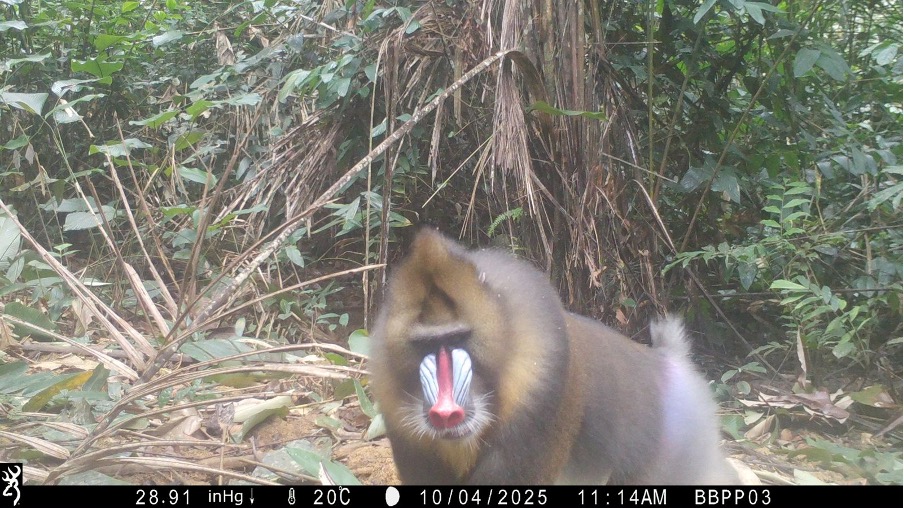
Click on an image to expand
Image Captions
Mandrill at CIRMF, Gabon,Geographic ranges of drills and mandrills in Central Africa, based on IUCN Red List distribution maps (mandrill: 2019; drill: 2020). Source: IUCN Red List of Threatened Species (www.iucnredlist.org).,Male mandrill photographed with a camera trap at Djibloho National Park, Equatorial Guinea, 2025. Photo Credit: INDEFOR-AP, Biopolis, Rainforest Trust
Methodology
The student will evaluate camera-trap detections, images and sampling metadata from Equatorial Guinea and additional datasets from across the ranges of both species. They will assess which forms of population inference each dataset supports, distinguishing absolute abundance estimation from relative monitoring. The student will evaluate approaches that do not require individual identification (‘unmarked’ estimators) alongside individual-based methods (e.g., spatial capture–recapture, SCR) where image quality and encounter rates permit, comparing their assumptions, data requirements and potential sources of bias.
The student will use computer simulations to examine the effect of camera spacing and placement, sampling effort, spatial scale, group movement, group size and heterogeneous detection on density estimation for mandrills and drills. These simulations, parameterised using existing data and ecological knowledge, will establish the limitations of existing datasets and identify survey designs capable of producing estimates with useful precision. Camera-derived information will be integrated with remotely sensed environmental data.
Complementary acoustic analyses will assess whether existing recordings can provide information on Mandrillus distribution or support methodological development. The student may also investigate individual acoustic identification in other primates where appropriate.
Findings from the first two years will determine whether targeted field validation is useful and feasible. This could combine camera trapping, acoustic monitoring and direct observations of known groups. Where independent information on group presence, movement, and size is available, the student will use it to assess model assumptions and evaluate the reliability of estimates. The precise validation strategy will depend on data availability and results from the simulations and the analysis of existing data.
You will join a team spanning primate behaviour, population modelling, AI-based wildlife monitoring and rainforest conservation, with access to established research and conservation networks in Central Africa. Jo Setchell contributes expertise in Mandrillus behaviour, ecology and conservation; Chris Sutherland in quantitative ecology and population estimation; Tiffany Vlaar in AI for biodiversity monitoring; and Luke L. Powell in quantitative modelling and Equatorial Guinea in particular.
Project Timeline
Year 1
You will receive intensive methodological training, evaluate available Equatorial Guinea camera-trap data, investigate additional datasets and assess the feasibility of abundance estimation. Initial simulations will examine sampling requirements and precision. You will also explore existing acoustic recordings and satellite-derived habitat data. The supervisory team will provide a defined starting programme while supporting your development of subsequent research questions.
Year 2
You will develop and test abundance estimation methods, using simulations to evaluate survey design, sampling effort and precision. You will investigate spatial variation using environmental data and pursue acoustic analyses where feasible. Increasingly student-led decisions will identify priorities for further methodological development and validation.
Year 3
You will refine and validate methods, potentially through targeted fieldwork or comparisons across species and sites, depending on earlier findings and available resources. You will prepare manuscripts and develop practical recommendations for estimating abundance and monitoring population change.
Year 3.5
You will complete analyses and manuscripts, integrate findings into the thesis, disseminate recommendations to research and conservation partners, and submit within the funded period.
Training
& Skills
You will build expertise at the intersection of primatology, ecological data science and conservation, developing transferable skills in population modelling, simulation, camera-trap analysis and remote sensing. Additional training may include acoustic analysis, machine learning and field validation, depending on how the project develops. Through international collaboration, scientific writing, conference presentations and engagement with conservation practitioners, you will gain experience relevant to careers in academic research, wildlife monitoring and conservation organisations, alongside opportunities to develop independent research questions.
References & further reading
Astaras et al. (2008). Am. J. Primatol. 70:306–310.
Curveira-Santos et al. (2026). J. Appl. Ecol. 63:e70261.
Dempsey et al. (2024). Cercocebus and Mandrillus conservation action plan 2024–2028. IUCN.
Guzmán-Santillán et al. (2026). Am. J. Primatol. 88:e70125.
Kalan et al. (2015). Ecol. Indic. 54:217–226.
Nakashima et al. (2022). Int. J. Primatol. 43:321–342.
Nawaz et al. (2021). Sci. Rep. 11:13104.
Villamarin et al. (2026). Am. J. Primatol. 88:e70154.
Vu et al. (2023). Am. J. Primatol. 85:e23544.
