

IAP-26-135
Human-wildlife coexistence in a changing world: Applying social learning theory to understand human–chimpanzee interactions in Western Uganda
Progressive human expansion is creating major challenges for wildlife conservation and sustainable coexistence. Such challenges are especially acute for chimpanzees – a flagship species in rapid decline. Increasing human encroachment is resulting in fragmented landscapes for chimpanzees, while snare-setting causes permanent injuries and death (1). This is particularly problematic in western Uganda, where an intensification of sugar cane farming has resulted in chimpanzees now regularly entering agricultural fields and villages, causing crop damage and even aggressive encounters with humans. Such interactions can generate negative attitudes towards chimpanzees, undermining conservation efforts and increased risk of retaliation (2). Despite local effort to improve human-chimpanzee relations, including educational, skills workshops, alternative livelihoods training and veterinary care (3), attitudes and behaviours towards chimpanzees remain fractious, especially in communities experiencing little socio-economic advantages associated with conservation.
Although community work demonstrates that people’s attitudes towards chimpanzees are malleable and influenced by their knowledge, experiences and land-use (4), we know very little about how information is socially transmitted through communities, nor why some information about chimpanzees becomes embedded while other information does not. Understanding the processes driving the acquisition and diffusion of knowledge about chimpanzees in this transitional landscape could help inform policy and support meaningful behavioural change to promote more sustainable and evidence-based co-existence.
Social learning theory provides a powerful framework for addressing this gap. Research shows that humans and other animals are not indiscriminate social learners but are selective about what, when and from whom they learn from, preferring particular social models, such as those with perceived prestige or influence (5-6). This project will combine social learning theory with behavioural science to investigate how information about wild chimpanzees is acquired and transmitted in communities. To help identify more effective interventions, we will use the COM-B framework to support behavioural diagnosis and a pathway for appropriate interventions from the Behaviour Change Wheel (7-8).
Focussing on villages surrounding the Budongo Forest, Western Uganda, we will investigate whether different types of information have different transmission dynamics: for example, whether personal experiences of chimpanzee crop-feeding spreads more rapidly than positive information concerning conservation and ecotourism. To target interventions, we will investigate whether people preferentially acquire information from particular sources, such as elders, family or organisations. Around Budongo Forest, villages vary in their proximity to chimpanzee habitat and to the Budongo Conservation Field Station (BCFS), an organisation that has been conducting conservation outreach and education programmes since 1990. Although communities close to BCFS are more exposed to conservation and socio-economic benefits including employment and ecotourism, the impact of these factors on attitudes and conservation awareness has never been assessed. The recent establishment of a community-based research site, the Budongo Families Project, offers unique infrastructure to conduct psychological research with adults and children locally.
The project aims to determine the social and ecological conditions facilitating information transmission, attitude and behaviour change towards an endangered species. Through embedding research within community strategy and co-production, it aims to provide an evidence base to support more effective, locally-appropriate interventions, thus moving from identifying information transmission to understanding its processes and testing how transmission can be harnessed for conservation.


Click on an image to expand
Image Captions
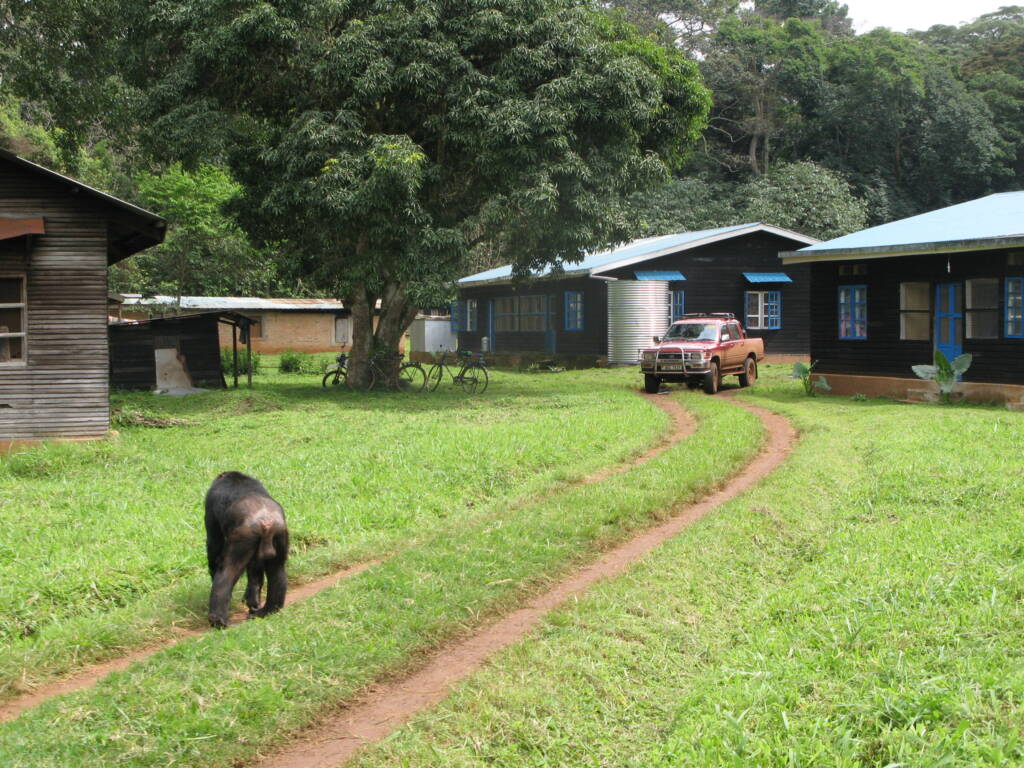
Map of Budongo, W Uganda,Budongo chimpanzees,Budongo Families Project research team,Budongo Forest,habiuated chimpanzee visiting Budongo Conservation Field Station
Methodology
This project combines community-based social, conservation and behavioural science with experimental and environmental psychology
Objective 1: Mapping the social learning landscape of human-chimpanzee interactions
Interviews, surveys and focus groups will establish knowledge and experience of chimpanzees, the information sources, chimpanzee encounter rates and demography. Questions will be mapped onto the COM-B framework to support objective 3.
Social network analysis will be used to test whether information transmission varies according to information type, source characteristics and environmental context, including proximity to forest, chimpanzee encounters and links to BCFS along with demography and socio-cultural orientation.
Objective 2: Testing social-learning biases with cultural transmission experiments
This represents an experimental complement (see 9) to Obj1, enabling causal investigation of social learning processes and biases. Working with the Budongo Families Project, the student will conduct field-based experiments with children and adults where participants receive novel or uncertain information about chimpanzees from different socially characterised sources (e.g. adult, child, conservation worker) and subsequently assessed for information recall, acceptance, and behavioural recommendations. Transmission chain experiments of varying compositions (e.g., children, adults, mixed) will test how information is transmitted. We will test whether participants prefer or value information from certain models and whether biases interact with information valence and differ across villages.
Objective 3: Information, attitudes and conservation behaviour.
Combining data from Objectives 1s and 2, Objective 3 will establish pilot interventions and investigate how information exposure predicts attitudes, perceived risks and benefits (aligning with COM-B, Capability, Opportunity and Motivation to adopt peaceful coexistence). The most appropriate intervention functions in the Behaviour Change Wheel will be determined through co-production, focussing on novel, locally relevant strategies that reflect our research approach including targeting the most relevant community members to support attitude change. Pre- and post-intervention measures will evaluate intervention effectiveness.
Data will be analysed using social network analysis, mixed-effects models and diffusion models. Qualitative data will be analysed with thematic analysis to capture culturally-specific beliefs and narratives.
Project Timeline
Year 1
• Establish project theory/methodology; literature review, apply for ethics/permits
• Training in social learning theory, behavioural and conservation science, qualitative and quantitative methods, research ethics.
• Months 3-6. Pilot visit to establish stakeholder/community engagement; establish baseline information, map villages, develop network and transmission measures.
Year 2
• Months 13-22. Main field-work to conduct surveys/interviews, network mapping, identify information sources, attitudes
• Conduct experimental social learning studies
• Interim analyses to identify transmission patterns.
Year 3
• Data analysis to model predictors of information transmission and network properties. Disseminate findings to local stakeholders to identify intervention points
• Co-design and co-produce pilot interventions.
• Months 28-31. Field visit to conduct and evaluate intervention.
Year 3.5
• Thesis preparation and publication. Dissemination through publications, presentations and stakeholder workshops. Provide recommendations for evidence-based communication and coexistence strategies that can be adapted for other human–great ape landscapes.
Training
& Skills
The student will receive exceptional interdisciplinary training spanning conservation science, behavioural ecology, social learning theory, behavioural science, developmental psychology and community-based research. Technical training will include social network analysis, statistical modelling, qualitative analysis, experimental design and open-research practices. Field training will include community engagement, interviewing, participatory research, ethical research with children and wildlife, research in tropical field environments. The student will gain experience communicating research to conservation organisations and local communities.
The project provides an unusually strong training environment through collaboration between Durham University, University of Stirling, BCFS and the Budongo Families Project. It will develop transferable skills relevant to academic research, conservation organisations, environmental policy and community-based environmental management. The project’s interdisciplinary nature is consistent with IAPETUS’s emphasis on developing researchers able to work across environmental science and related disciplines.
References & further reading
1 Fedurek, P., et al. (2022). Biotropica, 1–8
2 McLennan, M. R. et al. (2012). Oryx, 46(4), 598-603.
3 Babweteera, F. et al. (2018). In C. Sandbrook, C. J. Cavanagh & D. M. Tumusiime (Eds.), Conservation and development in Uganda . Routledge
4 Asiimwe, C. et al. (2016). PeerJ PrePrints,
5 Kendal, R.L. et al., (2018). Trends Cogn Sci, 22, 651–665.
6 Kendal RL & Watson R. (2023). In The Handbook of Cultural Evolution. Ox. Univ. Press.
7 Michie, S., Atkins, L., & West, R. (2014). The Behaviour Change Wheel: A Guide to Designing Interventions. Silverback Publishing. www.behaviourchangewheel.com
8 Michie, S. et al. (2011). Implementation Science, 6(1), 42
9 Mesoudi A., Whiten A. 2008. Phil. Trans Roy. Soc. B. 363: 3489-3501.
