

IAP-26-133
Adaptation to an anthropogenic habitat: Integrated modelling of ecological, physiological and reproductive impacts on chacma baboons
Global population growth is driving the rapid conversion of natural ecosystems into human-modified landscapes, creating heterogeneous environments characterised by mosaics of natural and anthropogenic land-cover types. This transformation of landscapes, and the accompanying loss of natural habitat, means that many animal species now live in increasingly close proximity to people. While some species are able to exploit and even flourish in human-modified habitats, for many animals living alongside humans can result in negative interactions arising from competition for food, space and other resources, alongside concerns about the safety and livelihoods of people sharing landscapes with wildlife. As human-wildlife ‘conflicts’ become increasingly widespread worldwide, there is a growing need to understand how animals adjust to human-modified environments and the consequences of these adaptations for their reproduction and survival.
Primates are particularly adaptable, and many species increasingly occupy human-modified landscapes where they may become habituated to close contact with people. Within these environments, primates can encounter a range of ecological challenges, including restricted home ranges, declining availability of natural foods and greater exposure to parasitic infections. At the same time, proximity to people may be associated with the reduction or local loss of natural predators, while anthropogenic environments can provide access to additional resources, including crops and gardens, as well as human dwellings and refuse sites. Access to these resources can nevertheless generate competition and negative interactions between primates and people, commonly described as human-wildlife conflict, with potential consequences for primate activity patterns, diet, physiology, reproduction and health, including serious injury or mortality (Rahman et al 2025). Despite this, relatively few studies have examined how primates balance the contrasting costs and opportunities associated with living in human-dominated landscapes, particularly in situations where competition between humans and primates over the animals’ primary food resources is limited.
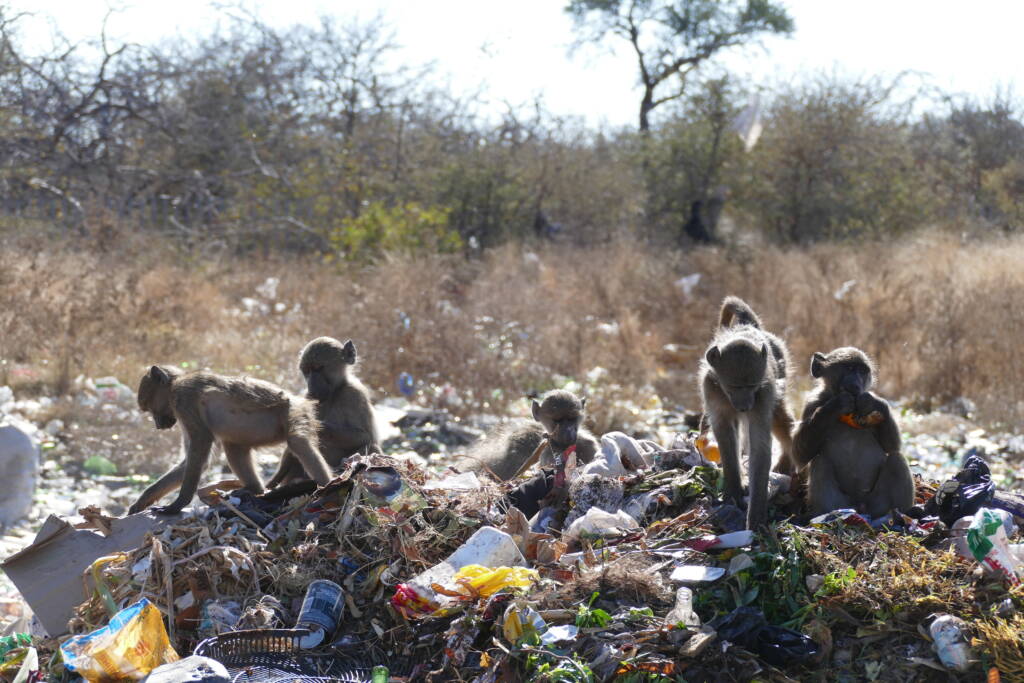
A number of chacma baboon (Papio ursinus) groups feed at the local landfill site on the edge of the rural town of Alldays, Limpopo Province, South Africa (Figure 1). Our initial work has shown that the food available at the dump can have significant impacts on the diets, time budgets and ranging patterns of the baboons, as well as impacting their physiology. While at the landfill site the baboons are tolerated and have a commensal relationship with dump workers, interactions with local residents in other areas are often aggressive towards the baboons – particularly around their houses – chasing, clapping and shouting at the baboons. Instances of shooting could be relatively frequent (Rahman et al 2025), and the age-sex structures of the baboon social groups is atypical despite high reproductive rates among females, suggesting significant impacts of human actions on demography. The baboons must thus navigate a complex landscape where access to resources, and the risk associated with negative interactions with humans, vary spatially and temporally. The system provides an ideal opportunity to understand the behavioural, physiological and reproductive responses of primates to living in human-modified landscapes and to understand how baboons trade-off the costs and benefits of living alongside humans to survive in anthropogenic environments.
Objectives: Building on our established understanding of this study system, this project will explore how feeding at the landfill site and other anthropogenic food resources influences the behaviour and physiology of chacma baboons. In particular, it will explore how access to dump foods impacts reproductive condition and fertility and how is this also mediated by natural food availability. Through integrating how negative interactions with humans and persecution events further influence the behaviour, physiology, reproductive condition and fertility of individuals, as well as close network partners, the study will explore the demographic consequences of access to human foods.


Click on an image to expand
Image Captions
Data collection on Alldays dump,Alldays dump baboons feeding,Female baboon with infant on Alldays dump,Young baboons on Alldays dump
Methodology
The project will involve fieldwork at an established field site in Alldays, Limpopo Province, South Africa, to collect: behavioural data on two habituated groups of chacma baboons; ecological data on the broader habitat usage and microhabitat usage of the baboons using the Alldays rubbish dump, plus natural and cultivated habitats; and faecal samples for non-invasive hormone analysis which the student will carry out in the Behavioural Ecology & Physiology (BEP) Laboratory, Anthropology Dept., Durham University. The student may have the opportunity to deploy telemetry collars to explore high resolution movement patterns.
Behavioural and ecological data
Systematic behavioural sampling will be used to record behaviour, diet, anthropogenic resource and space use. Ad hoc sampling will measure the nature and frequency of interactions with humans, and the frequencies of affiliative and agonistic interactions for determining dominance hierarchies and undertaking social networks analysis. Detailed behavioural data will also be collected on reproductive and mating behaviour alongside mother infant interactions. Phenological data collection will be used to estimate natural food availability and combined with modified methods used to determine the anthropogenic foods available in the environment.
Physiological data Energetic and reproductive physiological responses to ecological factors, including food intake and human persecution will be assessed through variation in stress, metabolic and reproductive hormone levels. Validated EIAs (enzyme immunoassay) will be used to analyse physiological stress levels and resilience (glucocorticoids), and metabolic rate and energy balance (thyroid hormone) and reproductive condition (progesterone) from faecal samples.
Analysis Mixed models will be used to analyse and compare the combined behavioural, ecological and physiological factors affecting activity budgets, energy balance, physiological stress responses and reproductive condition of the two baboon groups. s on close network partners.
Project Timeline
Year 1
Months 1-3 Initial PhD training, literature review, outline project design and ethical approval
Months 4-6 Pilot fieldwork in South Africa
Months 7-11 Finalisation of project plan and approval, laboratory training
Month 12 Start fieldwork
Year 2
Months 1-12 Observational and ecological data collection, plus faecal sample collection in South Africa; Presentation at SAWMA conference
Year 3
Month 1 Finalise fieldwork data collection in South Africa and transport of samples
Months 2-7 Laboratory sample preparation and hormone assays in BEP Lab (Anthropology Dept.) University plus initial field data analysis
Months 8-12 Detailed data analysis. Presentation at national conference. Start writing up thesis in format suitable for conversion to submission of manuscripts to peer-reviewed journals
Year 3.5
Months 1-6 Finalise writing of thesis and submission of first manuscripts to peer-reviewed journals.
Training
& Skills
The project offers the student the opportunity to develop their interests and skills in behavioural ecology and ecological physiology. Training and experience will be gained in international fieldwork, behavioural observation, ecological data collection, non-invasive hormone analysis, statistical and social network analysis (additional statistical training is available through Durham-based and IAPETUS training courses). The student may also wish to develop their skills and experience in telemetry. Skills in project management, information management, time management, written and oral communication as well as in presentations will be developed over the course of the project.
The supervisors have complementary expertise to provide the necessary training and support for the student’s project. The close proximity of Durham and Newcastle facilitate interaction and collaborative supervision. Through research groups and centres at Durham, Newcastle and in South Africa the student will gain integration into broad-based research networks. At Durham they will join the cross-University Behaviour, Ecology & Environment Research Centre as well as the Primatology Group, based in the Anthropology Department; at Newcastle, they will join the Centre for Behaviour & Evolution; in South Africa they will have the support of RH’s Primate & Predator Project.
References & further reading
Bach, A., Minderman, J., Bunnefeld, N., Mill, A.C., Duthie, A. B. (2022) Intervene or wait? A model evaluating the timing of intervention in conservation conflicts adaptive management under uncertainty. Ecol. Soc. 27:3.
Cristóbal-Azkarate, J., Maréchal, L., Semple, S., Majolo, B., MacLarnon, A.M. (2016) Metabolic strategies in free ranging male Barbary macaques: evidence from T3 in faeces. Biol. Lett. 12: 20160168.
Findlay, L.J., Hill, R.A. (2020). Baboon and vervet monkey crop-foraging behaviors on a commercial South African farm: Preliminary implications for damage mitigation. Human–Wildlife Interactions 14(3): 505-518.
Higham, J.P., MacLarnon, A.M., Ross, C., Heistermann, M., Semple, S. (2009) Rates of self-directed behaviour and faecal glucocorticoid levels are not correlated in female wild olive baboons (Papio hamadryas anubis). Stress 12: 526–532.
Lodge, E., Ross, C., Ortmann, S., MacLarnon, A.M. (2013) Influence of diet and stress on reproductive hormones in Nigerian olive baboons. Gen. Comp. Endocrinology 191: 146-154.
MacLarnon, A.M., Sommer, V., Goffe, A.S., Higham, J.P., Lodge, E., Tkaczynski, P., Ross, C. (2015) Assessing adaptability and reactive scope: a new measure and a case study of environmental stress in forest-living baboons. Gen. Comp. Endocrinol. 215:10-24.
Rahman, Md. M., Hill, R.A., MacLarnon, A.M. (2025) Behavioural and physiological responses of chacma baboons (Papio ursinus) to human-induced mortality in anthropogenically modified habitat. People and Nature 7:1865-1878.
Walton, B.J., Findlay, L.J., Hill, R.A. (2021). Insights into short‐ and long‐term crop‐foraging strategies in a chacma baboon (Papio ursinus) from GPS and accelerometer data. Ecol. Evol. 11: 990-1001.
Wasser, S.K., Cristòbal-Azkarate, J., Booth, R.K., Hayward, L., Hunt, K., Ayres, K., Vynne, C., Gobush, K., Canales-Espinosa, D., Rodríguez-Luna, E. (2010) Non-invasive measurement of thyroid hormone in feces of a diverse array of avian and mammalian species. Gen. Comp. Endocrinol. 168: 1–7.
