

IAP-26-005
Reconstructing glacier histories and investigating glacial geomorphology in the Sør Rondane Mountains, East Antarctica.
Background and Rationale:
The East Antarctic Ice Sheet (EAIS) contains enough ice that, were it to melt entirely, global sea level would rise by over 51 m (Rignot et al., 2019). The large volume of the EAIS means that even relatively small changes in ice sheet extent and/or thickness have potentially large impacts on global sea level (Suganuma et al., 2022; Andersen et al, 2023), and Antarctic ice loss contributes a large source of uncertainty in future sea-level projections (IPCC, 2021). Numerical models that are used to simulate the response of ice sheets and their potential contribution to sea level in a warming climate are calibrated using evidence for past ice sheet behaviour. However, satellite derived observations of ice sheet change only exist from the 1960s onwards. This project aims to extend our understanding of EAIS behaviour beyond the modern observational period and into the last ~20 thousand years through the application of cosmogenic nuclide exposure dating in the Sør Rondane Mountains (SRM), Dronning Maud Land (DML), East Antarctica. By furthering our understanding of the past behaviour of the EAIS, this project will help us understand with a greater degree of certainty how the ice sheet will change in the future. In other words, the project will help us better understand when and how quickly the Antarctic ice sheets will contribute to sea level rise, a key recommendation of the UK Environmental Audit Committee (2025) report on the UK and the Antarctic environment.
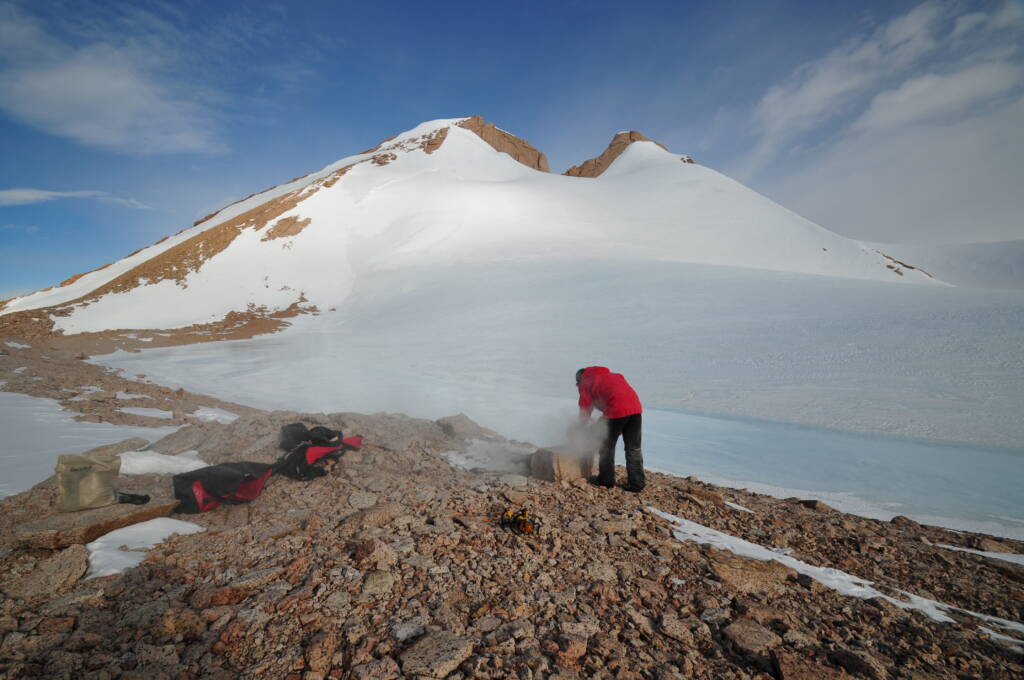
Whilst it is well understood that the EAIS was more extensive in the past, geologic constraints on its behaviour over the last ~20 thousand years (since the Last Glacial Maximum, LGM) are relatively sparse. Existing studies in DML, including in the SRM (Matsuoka et al., 2006; Suganuma et al., 2014), primarily constrain the pre-LGM behaviour of the ice sheet. To improve our understanding of more recent EAIS behaviour, this project will utilise the novel, relatively short-lived cosmogenic nuclide in situ 14C; measurements of 14C in rock samples are uninfluenced by ice sheet behaviour prior to ~30 ka (see Nichols, 2022). Rock samples have been collected from the surfaces of nunataks and moraines at multiple locations in the SRM, many of which will be provided by a project collaborator at the National Institute of Polar Research (Japan). Measurements of cosmogenic nuclides in these samples will improve our understanding of i) the LGM ice sheet thickness, ii) the timing of ice thinning and retreat since the LGM, and iii) the build-up of moraine sequences in the SRM. The samples collected from moraines may also yield evidence for glacier advances in the Late Holocene, potentially adding to the growing body of evidence that the Antarctic ice sheets were smaller than present in the Holocene before increasing in volume/readvancing (e.g. White et al. 2020, King et al., 2022, Suganuma et al., 2022). The project will require detailed geomorphic mapping from satellite imagery, digital elevation models, and field observations to contextualise and interpret the cosmogenic nuclide measurements. The student may also complement cosmogenic nuclide measurements with Pb isotope dust provenance analysis in collaboration with colleagues at Université Libre de Bruxelles and Ghent University.
The student will be integrated into the Scottish Universities Environmental Research Centre (SUERC) Cosmogenic Nuclide Research Group and utilise the newly established SUERC in situ 14C laboratory, part of the National Environmental Isotope Facility (NEIF). Bespoke training at and use of the laboratory will provide opportunities to build expertise in the extraction of carbon from quartz samples, the capability for which exists at only a handful of laboratories worldwide. This PhD project will also include the potential to collaborate with colleagues developing similar facilities at the University of Tokyo.
Research questions:
1) How extensive was the EAIS in the SRM at the LGM?
2) At what pace did ice thin/retreat to the present configuration following the LGM?
3) Was post-LGM ice thinning and/or retreat spatially variable across the SRM?
4) Over what timescale and by what mechanisms did moraines in the SRM form?
5) Do the SRM yield evidence for glacier advances in the Late Holocene, providing constraints on a readvance of the EAIS?
Aims and objectives:
Objective 1: Apply geomorphological mapping and compile published chronological datasets to characterise moraine complexes and identify which samples to target for geochronology.
Objective 2: Learn practical laboratory techniques involved in extracting carbon from quartz and produce a new dataset of in situ 14C exposure ages.
Objective 3: Combine in situ 14C exposure ages with existing longer-lived nuclide datasets (10Be & 26Al) to i) constrain past ice sheet behaviour and ii) explore the mechanisms influencing the build-up of moraines in the SRM.
Objective 4: Place the new records of glacier change into the context of published datasets and numerical ice sheet simulations.

Click on an image to expand
Image Captions
Photo credit: Steve Roberts,Photo credit: Steve Roberts
Methodology
Geomorphological mapping:
Produce a detailed geomorphological map of the study area using satellite imagery, digital elevation models, field photos, field observations, and ground penetrating radar data, to detail the extent of former glaciations and explore mechanisms for moraine build up. This geomorphological mapping will inform the selection of samples for cosmogenic nuclide analysis.
Cosmogenic nuclide analysis:
Select rock samples from which to isolate quartz and extract in situ 14C. These samples, in the form of erratic cobbles and boulders, have already been collected and are currently archived at the British Antarctic Survey. Convert in situ 14C measurements to exposure ages and combine them with unpublished 10Be and 26Al measurements to reconstruct glacier chronologies in the SRM.
Project Timeline
Year 1
• Take the NEIF GAEA (Geo-Biosciences E-Learning Academy) online Cosmogenic Nuclides course (from theory and sample collection to laboratory techniques and data interpretation).
• Review existing exposure ages and studies of glacial geology in the SRM.
• Undertake geomorphological mapping and select samples for cosmogenic nuclide analysis, informed by visit(s) to BAS supervisor S Roberts.
• Undertake practical laboratory training (mineral separation, quartz purification, carbon extraction).
• Isolate quartz from all samples and begin carbon extractions.
• Local fieldwork in Scotland for field training.
Year 2
• Finalise geomorphological mapping.
• Submit first cathodes for AMS analyses.
• Undertake data reduction and interpret cosmogenic nuclide measurements informed by geomorphological mapping.
• Submit abstract to present preliminary results at a conference such as the SAGES Annual Science Meeting, Scientific Committee on Antarctic Research (SCAR) Open Science Meeting (Sofia, Bulgaria), and/or Cosmo 2028.
• Extract carbon from remaining samples.
• Submit final cathodes for AMS analyses.
• Interpret complete dataset and begin write up of background, methods, and first data PhD chapter(s).
• Potentially apply for NERC BAS Advanced Training Short Course in Svalbard, Norway (if course is running) – to be attended in Year 3 if successful.
Year 3
• Submit Antarctic in situ 14C dataset to the British Antarctic Survey Polar Data Centre for archiving.
• Prepare and begin to submit chapters for peer review.
• Present results at another conference (e.g. QRA, EGU, SAGES ASM).
Year 3.5
• Submit remaining chapters for peer review.
• Complete write up of Dissertation/Thesis.
Training
& Skills
• The student will receive extensive and bespoke training in geomorphological mapping and cosmogenic nuclide analysis, including:
• NEIF GAEA (Geo-Biosciences E-Learning Academy) Cosmogenic Nuclides course.
• Practical laboratory training in the isolation of quartz from whole rock samples and the extraction of carbon from quartz.
• Sample collection (fieldwork) training locally in Scotland, with the possibility of applying for (but with no guarantee of) Antarctic fieldwork.
• If Antarctic fieldwork opportunities do not materialise, the student can apply to attend the NERC BAS Advanced Training Short Course in Svalbard, Norway in their third year to gain experience undertaking fieldwork in polar environments.
References & further reading
Rignot et al. (2019) https://doi.org/10.1073/pnas.1812883116
Suganuma et al. (2022) https://doi.org/10.1038/s43247-022-00599-z
Andersen et al. (2023) https://doi.org/10.1038/s43247-022-00673-6
UK Environmental Audit Committee (2025) (https://publications.parliament.uk/pa/cm5901/cmselect/cmenvaud/499/report.html)
Matsuoka et al. (2006) https://doi.org/10.1016/j.geomorph.2006.05.005
Suganuma et al. (2014) https://doi.org/10.1016/j.quascirev.2014.05.007
Nichols (2022) https://doi.org/10.1017/aog.2023.13
White et al. (2020) https://doi.org/10.1016/j.quascirev.2022.107401
King et al. (2022) https://doi.org/10.1029/2021GL097232
IPCC (2021) https://doi.org/10.1017/9781009157896
