

IAP-26-004
Quantifying the frequency and causes of extreme wet and dry periods in the Himalayas
Snowfall occurring in mountainous regions during winter provides a crucial source of freshwater for rivers during spring and summer when it is released by melting, securing essential water resources for large populations, which are also vital for food security, economic livelihoods, and healthy ecosystems. Snowfall is also the principal source of mass for all the world’s mountain glaciers, another critical natural reservoir. However, despite its importance, the amount of falling and accumulated snow in high mountain regions remains one of the least observed, least understood, and most uncertain components of the terrestrial water budget. This knowledge gap also limits our ability to predict the impacts of climate change on the amount and seasonality of meltwater, river flow, and stream flow – with snow amounts projected to decline in almost all mountainous regions throughout the twenty-first century.
One of the biggest knowledge gaps related to mountain water resources is the occurrence of extreme (multi-year) wet and dry periods. For example, severe droughts lasting 2-3 years are a particular threat to societies in Himalayan river basins, where populations are large and growing, glaciers are shrinking, and substantial water resources are shared by more than one country. However, because such hydrological extremes are extremely rare and therefore poorly represented by the relatively short ~100 year instrumental weather records in this region, their frequency and magnitude are poorly known. To overcome this limitation, sediment cores from lakes (obtained by drilling into the floor of the lake) can be used to construct a multi-century long, and potentially annually resolved, record of extreme wet and dry periods. In particular, these proxy data are a powerful way to extract a record of extreme dry periods over spatially extensive (~1000 km2) regions because, unlike extreme wet periods, drought signals at the lake sites are representative of drought events over a much large geographical area.
As part of the BAS-led Big Thaw project (https://www.bas.ac.uk/project/the-big-thaw/), sediment cores from a number of high-elevation lakes in the north-western and central parts of Nepal, spanning a strong northwest to southeast precipitation gradient across Nepal. This PhD project will focus on analysis of these cores to develop an unprecedented understanding of the frequency and magnitude of extreme wet and dry periods in Nepalese Himalaya over the last few centuries and beyond. High-resolution sediment core datasets will be generated and used to assess the representation of these events in simulations using coupled atmosphere-ocean climate models that cover the period 1000 to 2100 CE. The main aim of this project is to see if these models are able to accurately reproduce past hydrological extremes, but these simulations will also be used to increase our understanding of extreme wet and dry periods further back in time and identify the underlying climate factors that cause them.
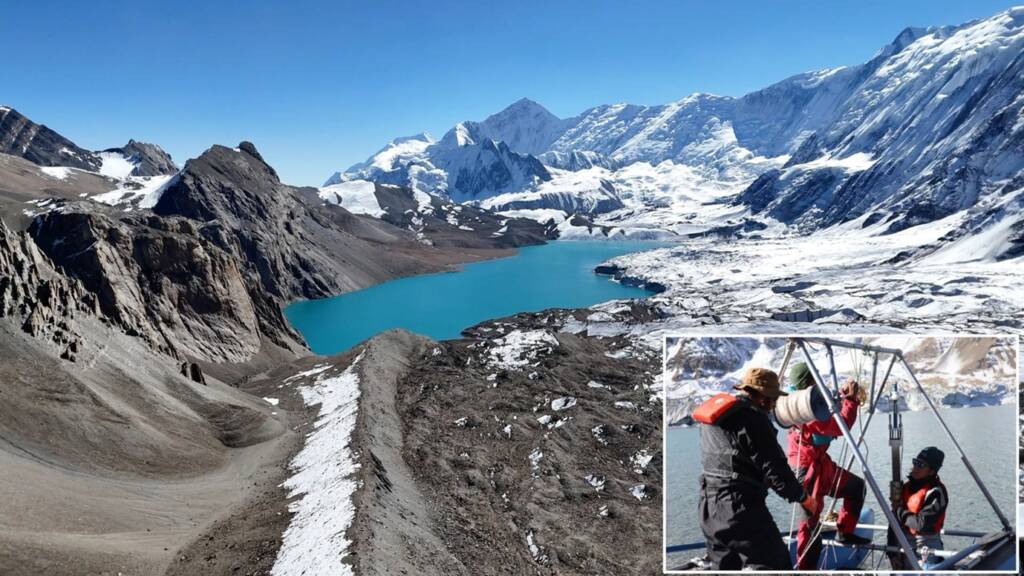
Click on an image to expand
Image Captions
Lake Tilichio, Nepal and taking cores from the centre of the lake in Nov. 2024 (photo credits: Stephen Roberts). You will work on a core from this lake alongside others already taken from a precipitation gradient across Nepal.
Methodology
In Years 1 and 2, you will analyse lake sediment cores from northwest and central Nepal that were collected during the Big Thaw project, with training in data collection and processing provided by supervisors Ascough, Henderson and Roberts alongside project partners at Manchester, Brussels (ULB), Utrecht, Bern and Toronto. Your primary task in Year 1 will be generating new high-resolution hyperspectral and geochemistry datasets using a recently installed coupled GEOTEK scanning system at Newcastle University (with Henderson/Roberts). In the second half of Year 1 and into Year 2, supervisor Ascough (Glasgow University) will train you in ramped oxidation-14C analysis at the NERC radiocarbon facility at SUERC, and in Pb-210 dating (at Durham and with collaborator Roland), enabling you to develop robust lake sediment chronologies and novel wet/dry proxies.
You will also work with existing multi-proxy datasets from the same cores, including ITRAX-XRF scan data (University of Manchester; Bishop/Roberts), GEOTEK-CT imagery (University of Durham; Ghazoui-Schaus/Roberts/Zahajska), and biological proxy records of past wet and dry phases (Utrecht; Peterse/Ghazoui-Schaus). As a complementary partner to Newcastle University’s core scanning facilities, the University of Bern (Zahajská) will support the project with specialised expertise in data processing, cleaning, alignment, and high-dimensional data operations for imaging outputs. Bern will provide remote-access support to established processing workflows alongside access to its High-Performance Computing (HPC) facilities to seamlessly handle the complex computational demands of the large-scale HySpex and other large datasets.
With guidance from all supervisors, you will use produce datasets and outputs that reconstruct records of extreme wet and dry periods, extending the historical instrumental record by centuries to potentially thousands of years. These longer records will provide a larger sample of the frequency distribution of extreme hydrological events in Nepal, allowing you to produce robust statistical models, underpinned by well-established time series, spectral, cyclicity and recurrence methods. For extreme wet periods, we expect to find event frequencies and trends that apply locally at each core site, while extreme dry periods will apply on a much larger regional, Himalayan scale.
In Years 2 and 3, you will be trained to analyse outputs from climate model simulations spanning 1000 to 2100 CE (with supervisors Orr/Baldini). These simulations are drawn from the Coupled Model Intercomparison Project 6 (CMIP6), which is well suited to capturing strong inter-annual precipitation variability. You will identify extreme wet and dry periods from an ensemble of these models and compare them directly against the multi-century lake sediment records. This comparison will help you understand the underlying climatic drivers of these hydrological extremes, such as variability in regional and global atmospheric circulation patterns including the Indian Monsoon and the El-Nino Southern Oscillation (ENSO). Because the climate simulations can extend further back in time than the sediment records, they will also allow you to assess how extreme the wet and dry periods of the industrialised 20th century were under anthropogenic forcing relative to the pre-industrial period. And because the models also run to the end of the 21st century, they will enable you to examine how hydrological extremes across Nepal and the Himalayas are likely to evolve in the future.
Throughout, there will be significant flexibility in the science undertaken in this PhD, allowing the science direction to be led and driven by the PhD student.
Project Timeline
Year 1
• BAS and IAPETUS induction activities.
• Training courses and bespoke training in data collection and analysis, computing, analysing large datasets, and analytical skills.
• Review of Himalayan climate and paleoclimate literature.
• Bespoke training in using the lake sediment cores hyperspectral + LIBS scanning system at the University of Newcastle
• Obtain and analyse modern-day precipitation gauge datasets for the lake core sites.
• Compare lake sediment records with gauge datasets to extend the chronology of extreme wet and dry periods over the full multi-century sedimentary record.
• Identify robust signals of extreme wet and dry periods over the full multi-century sedimentary record and determine how frequently these events occur across the Nepalese Himalaya
• Bespoke training in ramped oxidation-14C analysis at the NERC radiocarbon facility at SUERC, East Kilbride, Glasgow
• Begin working up data into a paper-ready format based on results of the core scanning.
Year 2
• Continue ramped oxidation-14C analysis at the NERC radiocarbon facility at SUERC, East Kilbride, Glasgow analysis and analyse datasets obtained in the first year, including training in the use of HPC facilities with Bern University
• Begin climate model simulations covering the period 1000 to 2100 by analysing the occurrence of extreme wet and dry periods in Nepalese Himalaya
• Compare simulations with signals over the full multi-century sedimentary record and use the model data to increase our understanding of extreme wet and dry periods further back in time
• Use the model data to determine what climate factors cause these hydrological extremes in Nepalese and wider Himalaya
• Use the model data to determine how extreme wet and dry periods in Nepal/Himalayas have changed throughout the 20th century, and how they will likely evolve over the 21st century.
• Begin working up data into a paper-ready format based on modelling results.
Year 3
• Continue to model and analyse datasets generated in Years 1 and 2
• Write papers based on results.
• Prepare chapters for thesis.
• Present work at major international conference(s).
Year 3.5
• Completion of thesis
• Completion of papers
Training
& Skills
• Bespoke training in state-of-the art and high-resolution and chronological lab analysis of sediment cores at three different Iapetus institutes (BAS, Newcastle and Glasgow/SUERC).
• Tailored climate modelling training and skills development.
• Opportunity to take wide variety of Iapetus DLA and BAS data and climate science training courses.
• Opportunity to take wide variety of transferable skills through the Iapetus DLA and BAS PhD training programmes, including writing research papers, public speaking training
• Iapetus also provides opportunities to work towards a Postgraduate Certificate in Research Methods and undertake a 3-month industrial placement activity (funded by Iapetus separately) during your PhD studies – see the Iapetus website for more details.
• Dedicated funding for attending conferences.
References & further reading
https://www.icimod.org/press-releases/hindu-kush-himalaya-glaciers-losing-ice-at-double-the-rate-since-2000-new-icimod-report-confirm/
Adolph M-L, Wang J, Zhu L, Clarke LJ, Henderson ACG, et al. (2026). The ICDP Nam Co Drilling Project (NamCore), Tibet: a 510.2 m sedimentary record from the Third Pole. Scientific Drilling 2026, 35(1), 99-117.
Garnett, Mark H. , Harman, Naima, Murdoch, Iain, Taylor, Christopher and Ascough, Philippa (2025) Processing of samples by ramped oxidation at the NEIF Radiocarbon Laboratory, SUERC: recent technical advances. Radiocarbon, https://doi.org/10.1017/RDC.2025.10155
Prichard, H. P. (2021), Global data gaps in our knowledge of the terrestrial cryosphere, Front. Clim., 3, https://doi.org/10.3389/fclim.2021.689823.
Pritchard, H. P. (2019), Asia’s shrinking glaciers protect large populations from drought stress, Nature, 649-654, https://doi.org/10.1038/s41586-019-1240-1.
Nelson, D. B., et al. (2011), Drought variability in the Pacific Northwest from a 6,000-yr lake sediment record, Proc. Natl. Acad. Sci., 8, 3870-3875, https://doi.org/10.1073/pnas.1009194108.
Barnett, T. P., J. C. Adam, and D. P. Lettenmaier (2005), Potential impacts of a warming climate on water availability in snow-dominated regions, Nature, 438, 303-309, https://doi.org/10.1038/nature04141.
Jungclaus, J. H., et al. (2017), The PMIP4 contribution to CMIP6 – Part 3: The last millennium, scientific objective, and experimental design for the PMIP4 past1000 simulations, Geosci. Model Dev., 10, 4005–4033, https://doi.org/10.5194/gmd-10-4005-2017.
Ljungqvist, F., et al. (2016), Northern Hemisphere hydroclimate variability over the past twelve centuries, Nature, 532, 94–98, https://doi.org/10.1038/nature17418.
