

IAP-26-003
Constraining the interplay of fault reactivation and fluid metasomatism in a continental strike-slip system
Would you like to dig deep into the heart of NW Europe’s largest strike-slip fault?
Faults transmit water, heat, geological fluids, magma and metals through the crust. Understanding the processes and properties of complex fault zones is key to delivering renewable energy infrastructure, developing new geothermal opportunities and understanding critical metal distributions. Fault zones are gaining new prominence in Scotland as OFGEM has given Cap and Floor support to three major Pumped Hydro Schemes intersecting such zones (Fig. 1). However, the abundance of broken and fluid-altered (metasomatized) rock generates costly engineering risk and uncertainty.
To address these challenges and consider the resource potential of fault zones requires a new understanding of the entire fault system from the ductile core to the wider brittle damage zone to understand the interplay of deformation, melts and fluids over geological time.
How does fault motion evolve over space and time? What fluids, melts and metals were transmitted, where did they come from, where did they go, how did they metasomatize and structurally stabilise or weaken, make more permeable or seal, the host rock? What implications are there for the planning and execution of infrastructure along the fault system? Might a fault system be considered for metal exploration or as a viable host for engineering geothermal systems?
Your case study will be the Great Glen Fault (GGF) in the Scottish Highlands which presents a long history from fault inception to multiple phases of reactivation and metasomatism: a unique opportunity to start addressing these questions in partnership with the British Geological Survey (BGS).
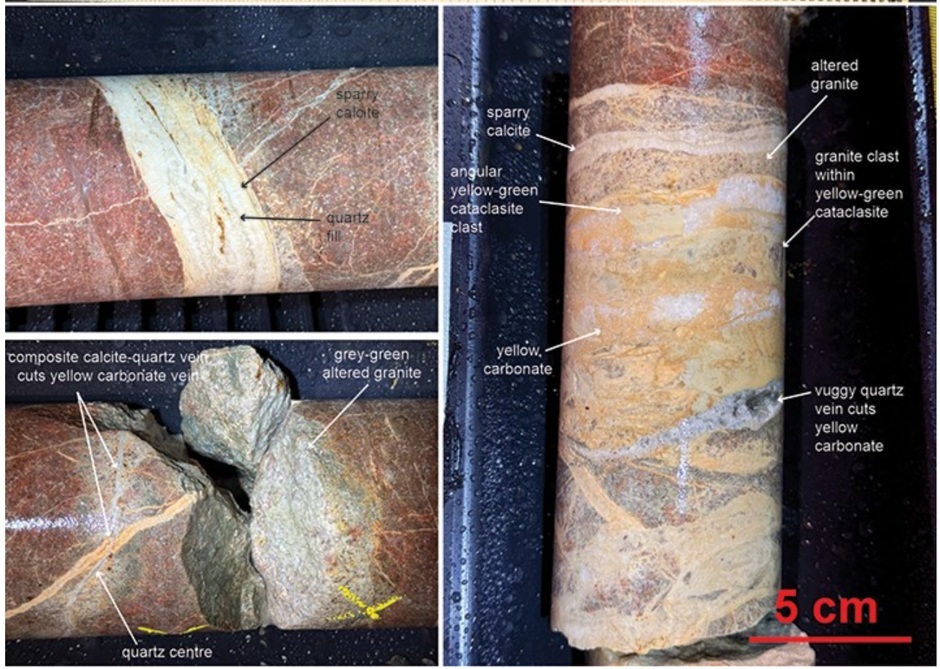
The GGF originated as an orogen-parallel strike-slip fault during the Silurian-Devonian Caledonian Orogeny, associated with extensive plutonism. The fault system has been reactivated multiple times during the Palaeozoic, Mesozoic and Early Cenozoic, though the nature and distribution of reactivated features and associated metasomatism is highly uneven. Along-strike changes range from highly brittle calcite-baryite-pyrite dominated mineralisation at Glensanda; quartz-carbonate dominated mineralisation and metasomatism at the Coire Glas Pump Storage Hydro scheme; and fenitization at Rosemarkie and the Foyers Igneous Complex (Fig. 2). Why? What is the ultimate source of the mineralising and metasomatic fluids? If, as we suspect, the carbonate was deeply sourced or even mantle-derived, how did this fault maintain trans-crustal connectivity over hundreds of millions of years? What are the dominant types of metasomatism at a given location and where is, or isn’t, potential for economic mineralisation? Where do extensive granite clasts come from in parts of the fault zone where none are exposed in the host rock? How might we predict the structures and rock strengths associated with the currently unexposed parts of the fault system?

Click on an image to expand
Image Captions
Fig. 1. An example of the relationships between faults and Net Zero infrastructure. We might also extend our thinking towards how metasomatism aids or hinders drilling for deep engineered geothermal systems, given many major faults are also associated with high crustal heat flow. Image created by Romesh Palamakumbura and submitted to Astronomy and Geophysics as part of Curtis et al. in review. The UK and Ireland Geophysical Array – Opportunities and Applications,Fig. 2. Examples of the core from Coire Glas pump storage ground investigation showing fault-hosted granite extensively metasomatized and mineralised by quartz-calcite veins of uncertain age and origin. Image available from the British Geology Survey and featured in Palamakumbura et al. (2026) Coire Glas: A window into the Great Glen Fault. Geoscientist Magazine, Summer 2026.
Methodology
You will have extensive access to core hosted by the BGS in Edinburgh, retrieved by contractors from ground investigation work at SSE’s £1BN Coire Glas scheme (Fig. 2). There will be fieldwork at Holcim’s Glensanda Superquarry, Ardgour, Torcastle, Loch Ness and the Black Isle to build a detailed relative and comparative history of the structural evolution and first order patterns of metasomatism and mineralisation of the fault core and damage zone along 150 km of strike. This work may include portable XRF analysis to rapidly assess the distribution of metasomatic effects.
Samples from these locations will be prepared and analysed petrographically using in-house facilities at the University of Glasgow and the BGS to further address the structural and metasomatic history and ensure suitable samples are selected for further laboratory analysis.
There will be an accompanying application for carbonate U-Pb, O and C isotopic analysis from Coire Glas samples via the NERC Environmental Isotope Facilities Committee to determine metasomatic timescales and carbonate fluid sources. Further applications might include analysis of a broader sample suite from along the fault zone, U-Pb provenance dating of igneous clasts, or constraints on brittle faulting and metasomatism from K-Ar dating of illite from fault gouges.
The project team are also considering collaborations to conduct deformation experiments on the fault rocks to help constrain engineering implications of reactivation and metasomatism. Ultimately, we expect the study will evolve as the project goes on and results become clearer, providing a range of directions the student can take ownership of.
Project Timeline
Year 1
Literature review, Coire Glas core collection, training on structures, fieldwork, metasomatism, initial isotopic analyses from Coire Glas, preparation of further samples from Coire Glas for petrographic and microstructural/chemical analysis.
Year 2
Wider field-based studies and sampling (Glensanda, Ardgour, Torcastle, Loch Ness, Black Isle), further sample preparation, petrography/micro-structure. Potential for further isotope application covering all sites, e.g., U-Pb, C, O, K-Ar as appropriate. Attend national conference to network and discuss initial findings.
Year 3
Integration of field data, petrography, chemical and isotopic analyses, building hypotheses, drawing in knowledge from other fields (e.g., rock deformation experiments). Attend international conference to present major findings. Commence thesis writeup/papers.
Year 3.5
International workshop or conference and/or opportunity to co-lead a “Great Glen Workshop”.
Compete thesis/paper write-up and feedback cycle.
Ongoing planning of future directions and career opportunities.
Training
& Skills
We are looking for a candidate who is interested in faults, structures, mineralogy and hard rock problems and is keen for a mixture of field, archival and laboratory analysis, with potential to engage with industrial stakeholders as the project evolves. Background knowledge of Scottish geology or fault zone analysis would be helpful. We envisage the core training to include:
– Field study of fault zones
– Field and laboratory petrography and geochemical analysis
– Sample preparation for isotope analysis
– Isotopic analysis, data reduction, interpretation
– Structural-chemical data integration
– Application-writing, paper-writing
– Networking and public engagement
The University of Glasgow graduate researcher programme includes >20 days of training, seminars, and public engagement opportunities. There will be opportunities to lead or assist with funding applications, for example to local geological societies, the Scottish Association of Geographical and Earth Sciences, and NERC’s environmental isotope facility steering committee. We hope to draw researchers towards a Scottish Geology or GGF-focused workshop towards the end of the project which would provide valuable organisational experience. The enthusiastic supervisory team from academia and the BGS give you the opportunity to grow wide-ranging Scottish geology expertise, perspectives across micro- to plate-scale studies of geological evolution, mineralisation, fault mechanics, geochronology, and magmatism. You’ll join a diverse postgraduate cohort in Glasgow and mix with other postgraduates studying at the BGS during regular visits, particularly to Edinburgh.
References & further reading
https://www.bgs.ac.uk/news/scientists-gain-access-to-once-in-a-lifetime-core-from-great-glen-fault/
https://geoscientist.online/wp-content/uploads/2026/05/Geoscientist-Summer-2026.pdf
Elliott, H.A.L., Wall, F., Chakhmouradian, A.R., Siegfried, P.R., Dahlgren, S., Weatherley, S., Finch, A.A., Marks, M.A.W., Dowman, E. and Deady, E., 2018. Fenites associated with carbonatite complexes: A review. https://doi.org/10.1016/j.oregeorev.2017.12.003
Kim, N., Shipton, Z., Kremer, Y. and Jack, C.D., Comparing Geological and Engineering Approaches to Characterizing Mechanical Heterogeneities: Insights from the Great Glen Fault, Scotland. https://doi.org/10.1016/j.enggeo.2025.108529
De Jongh et al. (2024) Petrography and mineralogy of fault material from the Great Glen Fault. http://dx.doi.org/10.1201/9781003429234-198
