

IAP-26-002
Jet Stream Regimes and Atmospheric Rivers as Drivers of Antarctic Climate Extremes and Surface Melting
Summary: Antarctic ice shelves are increasingly vulnerable to extreme surface melt events, which can lead to the formation of supraglacial lakes and increase the risk of ice-shelf collapse. Recent studies suggest that tropical climate variability can influence Antarctic weather by altering large-scale atmospheric circulation, including the Southern Hemisphere jet stream and the occurrence of atmospheric rivers, which transport large amounts of heat and moisture towards the Antarctic continent. However, the atmospheric pathways linking tropical climate variability, jet stream variability, atmospheric rivers, and Antarctic melt events remain poorly understood.
This project will investigate how jet stream regimes and atmospheric rivers interact to produce extreme warming and surface melting across Antarctica. Using atmospheric reanalysis data, climate model simulations, and satellite observations, the student will identify the large-scale circulation patterns that favour Antarctic climate extremes, quantify the role of atmospheric rivers in transporting heat and moisture to the ice sheet, and assess how these processes may change in a warming climate.
Background: Ice shelves around coastal Antarctica act as natural barriers that restrain the flow of grounded ice into the ocean. Surface melt and the formation of supraglacial lakes can weaken ice shelves through hydrofracturing, increasing their vulnerability to collapse (Stokes et al., 2019; Arthur et al., 2022; Tuckett et al., 2025). Understanding the climatic drivers of melt events is therefore critical for improving projections of Antarctic ice-sheet change and future sea-level rise.
The Southern Hemisphere jet stream plays a central role in regulating the transport of heat and moisture towards Antarctica. Variations in its position, strength, and structure can alter storm tracks and contribute to extreme warming events, atmospheric rivers, and surface melting (Trenberth, 1991; Patterson et al., 2020). Tropical climate variability may influence these processes through atmospheric teleconnections that modify Rossby wave propagation and large-scale circulation patterns (Xue et al., 2021). While these mechanisms have been linked to Antarctic heatwaves and moisture intrusions (Turner et al., 2021; Lu et al., 2023), the connections between tropical forcing, jet-stream variability, and Antarctic surface impacts remain poorly understood (Wille et al., 2025).
Overarching research question: How does Southern Hemisphere jet stream variability influence warm-air intrusions into Antarctic coastal regions, and what are the implications for extreme melt events and supraglacial lake formation?
Benefits: This project will advance understanding of how Southern Hemisphere circulation variability influences Antarctic climate extremes, surface melt, and ice-shelf vulnerability. By linking large-scale atmospheric processes to Antarctic surface impacts, the research will provide new insight into the drivers of extreme warming and melt events. The findings will help reduce uncertainties in projections of future Antarctic ice-sheet change and sea-level rise, while contributing to a more integrated understanding of interactions between the atmosphere and cryosphere in a changing climate.
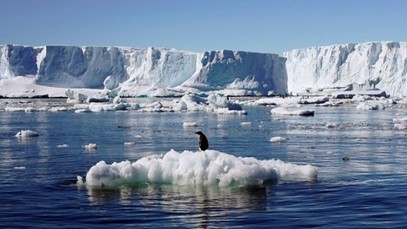
Click on an image to expand
Image Captions
Antarctica, one of the fastest-warming regions on Earth, recorded its highest-ever temperature of 18.3°C on 6 February 2020 at Esperanza Station. Such extreme surface warming events, particularly along coastal margins, are often driven by regional high-pressure systems and intense downslope föhn winds. These short-lived but powerful episodes can dramatically increase ice shelf vulnerability. This PhD studentship will explore the magnitude, frequency, and atmospheric drivers of these warm events, offering the opportunity to contribute to cutting-edge climate research with real-world implications for polar ice stability and sea level rise.
Methodology
We hypothesise that distinct jet stream regimes control the transport of heat and moisture towards Antarctica, thereby regulating the frequency and intensity of extreme warming events and the likelihood of supraglacial lake formation.
By combining atmospheric reanalysis data, climate model simulations, and satellite observations, this project will investigate the role of Southern Hemisphere jet stream variability in shaping Antarctic climate extremes and ice-shelf surface processes.
The project will address three specific research questions:
1. What are the dominant Southern Hemisphere jet stream regimes and atmospheric rivers reaching the Antarctic, and how are they influenced by tropical climate variability?
2. How do different jet stream regimes and atmospheric rivers influence Antarctic climate extremes?
3. How do jet-driven warm air intrusion influence Antarctic surface melt and supraglacial lake formation, and how might these relationships change in the future?
To address these questions, the student will undertake three interconnected research tasks.
Task 1: Identifying Southern Hemisphere jet stream regimes, atmospheric rivers, and their tropical drivers
Develop an objective classification of Southern Hemisphere jet stream regimes and determine their links to tropical climate variability and planetary wave activity.
Using ERA5 reanalysis data, the student will identify dominant jet stream regimes and atmospheric rivers based on variations in jet latitude, strength, width, and split-jet behaviour. Statistical and machine-learning techniques, including clustering and circulation-regime analysis, will be used to identify recurrent jet configurations. The student will then examine how these regimes relate to major modes of tropical climate variability, including ENSO and Indian Ocean variability, and assess the role of Rossby wave trains in transmitting tropical influences into the Southern Hemisphere extratropics.
Task 2: Understanding how jet stream regimes and atmospheric rivers influence Antarctic climate extremes
Quantify the dynamical mechanisms linking jet stream regimes to Antarctic warming events through changes in wave breaking, moisture transport, and large-scale circulation.
Building on Task 1, the student will examine how different jet regimes shape Antarctic weather and climate extremes. Dynamical diagnostics will be used to analyse Rossby wave breaking, atmospheric blocking, poleward heat transport, and atmospheric river frequency associated with each regime. Particular attention will be given to identifying the circulation pathways that promote warm-air intrusions and extreme warming events in Antarctic coastal regions, especially the Ross Sea sector and neighbouring ice shelves.
Task 3: Assessing impacts on surface melt and supraglacial lake formation
Link observed surface melt and supraglacial lake events to specific jet stream regimes and assess future changes using climate model projections.
The student will combine satellite observations of supraglacial lakes and surface melt from regional climate models with the atmospheric diagnostics developed in Tasks 1 and 2. This analysis will identify the jet stream regimes and climate extremes most strongly associated with ice-shelf melt and lake formation. Finally, CMIP6 climate model simulations will be used to examine how Southern Hemisphere jet stream regimes and atmospheric rivers may respond to future warming and to assess the implications for Antarctic melt events and ice-shelf vulnerability.
Project Timeline
Year 1
• Month 1: Induction programmes of IAPETUS, BAS.
• Months 1–3: Literature review; familiarisation with data, computing facilities, diagnostics, and programming.
• Month 3: Preliminary literature review and aims/objectives report.
• Months 2–12: Begin work on Tasks T1.
• Month 6: First-year progress report.
• Month 9: Presentation at first-year postgraduate conference, Durham, or a targeted national conference.
• Month 10: Visit co-supervisor SC at Durham.
• Month 12: Attend BAS Student Symposium.
Year 2
• Months 13–17: Complete work related to Tasks T1.
• Month 18: Submit Publication #1: Tropical drivers of Southern Hemisphere jet stream regimes and Antarctic circulation variability. This paper focuses on atmospheric drivers, i.e., teleconnections -> jet regimes.
• Month 19: Present at International Conference #1 (e.g., EGU or AGU or equivalent).
• Month 20–22: Industrial placement, e.g. Met Office, another university, a satellite data provider or policy organisation.
• Month 23: Poster presentation at BAS Student Symposium.
• Months 23–24: Work on Task T2 and submit second year progress report to both Durham and BAS.
Year 3
• Months 25–30: Continue work on Tasks T2 and revise publication #1 according to reviewers comments.
• Month 30: Oral presentation at Durham postgraduate research day.
• Month 32: Submit Publication #2: Dynamical pathways linking Southern Hemisphere jet regimes and Atmospheric Rivers to Antarctic climate extremes. This paper focuses on mechanisms and pathways, i.e., jet regimes -> Antarctic extremes.
• Months 33-36: Work on Task T3
• Month 33: Present at International Conference #2 (e.g., SCAR Conference).
• Month 36: Oral presentation at BAS Student Symposium.
Year 3.5
• Months 37-40: continue working on Task T3
• Month 40: submit Publication #3: Jet stream variability as a driver of Antarctic surface melt and supraglacial lake formation. This paper focuses on the impacts, i.e., climate extremes -> supraglacial lake formation.
• Months 41-42: Writing and organizing thesis based on three publications, one published, one accepted or under revision; and one in draft or about to submit.
Training
& Skills
The successful candidate will be registered at Durham University and primarily based at the British Antarctic Survey (BAS) in Cambridge within the Atmospheric, Ice and Climate Team. The Iapetus DTP will provide comprehensive postgraduate training through its core training programme, induction activities, cohort-building events, and professional development workshops.
At BAS, the student will be supervised by Dr Hua Lu (primary supervisor) and Dr Thomas Bracegirdle (co-supervisor). The student will receive specialist training in atmospheric dynamics & circulation regimes, wave-mean flow interactions, climate extremes, heat and moisture transport, and polar meteorology. The student will also gain experience in analysing reanalysis datasets, applying circulation-regime and machine-learning techniques, and interpreting climate model simulations to investigate future climate change. The student will develop advanced skills in handling large environmental datasets, statistical analysis, scientific programming, and visualisation. They will join a vibrant community of approximately 100 PhD students across five NERC Doctoral Training Programmes, providing excellent opportunities for peer learning, networking, and interdisciplinary collaboration.
The student will spend time at Durham University under the supervision of Professor Chris Stokes, gaining training in glaciology, remote sensing, and cryosphere processes. They will learn how satellite observations can be used to investigate surface melt, supraglacial lake formation, and ice-shelf vulnerability, enabling them to connect atmospheric processes with impacts on the Antarctic ice sheet.
Additional training opportunities will be available through NERC summer schools, specialist workshops, and seminars at both BAS and Durham University. The student will also develop transferable research skills in scientific writing, project management, reproducible research, and science communication. They will present their work at BAS Student Symposia, Durham research seminars, and national and international conferences, building confidence and experience within the wider polar and climate science communities.
Person Specification
We are seeking an enthusiastic, self-motivated, and intellectually curious candidate with a strong quantitative background in atmospheric science, physics, mathematics, environmental science, geophysics, or a related discipline. Experience in scientific programming (e.g. Python, MATLAB, R, or similar), data analysis, and numerical methods would be advantageous. An interest in atmospheric dynamics, climate variability, weather and climate extremes, or polar science is desirable, as is evidence of strong written and oral communication skills.
References & further reading
Andreasen JR, Hogg AE, and Selley HL (2023). Change in Antarctic ice shelf area from 2009 to 2019, The Cryosphere, 17, 2059–2072, https://doi.org/10.5194/tc-17-2059-2023, 2023.
Arthur JF, Stokes CR, Jamieson SSR et al. (2022). Large interannual variability in supraglacial lakes around East Antarctica. Nat Commun 13, 1711 https://doi.org/10.1038/s41467-022-29385-3.
Gilbert, E., Pishniak, D., Torres, J. A., Orr, A., Maclennan, M., Wever, N., and Verro, K.: Extreme precipitation associated with atmospheric rivers over West Antarctic ice shelves: insights from kilometre-scale regional climate modelling, The Cryosphere, 19, 597–618, https://doi.org/10.5194/tc-19-597-2025, 2025.
Lu, H. et al. (2023) Extreme warm events in the South Orkney Islands, Southern Ocean: Compounding influence of atmospheric rivers and föhn conditions. Quarterly Journal of the Royal Meteorological Society, 149(757), 3645–3668.
Patterson, M., Woollings, T., Bracegirdle, T. J., & Lewis, N. T. (2020). Wintertime Southern Hemisphere Jet Streams Shaped by Interaction of Transient Eddies with Antarctic Orography. J. Clim., 33, 9047-9067.
Stokes CR, Sanderson JE, Miles BWJ et al. (2019). Widespread distribution of supraglacial lakes around the margin of the East Antarctic Ice Sheet. Sci Rep 9, 13823. https://doi.org/10.1038/s41598-019-50343-5.
Trenberth, K. E. (1991). Storm Tracks in the Southern Hemisphere. Journal of the Atmospheric Sciences, 48(19), 2159-2178.
Tuckett, P.A., Sole, A.J., Livingstone, S.J. et al. Continent-wide mapping shows increasing sensitivity of East Antarctica to meltwater ponding. Nat. Clim. Chang. 15, 775–783 (2025). https://doi.org/10.1038/s41558-025-02363-5.
Turner, J., Lu, H., King, J., Marshall, G. J., Phillips, T., Bannister, D., & Colwell, S. (2021). Extreme Temperatures in the Antarctic, J. Clim., 34, 2653-2668.
Wille, J. D. et al. (2025). Atmospheric rivers in Antarctica. Nature Reviews Earth & Environment, 6, 178-192. https://doi.org/10.1038/s43017-024-00638-7.
Wille, J.D., Favier, V., Jourdain, N.C. et al. Intense atmospheric rivers can weaken ice shelf stability at the Antarctic Peninsula. Commun Earth Environ 3, 90 (2022). https://doi.org/10.1038/s43247-022-00422-9
Xue, T., et al. (2021). Tropical teleconnection impacts on Antarctic climate changes. Reviews of Geophysics, 59(3), e2020RG000727.
