

IAP-26-001
Melting the ice: modelling ice-brine dynamics and cryovolcanism on Europa
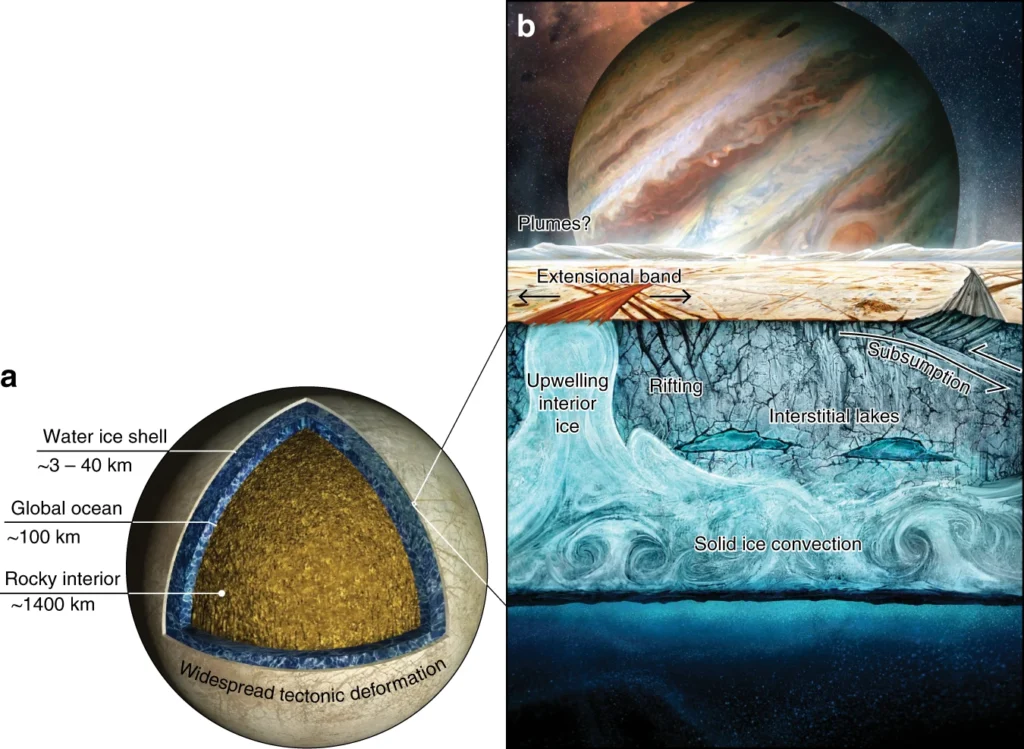
Jupiter’s icy moon Europa is one of the most compelling targets for planetary science and astrobiology. Its young surface is crisscrossed by bands, ridges, pits, domes and chaos terrains, features that suggest an active ice shell undergoing processes potentially similar to plate-like tectonics on Earth (Figure 1, Sullivan et al., 1998; Tufts et al., 2000; Kattenhorn & Prockter, 2014). This suggests that cryovolcanism — i.e., the ascent and eruption of briny water or ice melts — might play a central role in resurfacing Europa, contributing to the exchange of oxidants and reductants between surface and ocean, and sustaining potential habitability (Vance, 2018; Soderlund et al., 2020).
Several mechanisms have been proposed to explain the origins of cryovolcanism on Europa (Figure 1). One possibility is that brittle ice at the surface is recycled downwards into the warmer, ductile, convecting ice deeper in the shell. This might warm the recycled ice locally to form mushy or briny layers. Another possibility is that salt segregation during solidification forms brine lenses that persist and destabilise, driving the formation of chaos terrains or transient flows (Buffo et al., 2021). Ocean heat may also promote melting at the base of the ice shell, though turbulent heat loss and rapid refreezing appear to limit direct material exchange with the ocean below, favouring in-situ melting instead (Soderlund et al., 2020; Ojha et al., 2026). Together these pathways are further influenced by tidal heating (Tobie et al., 2025) and the complex thermophysical properties of ice–brine mixtures.
While each mechanism has been studied individually, few studies consider how they interact. This project builds an integrated framework to weigh their relative contributions and predict what each would produce at the surface, addressing four questions:
1. Under what conditions can recycled material in the shell warm-up and contribute to cryovolcanic activity?
2. How do mushy-layer physics and salt segregation promote the formation, persistence, and destabilisation of brine-rich zones?
3. To what extent can boundary conditions derived from ocean circulation models influence ice shell convection and melting dynamics?
4. What would each mechanism look like at the surface, and are these predictions consistent with existing Galileo-era imagery (Schenk, 2004; Kattenhorn & Prockter, 2014; Lesage et al., 2021)?
By combining tectonics, brine dynamics, and ice–ocean boundary interactions within one modelling framework, this project will investigate the drivers and style of cryovolcanism on Europa with the same brine-transport and basal-melting physics feeding directly back into how these processes are understood in Earth’s own ice shelves and sea ice (Feltham et al., 2006).
Click on an image to expand
Image Captions
Figure 1. Conceptual model of Europa’s ice shell and ocean dynamics, showing subduction, brine storage, convective upwellings, and possible surface plumes (adapted from Howell & Pappalardo, 2020)
Methodology
The student will build coupled thermo-mechanical models of Europa’s ice shell using the open-source finite-element geodynamics code ASPECT (Heister et al., 2017). The modelling will include:
• Ice-shell tectonics and subduction with visco-elasto-plastic rheology, extending our existing ASPECT implementation of latitudinally-varying tidal dissipation heating (Kim et al., 2025) to investigate the role tidal heat dissipation on surface recycling, subduction-style recycling and brine generation and transport.
• Brine migration and mushy-layer physics, adapting ASPECT’s existing two-phase flow implementation (Dannberg & Heister, 2016) to the salt segregation and phase-change processes that create and destabilise brine-rich zones (Buffo et al., 2021; Wong & Keller, 2023).
• Application of boundary conditions derived from ocean circulation and ice-ocean heat-flux models (Soderlund et al., 2020; Lemasquerier et al., 2024) to represent the influence of ocean-driven processes on ice shell dynamics.
• Generation of quantifiable model observables e.g., surface thermal anomalies and local ice-shell thickness perturbations for validation against existing Galileo-era topography and imagery (Schenk, 2004; Kattenhorn & Prockter, 2014; Lesage et al., 2021), following the observational framework of Lesage et al. (2025), and as testable predictions for Europa Clipper’s thermal and radar instruments once science operations begin in 2030 (Pappalardo et al., 2024; Daubar et al., 2024).
Project Timeline
Year 1
Year 1 (Months 1–12): IAPETUS cohort training and induction; literature review and refinement of the four research questions; onboarding to ASPECT and the group’s existing tidal-dissipation implementation (Kim et al., 2025); build and benchmark the baseline thermo-mechanical ice-shell model with visco-elasto-plastic rheology. Run ice-subduction/downwelling models and test these with tidal heating dissipation. First-year annual progression report and progress review.
Year 2
Year 2 (Months 13–24): Develop the brine-migration and mushy-layer module, adapting ASPECT’s two-phase flow implementation (Dannberg & Heister, 2016) to salt segregation and phase-change physics; couple this to tidal-heating models built in Year 1 and include these within the icy subduction/downwelling models. Incorporate ocean-circulation boundary conditions (Soderlund et al., 2020; Lemasquerier et al., 2024). Week-long visit to the Planetary Geophysics and Geodynamics groups at the University of Texas at Austin for training in icy-moon fluid dynamics and support with model interpretation. Present preliminary coupled-model results at a major international conference (e.g. AGU Fall Meeting or EGU General Assembly).
Year 3
Year 3 (Months 25–36): Generate model observables (topography, thermal signatures) from the coupled model; validate against existing Galileo-era imagery and topography (Kattenhorn & Prockter, 2014; Lesage et al., 2021), following the observational framework of Lesage et al. (2025). Refine the model based on this comparison and frame testable predictions for Europa Clipper. Shorter follow-up visit to UT Austin. Present at a national conference (e.g. the British Geophysical Association’s Postgraduate Research in Progress meeting). First manuscript submitted.
Year 3.5
Complete remaining analysis and manuscripts; write up and submit thesis; viva preparation.
Training
& Skills
• Scientific skills: Geodynamic modelling, planetary geophysics, brine dynamic
• Technical skills: HPC, numerical modelling with ASPECT, coding in Python/C++, data analysis, visualisation.
• Transferable skills: Scientific writing, conference presentation, interdisciplinary collaboration, public outreach, project/time management.
• Career development: The student will be trained for careers in planetary science and exploration, computational geophysics, and Earth/ocean sciences, with strong cross-disciplinary applications.
References & further reading
1. Buffo, J. et al., 2021. Characterizing the ice-ocean interface of icy worlds: a theoretical approach. Icarus.
2. Dannberg, J. & Heister, T., 2016. Compressible magma/mantle dynamics: 3-D, adaptive simulations in ASPECT. Geophysical Journal International, 207(3), 1343-1366. https://doi.org/10.1093/gji/ggw329
3. Daubar, I. J. et al., 2024. Planned Geological Investigations of the Europa Clipper Mission. Space Science Reviews, 220(1). https://doi.org/10.1007/s11214-023-01036-z
4. Feltham, D. L. et al., 2006. Sea ice is a mushy layer. Geophysical Research Letters, 33, L14501. https://doi.org/10.1029/2006GL026290
5. Heister, T., Dannberg, J., Gassmöller, R. & Bangerth, W., 2017. High accuracy mantle convection simulation through modern numerical methods – II: realistic models and problems. Geophysical Journal International, 210(2), 833-851. https://doi.org/10.1093/gji/ggx195
6. Kattenhorn, S. A. & Prockter, L. M., 2014. Evidence for subduction in the ice shell of Europa. Nature Geoscience, 7(10), 762-767. https://doi.org/10.1038/ngeo2245
7. Kim, H., Grima, A. G. & Daly, L., 2025. Investigating the Effect of Latitudinally Varying Tidal Heating on the Surface-Interior Dynamics in Europa’s Icy Shell. AGU Fall Meeting 2025 (abstract).
8. Lemasquerier, D. G. et al., 2024. Europa’s Ocean Translates Interior Tidal Heating Patterns to the Ice-Ocean Boundary. AGU Advances, 5, e2023AV000994. https://doi.org/10.1029/2023AV000994
9. Lesage, E. et al., 2021. Constraints on effusive cryovolcanic eruptions on Europa using topography obtained from Galileo images. Icarus, 361, 114373.
10. Lesage, E. et al., 2025. Identifying signatures of past and present cryovolcanism on Europa. Nature Communications, 16, 1886. https://doi.org/10.1038/s41467-025-57070-8
11. Ojha, L., Barik, A. & Buffo, J., 2026. Limited direct fluid exchange between the deep subsurface ocean and the shallow subsurface environment of Europa. Nature Astronomy. https://doi.org/10.1038/s41550-026-02918-2
12. Pappalardo, R. et al., 2024. Science overview of the Europa Clipper Mission. Space Science Reviews.
13. Schenk, P. M., 2004. Topographic variations in chaos on Europa: Implications for diapiric formation. Geophysical Research Letters, 31, L16703.
14. Soderlund, K. et al., 2020. Ice-ocean exchange processes in the Jovian and Saturnian satellites. Space Sci Rev.
15. Sullivan, R. et al., 1998. Episodic plate separation and fracture infill on the surface of Europa. Nature, 391(6665), 371-373. https://doi.org/10.1038/34874
16. Tobie, G. et al., 2025. Tidal deformation and dissipation processes in icy worlds. Space Science Reviews.
17. Tufts, B. R., Greenberg, R., Hoppa, G. & Geissler, P., 2000. Lithospheric dilation on Europa. Icarus, 146(1), 75-97.
18. Vance, S. D., 2018. The Habitability of Icy Ocean Worlds in the Solar System. In Handbook of Exoplanets (pp. 1-23). Springer International Publishing. https://doi.org/10.1007/978-3-319-30648-3_63-1
19. Wong, Y.-Q. & Keller, T., 2023. A unified numerical model for two-phase porous, mush and suspension flow dynamics in magmatic systems. Geophysical Journal International, 233(2), 769-795. https://doi.org/10.1093/gji/ggac481
