

IAP-26-119
Understanding the genetic health of Galapagos giant tortoises
An important component of population viability is genetic variation, which contributes to adaptive potential and resilience in changing environments (Frankham 2005). Small and endangered populations may lose genetic diversity through drift and experience increased inbreeding, reduced adaptive potential, and greater expression or accumulation of deleterious variation. Present-day genetic diversity alone is an incomplete measure of genetic health as the consequences of low diversity depend strongly on demographic history. Recently bottlenecked populations can retain substantial recessive deleterious variation that is exposed by inbreeding, whereas populations that have remained small for long periods may purge some strongly deleterious alleles while accumulating mildly deleterious ones through drift (Grossen et al. 2020; Bertorelle et al. 2022). Assessing genetic risk therefore requires integrating contemporary genomic variation with population size, inbreeding, demographic history, and genetic load.
The endemic Galapagos giant tortoises (Chelonoidis sp.) are iconic emblems of both evolutionary biology and the fight to save endangered species. This radiation of at least 15 lineages across multiple islands can be considered a “natural experiment” and is an excellent study system for evolutionary biology that has the benefit of also being of huge public and conservation interest. Previous studies have demonstrated that within this radiation, there are a range of demographic histories, including species that have always maintained small population sizes, to those that have experienced large changes (Garrick et al. 2025, Jensen et al. 2021). Most species have experienced recent bottlenecks due to human exploitation during the 18-20th centuries, with conservation actions successfully rebuilding some of the species.
The overarching goal of this studentship is to use whole genome sequencing to assess the genetic health of contemporary Galapagos giant tortoise species and investigate the impact of ancient and recent demographic history on genetic variation. Genetic health will be measured using indicators such as heterozygosity, nucleotide diversity and effective population size (Hoban et al. 2022), as well as through inferring genetic load (Bertorelle et al. 2022). Demographic history will be modelled using complementary approaches based on coalescent theory and Approximate Bayesian Computation simulations (Marchi et al. 2021). These results will be synthesised to understand to which species may be threatened by genetic load and poor genetic health and thus reduced adaptability.
This project will be a CASE partnership with the Galapagos Conservancy, an NGO that is involved in the active management of giant tortoise populations. The results of this studentship will be used to design monitoring and management plans, and guide conservation efforts such as translocations, head-starting and captive breeding.
Click on an image to expand
Image Captions
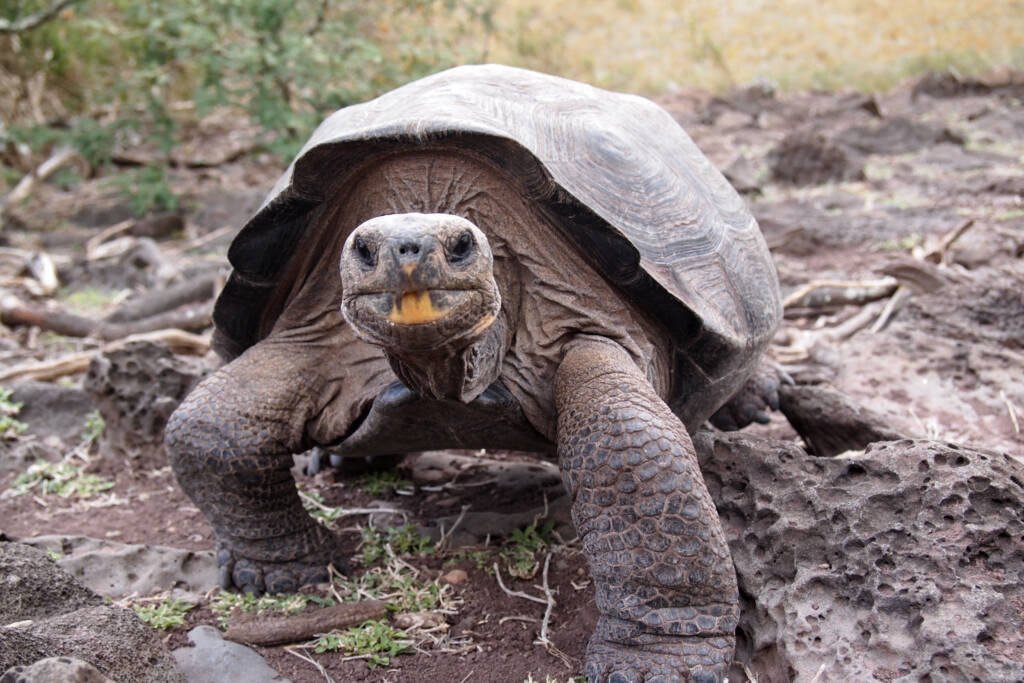
Photograph of a Pinzón Galapagos giant tortoise (image E. Jensen)
Methodology
The student will analyse whole genome sequences from all lineages of Galapagos giant tortoises, including contemporary and historical specimens, to build a robust understanding of past and present levels of genetic diversity and model demographic history. Existing genome sequences (n > 200) will be supplemented with new data collected from additional museum specimens and expanded sampling of selected lineages, providing an ideal dataset for this work.
Using the genome data, the student will investigate the links between demographic history, recent bottlenecks and present-day genetic health.
Project Timeline
Year 1
Training in laboratory methods, genomic analyses, high-performance computing and bioinformatics. Sample acquisition, genome sequencing, literature review.
Year 2
Focus on genetic diversity indicators and building models of demographic history, finalise datasets and analyses, prepare manuscript. Present at national conference.
Year 3
Focus on modelling genetic load with focus on key species such as C. hoodensis, finalise datasets and analyses, prepare manuscripts, and write thesis. Present at international conference.
Year 3.5
Finalise analyses, manuscripts and thesis.
Training
& Skills
The student will join the Ecology Research Group at Newcastle University which has a dynamic and welcoming PGR community, as well as the active community of evolutionary biologists at the University of Glasgow. The student will also be embedded into a highly collaborative, international network of researchers studying Galapagos giant tortoises, and benefit from having multiple mentors available to them.
The student will gain technical skills and specific training in DNA sample and library preparation, bioinformatics and genomic analyses. Specific training will be provided in historical DNA lab techniques and analyses, with the opportunity to work in the Newcastle University ancient DNA lab.
Over the course of the PhD the student will gain transferable skills such as creative thinking and problem solving, scientific writing, public outreach of science, networking, and technical skills in data analysis and visualisation, and high-performance computing.
The project will be conducted in close consultation with the Galapagos National Park Directorate and CASE partner NGO the Galapagos Conservancy. The student will gain experience communicating their results to these stakeholders.
References & further reading
Bertorelle, G., F. Raffini, M. Bosse, C. Bortoluzzi, A. Iannucci, E. Trucchi, H. E. Morales, and C. van Oosterhout. 2022. Genetic load: genomic estimates and applications in non-model animals. Nature Reviews Genetics 23:492-503.
Frankham, R. 2005. Genetics and extinction. Biological Conservation 126:131-140.
Garrick, R. C., B. Kajdacsi, M. A. Russello, E. Benavides, C. Hyseni, J. P. Gibbs, W. Tapia, and A. Caccone. 2015. Naturally rare versus newly rare: demographic inferences on two timescales inform conservation of Galápagos giant tortoises. Ecology and Evolution 5:676-694.
Grossen, C., F. Guillaume, L. F. Keller, and D. Croll. 2020. Purging of highly deleterious mutations through severe bottlenecks in Alpine ibex. Nature Communications 11:1001.
Hoban, S., F. I. Archer, L. D. Bertola, J. G. Bragg, M. F. Breed, M. W. Bruford, M. A. Coleman, R. Ekblom, W. C. Funk, C. E. Grueber, B. K. Hand, R. Jaffe, E. Jensen, J. S. Johnson, F. Kershaw, L. Liggins, A. J. MacDonald, J. Mergeay, J. M. Miller, F. Muller-Karger, D. O’Brien, I. Paz-Vinas, K. M. Potter, O. Razgour, C. Vernesi, and M. E. Hunter. 2022. Global genetic diversity status and trends: towards a suite of Essential Biodiversity Variables (EBVs) for genetic composition. Biol Rev Camb Philos Soc 97:1511-1538.
Jensen, E. L., S. J. Gaughran, R. C. Garrick, M. A. Russello, and A. Caccone. 2021. Demographic history and patterns of molecular evolution from whole genome sequencing in the radiation of Galapagos giant tortoises. Molecular Ecology 30:6325-6339.
Marchi, N., F. Schlichta, and L. Excoffier. 2021. Demographic inference. Current Biology 31:R276-R279.
