

IAP-26-118
Understanding planktonic foraminiferal ecology and geochemistry
The North Atlantic is changing rapidly, with major consequences for ocean circulation, climate, marine ecosystems and society. Judging whether these changes are unprecedented or within natural variability requires robust reconstructions of past ocean conditions beyond ocean observations. Paleoceanographic reconstructions are only as reliable as our understanding of the proxies behind them. Planktonic foraminifera are among the most widely used archives of past ocean temperatures and salinities. The geochemistry of foraminiferal calcite shells and their species composition, record the conditions in which they grew (Rebotim et al., 2019). Yet species live at different depths and seasons and their calcification depth can also shift with hydrography (Rebotim et al., 2017), all of which can bias the reconstructions (Telford et al., 2013).
These uncertainties matter most in the North Atlantic, a key region for the Atlantic Meridional Overturning Circulation (AMOC) (IPCC, 2023) with strong vertical and horizontal gradients in temperature, salinity and water masses (Daniault et al., 2016). Surface and subsurface temperatures here are important fingerprints of AMOC change (Zhang, 2008; Rahmstorf et al., 2015).
This PhD will use newly collected depth-stratified plankton-tow samples and high-resolution hydrographic observations from the OVIDE2026 cruise, spanning ~35–62°N across subtropical and subpolar waters, to:
1. Determine the depth habitats of key planktonic foraminiferal species and how they vary with temperature, salinity, density, water masses and productivity.
2. Calibrate the foraminiferal shell chemistry (δ¹⁸O, δ¹³C, Mg/Ca) against the conditions experienced during calcification, producing species- and depth-specific calibrations.
3. Evaluate which species and proxies record surface versus subsurface conditions, and the implications for interpreting foraminiferal records of North Atlantic change.
By explicitly linking foraminiferal ecology to shell geochemistry, the project will deliver a reference dataset and calibration framework for future North Atlantic palaeoceanographic studies.
Click on an image to expand
Image Captions
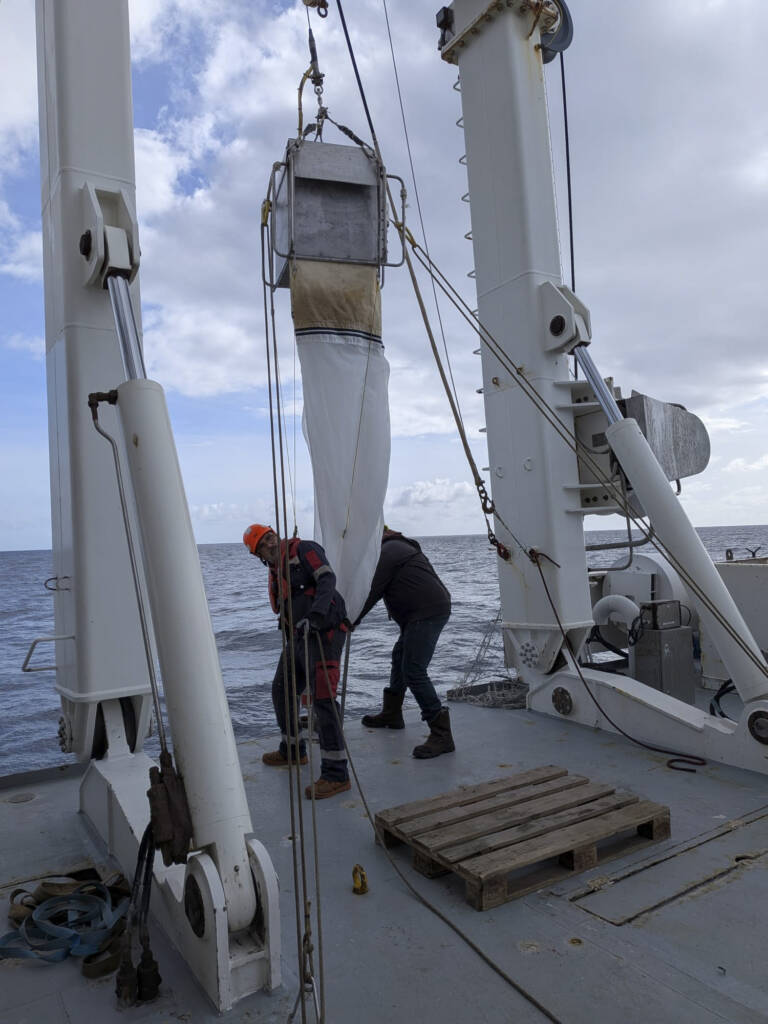
Plankton Nets during the OVIDE line (July 2026, Credit Natalia Vazquez Riveiros)
Methodology
The project will combine newly recovered plankton-tow and seawater samples, planktonic foraminifera shell geochemistry and species composition, oceanographic data and statistical modelling.
1. Depth-resolved foraminiferal ecology: Multi-depth plankton tows from contrasting hydrographic regimes along the OVIDE2026 transect will be analysed to establish species-specific vertical distributions. Abundance, assemblage composition and shell preservation will be related to water-column structure.
2. Shell geochemistry and proxy calibration: Selected species and depth intervals will be analysed for δ¹⁸O, δ¹³C and Mg/Ca in individual foraminifera. Results will be compared directly with co-located CTD datasets: temperature, salinity, density, mixed-layer depth, chlorophyll and water-mass properties, was well as the seawater sample chemistry. Statistical modelling will identify the controls on shell chemistry and establish species- and depth-specific calibrations.
3. Evaluating proxy signals: The calibrations will be combined with OVIDE hydrography, hydrographic databases, satellite observations and ocean reanalyses to predict the signal each species should record across the subpolar–subtropical transition. This will test whether a depth-resolved, species-specific approach changes the interpretation of foraminiferal signals compared with conventional surface-based calibrations. It will also identify the species–proxy combinations best suited to tracking surface versus subsurface (AMOC-related) change.
Collaborations outside Iapetus. The OVIDE programmeprovides the plankton-tow material and hydrographic data, and Ifremer/UMR Geo-Ocean contributes expertise in micropalaeontology and foraminiferal geochemistry. Stable isotopes will be measured at the Pôle Spectrométrie Océan (Brest) and Mg/Ca at the Geography Department at Durham University.
Project Timeline
Year 1
During the first year the student will produce a literature review on the topic. An initial research visit to Geocean (Brest) will be used to prepare and process the OVIDE plankton tow samples. The student will receive specific training in planktonic foraminiferal taxonomy and micropalaeontology to identify and count the planktonic foraminifera in the plankton tow samples. The student will compile the CTD data and learn how to analyse reanalysis data.
Year 2
During the second year a depth habitat analysis and comparison to oceanographic data will be completed. The new findings of the foraminiferal depth-habitat preference will be written and drafted as paper 1. Selection of planktonic foraminiferal shells and cleaning of tests will be undertaken during year 2. The student will received analytical training to measure the geochemistry of the planktonic foraminiferal shells. Trace element analysis will be undertaken in Durham on the ICP-MS. Oxygen and carbon isotopes will be measured in Brest during a research stay. These datasets will be presented at an international conference and written as a scientific article (paper 2).
Year 3
During the third year the student will integrate the geochemical and oceanographic datasets and undertake statistical modelling of species and depth specific calibrations. The new calibrations will be validated against sedimentary records spanning the last 150 years (paper 3).
Year 3.5
The last 6 months will be dedicated to write and submit the thesis. The thesis will include a synthesis of all the new data and an a discussion of implications for interpreting foraminiferal records .
Training
& Skills
The student will be trained in planktonic foraminiferal taxonomy and micropalaeontology; trace metal sample preparation under clean laboratory conditions; stable-isotope and Mg/Ca geochemistry; analysis of oceanographic data (CTD profiles, hydrographic databases and reanalyses); and quantitative data analysis and statistical modelling (e.g., R or Python). They will join an international, multidisciplinary network spanning micropalaeontology, geochemistry and physical oceanography, including a research visit to Geocean and Ifremer, Brest. Alongside Iapetus cohort training, they will develop scientific writing, FAIR data management, conference presentation and public engagement skills, preparing them for careers in academia, research institutes, government agencies or the environmental sector.
References & further reading
• Daniault, N., et al. (2016). The northern North Atlantic Ocean mean circulation in the early 21st century. Progress in Oceanography, 146, 142–158.
• IPCC (2023). Summary for Policymakers. In: Climate Change 2023: Synthesis Report. IPCC, Geneva, pp. 1–34.
• Rahmstorf, S., et al. (2015). Exceptional twentieth-century slowdown in Atlantic Ocean overturning circulation. Nature Climate Change, 5, 475–480.
• Rebotim, A., et al. (2017). Factors controlling the depth habitat of planktonic foraminifera in the subtropical eastern North Atlantic. Biogeosciences, 14, 827–859.
• Rebotim, A., et al. (2019). Calcification depth of deep-dwelling planktonic foraminifera from the eastern North Atlantic constrained by stable oxygen isotope ratios of shells from stratified plankton tows. Journal of Micropalaeontology, 38, 113–131.
• Sahoo, et al. (2022). Planktic foraminiferal assemblages in surface sediments from the subpolar North Atlantic Ocean. Frontiers in Marine Science, 8.
• Telford, R.J., Li, C. & Kucera, M. (2013). Mismatch between the depth habitat of planktonic foraminifera and the calibration depth of SST transfer functions may bias reconstructions. Climate of the Past, 9, 859–870.
• Zhang, R. (2008). Coherent surface-subsurface fingerprint of the Atlantic meridional overturning circulation. Geophysical Research Letters, 35.
