

IAP-26-115
Reindeer and a changing Arctic: reconstructing long-term interactions between herbivores, climate and ecosystems
Large herbivores are important components of Arctic ecosystems, influencing vegetation dynamics, nutrient cycling and terrestrial food webs. Reindeer (Rangifer tarandus) are also integral to Indigenous cultures, livelihoods and economies. However, rapid Arctic warming and increasing pressures on grazing landscapes raise concerns about the future of reindeer populations and herding practices. Changing temperature, precipitation and snow conditions, including increased rain-on-snow events, can restrict access to winter forage, while competition for land and changing vegetation further influence herd dynamics (Rosqvist et al., 2022; Laptander et al., 2024; Bostedt et al., 2025). Understanding how reindeer populations and Arctic ecosystems have responded to past environmental change is therefore important for assessing their vulnerability to future change.
This PhD project will investigate the long-term relationships between reindeer activity, climate variability and ecosystem change in the Fennoscandian Arctic. Using independently dated lake sediment records, the project will combine organic geochemical biomarkers and complementary palaeoenvironmental indicators to reconstruct changes in reindeer presence, vegetation and lake nutrient cycling throughout the Holocene. By analysing faecal lipid biomarkers preserved in lake sediments, the student will explore an emerging approach for tracking past herbivore activity and its environmental impacts over timescales extending beyond historical observations (Mackay et al., 2026). These records will provide a longer-term perspective than historical observations alone, helping to identify how climate variability and changing reindeer activity have interacted to shape Arctic landscapes.
The specific objectives of the PhD are to:
1. Evaluate and calibrate faecal lipid biomarkers as indicators of reindeer presence and relative activity through the analysis of modern reference materials and environmental samples.
2. Reconstruct long-term changes in reindeer activity and climate variability in northern Norway and Finland using Holocene lake sediment records and complementary palaeoenvironmental data.
3. Investigate relationships between reindeer activity and environmental change, assessing how climate variability may have influenced reindeer dynamics and how changing herbivore activity relates to vegetation and lake nutrient cycling.

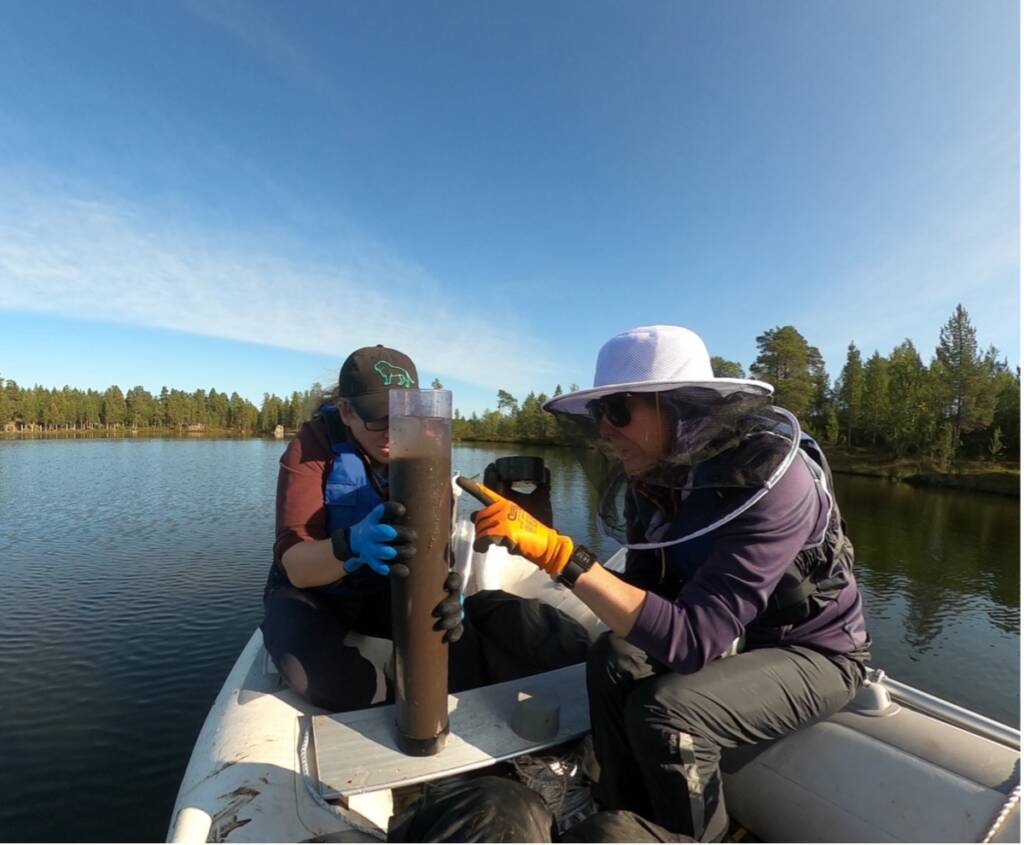
Click on an image to expand
Image Captions
Winter lake coring in northern Finland,Summer lake coring in northern Norway
Methodology
The project focuses on the application of geochemical techniques to reconstruct past reindeer activity and environmental change using lake sediments. Fieldwork in northern Norway and Finland will involve surveying lake study sites, measuring lake water physicochemical properties and recovering sediment cores for Holocene palaeoenvironmental reconstruction. Sediment cores will be characterised using techniques including loss-on-ignition (LOI) and X-ray fluorescence (XRF) scanning, and independently dated using radiocarbon (14C) and lead-210 (210Pb) dating. Existing sediment cores provide material for initial analyses and ensure that the core research objectives can be achieved independently of new fieldwork.
A key component of the project will involve developing and testing faecal lipid biomarkers as indicators of past reindeer activity. The student will undertake modern calibration studies using reference materials and environmental samples, alongside the analysis of sterols and bile acids preserved in lake sediments (e.g., Mackay et al., 2026). These analyses will be complemented by plant wax n-alkanes to investigate vegetation change, with opportunities to use compound-specific hydrogen isotope analyses to explore past hydroclimatic variability (McClymont and Mackay et al., 2023). By comparing independently dated records of reindeer activity, vegetation change and hydroclimatic variability, the project will assess the timing and relationships between these processes, helping to distinguish climate-driven ecosystem change from changes associated with herbivore activity.
High-resolution elemental and pigment analyses using laser-induced breakdown spectroscopy (LIBS) and hyperspectral imaging will provide complementary evidence of changes in lake biogeochemistry. These approaches will be used to investigate changes in sediment geochemistry and photosynthetic communities, including algal and bacterial pigment signatures, helping to assess how lake ecosystems have responded to changing herbivore activity and climate variability.
Depending on the direction of the project, there will also be opportunities to incorporate additional palaeoenvironmental approaches, such as glycerol dialkyl glycerol tetraethers (GDGTs) for investigating past temperature variability, or sedimentary ancient DNA and other palaeoecological indicators to investigate vegetation and animal presence.
The PhD will be undertaken in collaboration with international research partners in Norway, the Netherlands and the USA offering opportunities for collaborative Arctic fieldwork, research visits and knowledge exchange. The student will benefit from expertise spanning organic geochemistry, palaeoecology and Arctic environmental change, with opportunities to shape aspects of the research according to their interests. Full training in fieldwork, laboratory techniques and data analysis will be provided by the supervisory team and collaborators.
Project Timeline
Year 1
• Literature review and production of a PhD work plan.
• Design of fieldwork sampling strategy.
• Fieldwork in Fennoscandia and collaboration with international partners.
• Training in geochemical analysis techniques using samples collected in year 1.
Year 2
• Geochemical analysis of sediment core samples
• Attendance at national conference
• Begin writing of thesis and papers
Year 3
• Finalise laboratory work
• Attendance at international conference to share findings
• Communication of project outcomes with local stakeholders
• Continue writing of thesis and papers
Year 3.5
• Completion of thesis writing.
• Thesis submission and preparation / submission of papers.
Training
& Skills
This project will develop cross-disciplinary, transferable skills in problem solving, project management, experimental design, data analysis and visualisation and report writing.
Specialist skills will be developed in:
• Laboratory analyses: training will be provided on sediment core logging, 14C and 210Pb dating, XRF scanning and lipid biomarker extraction, processing and analysis at Durham University state-of-the-art research laboratories.
• Computational/statistical analyses: Training in computer programming in R for data visualisation and statistical analyses is provided at Durham University.
• Field techniques: training in lake surveying and coring with opportunities for Arctic fieldwork experience depending on student interest. The project success does not depend on fieldwork since cores are already available for analysis.
The candidate will also benefit from broad skills training provided in-house at Durham (e.g. science communication, thesis writing, writing for grants and publications, presentation skills) via the Geography Department and the award-winning Career and Research Development (CAROD) group. Furthermore, a broad range of cohort-based training in environmental science and science communication is provided within the Iapetus Doctoral Training Partnership. Training requirements of the individual will be identified and met through the development of a personal training plan.
Regular participation in Durham’s Physical Geography weekly research group meetings and seminar series will further support the student’s development as an independent, well-connected researcher.
References & further reading
Bostedt, G., Johannesen, A.B., Sandorf, E.D., and Helgesen, I.S. 2025, Cumulative worries in Sápmi—the interplay between climate change and other threats to reindeer herding in Sweden and Norway. Regional Environmental Change 25, 2, 53. DOI: https://doi.org/10.1007/s10113-025-02380-2
Laptander, R., Horstkotte, T., Habeck, J.O., Rasmus, S., Komu, T., Matthes, H., Tømmervik, H., Istomin, K., Eronen, J.T., and Forbes, B.C. 2024, Critical seasonal conditions in the reindeer-herding year: A synopsis of factors and events in Fennoscandia and northwestern Russia. Polar Science 39, 101016. DOI: https://doi.org/10.1016/j.polar.2023.101016
Mackay, H., Whelton, H., Reuther, J., Potter, B., Edwards, M., Henderson, A., Bull, I., Baldwin, E., Clarke, C., Mayfield, R., Davies, K., van Hardenbroek, M., and Bigelow, N. 2026, Testing the limits of lacustrine faecal lipid biomarkers as tools to document human and herbivore presence in Alaskan and Eastern Beringian landscapes. Quaternary Science Reviews 391, 110193. DOI: https://doi.org/10.1016/j.quascirev.2026.110193
McClymont, E.L., Mackay, H., Stevenson, M.A., Damm-Johnsen, T., Honan, E.M., Penny, C.E., and Cole, Y.A. 2023, Biomarker proxies for reconstructing Quaternary climate and environmental change. Journal of Quaternary Science 38, 7. 991-1024. DOI: https://doi.org/10.1002/jqs.3559
Rosqvist, G.C., Inga, N. and Eriksson, P. 2022, Impacts of climate warming on reindeer herding require new land-use strategies. Ambio 51, 1247-1262. DOI: https://doi.org/10.1007/s13280-021-01655-2
