

IAP-26-123
Plastic pathways: heavy metal uptake and transport by microplastics in the environment
Microplastic pollution is a persistent environmental challenge, connecting rivers, estuaries and oceans through the movement and accumulation of plastic particles. These plastics can accumulate pollutants, including heavy metals, particularly as they weather and become coated with algae and other microorganisms. Buoyant particles can carry pollutants over considerable distances, spreading contamination beyond its original source, and potentially entering the food chain if consumed by wildlife. Understanding how plastics acquire, transport and release pollutants is therefore important for assessing the wider consequences of microplastic pollution.
Understanding this problem is often complicated as environmental microplastics typically have unknown origins and exposure histories, making it difficult to distinguish the effects of time and local conditions on their pollutant uptake. The July 2026 nurdle spill in the River Tyne (www.tynenurdles.org.uk) provides an opportunity to examine these relationships following a large release (850 million pellets) with a known location and timing, into a river that is heavily contaminated by legacy mining waste.
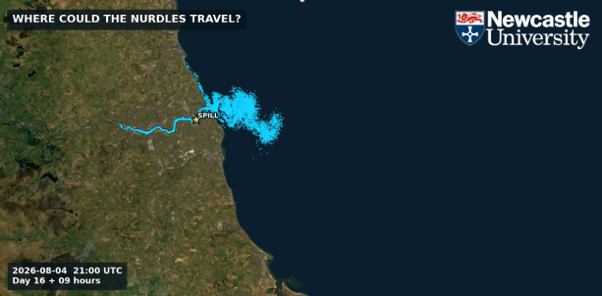
The project will combine field monitoring, numerical modelling and laboratory experiments to investigate the dispersal, retention and remobilisation of nurdles, alongside changes in their associated heavy metals. Repeated sampling across the estuary and surrounding coastline will establish how pellet distributions and metal burdens evolve. Dispersal modelling will help reconstruct plausible exposure histories and identify environments where prolonged retention or repeated remobilisation may influence metal accumulation.
Complementary laboratory investigations will examine how weathering, biofilms, mineral coatings and changing water chemistry control metal uptake and release. Comparisons between nurdles and selected microplastic fragments and fibres will test whether relationships identified following the spill extend to particles with different compositions, sizes and shapes.
By linking microplastic transport with contaminant exchange, this research will establish when and where microplastics retain or redistribute heavy metals, and assess the significance of this pathway relative to natural particles and sediments. The findings will improve understanding of the long-term consequences of plastic pollution and provide evidence to guide environmental monitoring and responses to future spills.
Click on an image to expand
Image Captions
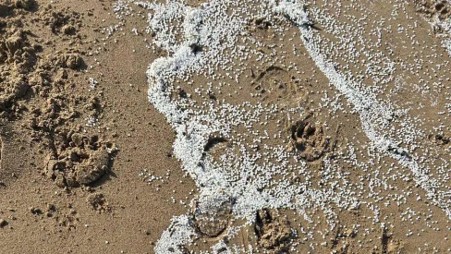
A numerical model output of nurdle distribution following the July 2026 spill in the River Tyne,Tyne nurdle pollution washed up on local beaches (BBC News Story: https://www.bbc.co.uk/news/articles/cr1exn58w70yo)
Methodology
This project offers the opportunity to combine coastal fieldwork, specialist laboratory analysis and numerical modelling to investigate how plastics carry heavy metals through aquatic environments. Nurdles from the Tyne spill will form the main focus because their identifiable source and known release date provide a valuable starting point for investigating changes through time. You will also explore other microplastics and larger plastic debris where their origin or release history can be established with reasonable confidence, testing how widely the findings apply.
Through repeated surveys of the Tyne estuary and surrounding coastline, you will investigate where nurdles accumulate, how long they remain, and what causes them to move again. Sampling will use international standards and cover contrasting environments, including beaches, mudflats and sheltered areas, with additional surveys following major floods or storms. The student will then have the opportunity to feed their data back into international databases. By analysing recovered pellets alongside water and sediment, you will explore how their metal burdens change through time and identify the environmental conditions associated with these changes. Existing observations and archived samples, where available, will help extend the record back towards the spill.
Working with UKCEH’s Microplastics Analysis Facility, you will learn techniques for identifying plastics and examining how their surfaces change in the environment. You will use laboratory methods to help you pose and answer questions such as: Do weathered particles carry more metals? What role do algae, other microorganisms and mineral coatings play? Controlled laboratory experiments will then investigate how particle characteristics and water/sediment conditions influence metal uptake and release.
You will bring these findings together with hydrodynamic and particle-tracking modelling, building on existing work to explore how currents, river flows and storms influence nurdle dispersal. Comparing simulations with field observations will help identify likely transport pathways and areas of prolonged retention. You will then test whether combining these estimated exposure histories with laboratory measurements improves our ability to explain metal burdens on recovered plastics. Together, these approaches will connect the journeys of plastic pollution with its changing capacity to carry and release heavy metals.
Project Timeline
Year 1
Explore the literature on plastic dispersal and heavy metal uptake, and develop skills in field sampling, microplastic identification, metal analysis and numerical modelling. Bring together existing Tyne observations and archived samples, establish monitoring sites and begin seasonal surveys. Initial analyses and pilot experiments will refine the research questions and identify suitable additional plastics with documented provenance.
Year 2
Continue field monitoring to capture seasonal changes and redistribution following floods or storms. Analyse changes in nurdle metal burdens and surface characteristics. Undertake laboratory experiments with UKCEH to investigate nurdle properties, and at Newcastle to understand how weathering, biological growth and water conditions influence metal uptake and release.
Year 3
Complete targeted field sampling and laboratory experiments, extending comparisons to other plastics where suitable material is available. Combine experimental results with modelled transport histories to explain patterns in metal accumulation and release. Assess how widely the findings apply beyond the Tyne spill. Present results at an international conference and develop manuscripts and thesis chapters.
Year 3.5
Finalise and submit the thesis and prepare manuscripts for publication. Share findings with organisations involved in environmental monitoring and spill response.
Training
& Skills
This studentship will provide interdisciplinary training in plastic pollution, environmental chemistry and aquatic transport processes. Training will build on your existing strengths, supporting you to develop expertise across field monitoring, laboratory experiments and numerical modelling.
Through fieldwork in the Tyne estuary and surrounding coastline, you will learn to design sampling programmes, collect and handle environmental samples, and assess changes in plastic distributions through time. You will receive training in safe field practice, representative sampling and contamination control. Depending on your own interests, you may have the opportunity to pursue a Royal Yachting Association Safety Boat qualification for boatwork, or a Civil Aviation Authority qualification for drone-based work.
Working with UKCEH’s Microplastics Analysis Facility, you will develop skills in plastic identification and characterisation using vibrational spectroscopy techniques including Fourier Transform Infra-Red (FTIR) and Quantum Cascade Laser infra-red (LDIR) microscopy. Complementary training at Newcastle in trace-metal analysis, experimental design and analytical quality assurance will support your investigation of metal uptake and release.
Alongside specialist training, university courses and relevant IAPETUS and NERC workshops will support your development in scientific writing, communication and project management. Presenting at conferences and engaging with organisations involved in environmental monitoring and spill response will help you build professional networks and communicate research beyond academia. These experiences will equip you for careers in environmental research, consultancy, monitoring and regulation.
References & further reading
• Project Website: https://tynenurdles.org.uk/
• Lee, A., Mondon, J., Merenda, A., Dumée, L.F. & Callahan, D.L. (2021). Surface adsorption of metallic species onto microplastics with long-term exposure to the natural marine environment. Science of the Total Environment, 780, 146613.
• Holmes, L.A., Turner, A. & Thompson, R.C. (2014). Interactions between trace metals and plastic production pellets under estuarine conditions. Marine Chemistry, 167, 25–32.
• Rochman, C.M., Hentschel, B.T. & Teh, S.J. (2014). Long-term sorption of metals is similar among plastic types: implications for plastic debris in aquatic environments. PLOS ONE, 9(1), e85433.
• Richard et al. (2019). Biofilm facilitates metal accumulation onto microplastics in estuarine waters. Science of the Total Environment, 683, 600–608.
• Cross, R.K. et al. (2025). Ensuring representative sample volume predictions in microplastic monitoring. Microplastics and Nanoplastics, 5.
