

IAP-26-124
Physics, biology and microbial ecology of toxic plankton blooms
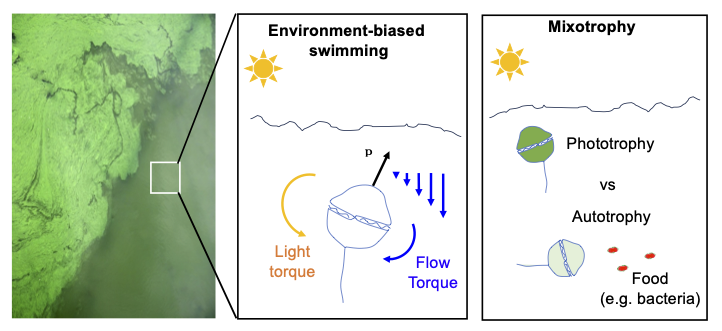
Marine microalgal populations can grow explosively giving rise to plankton blooms. This has important ecological consequences: bloom biomass can stimulate life across the food web; however, blooms can also be harmful (Smayda, 2019). Each year, toxin-producing Harmful Algal Blooms (HABs) kill vast numbers of animals (including fish and mammals), with substantial health and economic impacts on human society, including major losses in the aquaculture sector (Gianella et al. 2025). In addition, climate induced changes in environmental conditions, such as nutrient availability and water temperature, have made toxic HABs more frequent. Despite recent progress, toxic HABs remain poorly understood and hard to predict (Flynn & McGillicuddy, 2018). Conditions favourable to growth, e.g., nutrients, temperature and light, are necessary but not sufficient for bloom genesis and spatio-temporal evolution (Paerl, 1988). The vast majority of toxic HAB formers belong to a group known as dinoflagellates, which swim by means of flagella and have flexible feeding strategies switching between photosynthesis and predation. Swimming, particularly in calmer waters, can be biased by environmental factors (nutrient gradients, light levels) leading to competitive advantage and the potential to dominate blooms. However, current studies treat swimming simplistically, without accounting for recent progress in the physics of microswimmers, such as dinoflagellates. In the last four decades, enormous progress has been made in this area of biophysics (Bees & Croze 2014, Elgeti et al. 2015, Ishikawa et al. 2025). However, only recently are the ecological implications of the physics swimming, and its bias by environmental cues, beginning to be explored (Grunbaum, 2009). For example, it has been shown that ‘thin plankton layers’ in the ocean arise when biased swimming algae, including the HAB former Heterosigma asakiwo, get trapped in the strong flow shear which characterises these layers (Durham et al. 2009, Durham and Stocker 2012). In this interdisciplinary project you will combine state of the art biophysics, theoretical and experimental, with algal physiology and ecotoxicology to elucidate the mechanisms of toxic HAB formation. You will work with Karenia mikimotoi – a HAB dinoflagellate of increasing global concern (Li et al. 2019). This dinoflagellate has been shown to migrate vertically in the water column, getting trapped in salinity gradients (Gentien 2007). It also has been shown to feed on bacteria and other microalgae (Zhang et. al. 2011). You will investigate its biophysics, biology and ecotoxicology, which remain largely unexplored. Through a combination of lab-based studies and controlled marine environments (microcosms) you will investigate how light and nutrient availability shape K. mikimotoi blooms and their toxic content. You will also study the link between motility and mixotrophy, the ability of toxic algae to switch between photosynthetic growth and other types of nutrient acquisition (e.g. feeding on bacteria). This has not previously been investigated. The project aims to contribute to a mechanistic understanding of toxic plankton blooms, leading to more accurate forecasting by mathematical models, informed by remote sensing data, which will also be available as part of the modelling element of the project.
Click on an image to expand
Image Captions
Image showing a Karenia mikimotoi bloom and an illustration of how these dinoflagellates respond to environmental clues (taxes) and can switch between photosynthetic and predatory growth (mixotrophy)
Methodology
• Advanced microscopy (including differential dynamic microscopy) to characterise the motility of dinoflagellates and their ‘taxes’, biased responses towards light and other environmental cues
• Microfluidics to quantify chemotaxis to nutrients and access to prey
• Quantitative macroscopy to chart the migration of dinoflagellates in lab-based millifluidic devices (cuvettes)
• Migration in microcosms will be quantified by macro imaging of the water surface, plus samples of the population density measured by calibrated optical density
• The growth and health of the microalgae in various nutrient regimes will be characterised by growth assays and Fv/Fm measurements
• Toxic chemicals will be characterised by LCMS
• Agent based and continuum models will be used to predict microalgal migration in response to environmental taxes
• AI methods, including Bayesian inference, to facilitate model and experiment comparison, and assist with model predictions
Project Timeline
Year 1
Year 1 work will be largely lab-based involving:
• Characterisation of Karenia mikimotoi growth, both phototrophic and mixotrophic simultaneously to photosynthetic health
• Measurement of toxin production in various stages of growth
• Determination by advanced microscopy of the biased swimming of Karenia to light (phototaxis), chemicals (chemotaxis) and bacteria (bacteriotaxis), and measurement of key taxis parameters.
• Development of an agent-based model of bloom formation, and test in the lab using artificial intelligence to facilitate model-experiment comparisons and assist with bloom model predictions
• Draft 1st paper on lab-based studies and initial model
Year 2
Year 2 work will involve:
• Scaling up the artificial blooms to microscosms (square ponds)
• Quantification of blooms by top-view imaging measuring algal accumulation and depth sampling to obtain the population depth profile
• Adaptation of the model to describe the microcosms (addition of fluid flow and temperature gradients).
Year 3
Year work 3 builds on years 1 and 2, allowing:
• Model testing using microcosm data, and enhancement to describe environmental blooms. Use artificial intelligence to facilitate model-experiment comparisons, and enhance predictions
• Use aerial and satellite data to check the model predictions and explore opportunities to incorporate findings into existing K. mikimotoi bloom development and transport models.
• Draft 2nd and 3rd papers on microscosm theory and experiments, and bloom prediction models
• In this year you should also be looking for opportunities beyond the PhD
Year 3.5
In year 3.5, you will be writing your thesis and doing minor amounts of further analysis of to refine your presentation of results.
Training
& Skills
• School of Mathematics, Statistics and Physics and Newcastle University training: Health and Safety. Skills: How to write a literature review, Unix shell, github, etc.
• Culture training visit to the Culture Collection of Algae and Protozoa in Oban, Scotland. Skills: learn how to culture and maintain dinoflagellate cultures.
• Visit to Plymouth Marine Laboratory to explore whether project findings can be used to improve the predictive power of the S3 EUORHAB (https://pml.ac.uk/news/blooming-algae-off-the-south-west-coast/)
• Integration with the Sonic Intangibles programme (https://sonicintangibles.github.io/). Expertise: explore sonification of swimming data as an additional path for dissemination.
References & further reading
Bees MA, Croze OA. 2014. Mathematics for streamlined biofuel production from unicellular algae. Biofuels 5:53–65
Durham, WM et al. 2009. Disruption of vertical motility by shear triggers formation
of thin phytoplankton layers. Science, 323:1067–1070
Durham, WM & Stocker, R. 2012. Thin phytoplankton layers: characteristics, mechanisms, and consequences. Ann Rev Mar Sci 2012:4:177-207.
Elgeti J et al, 2015. Physics of microswimmers—single particle motion and collective behavior: a review 2015 Rep. Prog. Phys. 78 056601
Flynn, KJ and McGillicuddy, D.J. (2018). Modeling Marine Harmful Algal Blooms: Current Status and Future Prospects. In Harmful Algal Blooms (eds S.E. Shumway, J.M. Burkholder and S.L. Morton).
Garnier, S et al. 2016. Individual-based modelling of the development and transport of a Karenia mikimotoi bloom on the North-west European continental shelf. Harmful Algae, 2016 53, 118-134.
Gentien, P et al. 2007. Phil. Trans. R. Soc. 362 (1487): 1937–1946 .
Gianella, F et al. 2025. Risk assessment of harmful algal blooms in salmon farming: Scotland as a case study. Toxins, 17, 35.
Ishikawa, T et al. 2025. Physics of microbial taxis and behaviours in response to various physical stimuli, Philosophical Transactions of the Royal Society A, 383, 20240 264
Grunbaum, D 2009 Peter principle packs a peck of phyto-plankton. Science, 323(5917):1022–1023, 2009.
Li, X et al. 2019. A review of Karenia mikimotoi: Bloom events, physiology, toxicity and toxic mechanism. Harmful Algae 90, 101702
Paerl, HW. 1988. Nuisance phytoplankton blooms in coastal, estuarine and inland waters. Limnol. Oceanogr., 33:823–847.
Smayda, T. 2019. Global Epidemic of Noxious Phytoplankton Blooms and Food Chain Consequences in Large Ecosystems. In Food Chains, Yields, Models, and Management of Large Marine Ecosoystems; Routledge: London, UK, 2019.
Zhang, Q et al. 2011 Will harmful dinoflagellate Karenia mikimotoi grow phagotrophically?. Chin. J. Ocean. Limnol. 29, 849–859
