

IAP-26-090
How hot is my plant? Modelling global warming effects at the plant level
Aim:
This project seeks to improve our understanding of the impact of global warming on plants in different microclimates, model the result of potential mitigation through rewilding, predict the effect on their genomes, and better link laboratory research to ecologically relevant processes.
Background:
Plants are sessile organisms, and so are highly exposed to environmental variability. This includes the seasonal changes that an individual plant will experience through its life, plus the high variance in different microclimates that genetically-closely related plants may germinate in after seed dispersal.
For example, the self-fertile weed thale cress (Arabidopsis thaliana) may grow on unshaded beaches in full sun, at path edges under high woodland canopy, on exposed rock faces, on molehills, or in field margins surrounded by tall competing grasses; and moderates its life cycle accordingly. Plant phenology has therefore evolved to be highly flexible, taking cues from light and temperature to match their development both to the seasons and their local microclimate, avoiding drought and extreme heat while maximising fitness.
These processes are well studied in laboratory conditions, where the entire plant will be kept at constant temperatures that are the same from root-to-shoot, and with low lighting. However, these temperatures are not representative of the actual ecology and temperature experience of the plants (1); roots are sheltered underground from temperature fluctuations while leaf temperature is strongly affected by sunlight. So, “how hot is my plant?”
While understanding of plant temperature responses is excellent at the small – gene – scale and poor at the larger – ecological niche – scale, understanding of climate is the opposite. Many global warming estimates are projected across large geographic scales and based on weather stations situated well above ground in full sun, while plants live in microclimates at ground level. However, recent advances in modelling climate at the microscale allows increased precision in both understanding present, and forecasting future microclimates (e.g. 2,3). This allows us to ask – “how hot is my plant going to get?”.
Objectives:
This project will take detailed measurements of plant temperature in different ecological contexts across the plant body (roots, leaves and flowering shoots) in plants around Durham and common garden experiments in Durham Botanic Garden, and controlled environments at Glasgow. A selection of plants from the ‘1001 genomes’ collection (4), a unique panel of seed from wild plants of the same species from latitudes varying from the equator to near the Arctic Circle, from North America to Japan, will be grown in the common garden to assess their fitness and phenological responses. These will be compared with laboratory experiments on plants kept in a range of controlled climates to precisely model the effect of incident light and air temperature on plant temperature (5). This plant-level model will then be combined with microclimate reconstruction techniques to predict the precise temperature experience of the parents of the ‘1001 genomes’ collection across their global and temporal distribution. Genome-Wide-Association Studies will be used to identify genomic regions selected for survival and phenological traits in the past (at collection time of the accessions), and predict these for future climate scenarios, including investigating the potential effect of rewilding and climate-driven microclimate change. Overall, the project will define how past and future microclimate will affect the genomic composition of a globally distributed wild plant at the local scale.
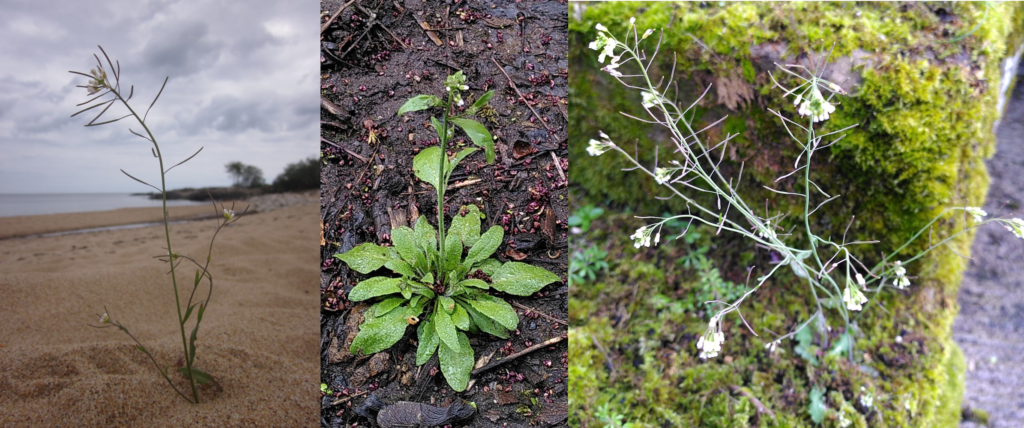
Click on an image to expand
Image Captions
Wild Arabidopsis thaliana, (c) Jo Hepworth
Methodology
The methodologies will exploit the expertise of the three collaborating research groups: Dr Hepworth will provide training in molecular genetic control of flowering in response to climate and Genome Wide Association Studies; Dr Antoniou-Kourounioti will provide their expertise on plant temperature responses and mathematical modelling; while Dr Senior will supervise the student on microclimate reconstruction, ecological niches and rewilding. Dr Hepworth and Dr Antoniou-Kourounioti have experience in working together on controlled environment and common garden experiments, investigating phenology in response to temperature and field conditions (5). With them the student will exploit the excellent light-control facilities at Glasgow and the Botanic Garden at Durham. Meantime, they will benefit from Dr Senior’s experience in studying the effect of different canopy structures and ecological niches to learn about how plants affect the microclimate around them, and how temperature constrains different species (2,3).
Project Timeline
Year 1
In the first year the student would select a small (<10), geographically diverse set of Arabidopsis thaliana accessions, and subject these to different microclimate regimes in controlled conditions. They would measure temperatures across the plant with ultra-fine wire thermocouples to assess the effect of high incident light, far-red enriched shade (plant-mimicking plant shade), higher humidity, etc. This will be used to generate a precise map of plant internal temperature in response to microenvironment, and match this to the phenology and fitness of the plants. In parallel, the student would work with Dr Senior to reconstitute temperature profiles for the collection sites and dates of the ‘1001 genomes’ Arabidopsis panel from around the world, and match this to ‘in situ’ phenology data. This will allow them to correlate phenology to the microclimate in which the plants evolved, and use genome-wide-association studies to identify genomic regions associated with local temperature much more accurately than previous attempts using BioClim statistics.
Year 2
In following year the student would test these predictions by choosing a large subset of the 1001 genomes accessions and grow these in a common garden experiment at Durham’s Botanic Garden, measuring their phenology and fitness, and including parallel experiments in which the microclimate is artificially changed in field (for example, by shading). The student will monitor plant temperature within the garden, and for selected plants that grow naturally around the Durham University estate, allowing them to iteratively improve their temperature model.
Year 3
The common garden experiment would be repeated the following year for robustness. Meanwhile, the project would explore the genetics underlying fitness responses in particular microclimates, e.g. via in-field expression of known temperature-responsive genes. The optimised models of plant temperature, microclimate and genomic response would be used to forecast population genetic and phenological change, asking questions such as:
Are plants likely to change niche (e.g. from sunny spots to shade) with climate change?
How is phenology in different microclimates likely to change with global warming?
How could conservation efforts such as rewilding, which substantially change local microclimates, affect plant phenology and local population genetics?
Year 3.5
The final six months would be dedicated to data analysis as the student compiles their thesis and prepares publications.
Training
& Skills
This project will provide the student with comprehensive practical and theoretical training in evolutionary plant biology, from field observation and common garden experimentation to population genomics and gene expression, suitable for a wide range of biological and ecology-based roles. The bioinformatics and modelling training will be highly transferable to a range of scientific or commercial data acquisition and analysis roles.
References & further reading
1) Arana & Picó, 2025. Advancing ecological and evolutionary research in Arabidopsis: Extending insights into model and nonmodel plants https://doi.org/10.1093/plcell/koaf151
2) Lembrechts et al., 2020. SoilTemp: A global database of near-surface temperature. https://doi.org/10.1111/gcb.15123
3) Klinges et al… Senior. 2025. A workflow for microclimate sensor networks: Integrating geographic tools, statistics, and local knowledge. https://doi.org/10.1016/j.ecoinf.2025.103376
4) 1001 Genomes Consortium, 2016. 1,135 Genomes Reveal the Global Pattern of Polymorphism in Arabidopsis thaliana. https://doi.org/10.1016/j.cell.2016.05.063
5) Hepworth et al. 2020. Natural variation in autumn expression is the major adaptive determinant distinguishing Arabidopsis FLC haplotypes. https://doi.org/10.7554/eLife.57671
