

IAP-26-089
A nitrogen cycle inside a plant: do ants or microbes feed ant-farmed epiphytes?
Background
Nitrogen limits plant growth in rainforest canopies, where epiphytes grow without soil. Some species have solved this problem by recruiting ants. In Fiji, Squamellaria epiphytes (Rubiaceae) are farmed by the ant Philidris nagasau, which plants their seeds, defends them, and fertilises them by defecating on absorptive warts inside the hollow chamber (domatium) in which the colony lives (Fig. 1) [1-4]. The warts absorb ant-derived nitrogen at rates that no free-living plant matches (Fig. 1c) [5]. Epiphytes feeding on ant waste were first documented three decades ago [6], yet what happens to the nitrogen between the ant’s gut and the plant’s cells has never been resolved, in this or any other ant-plant.
Even the form in which the ants deliver this nitrogen is unknown. Our unpublished genomes and transcriptomes suggest that the plant is equipped to take up several forms. Farmed species have partly lost CIPK23, the kinase that brakes ammonium uptake in other plants [7], and their warts express nitrate and purine transporters at high levels. Ammonium and purines could be absorbed straight from ant waste, whereas nitrate is most likely produced by microbes that oxidise ant-derived nitrogen on the warts. The plant may therefore be fed not only by its ants but also by microbes living on their waste, through a nitrogen cycle that runs inside a single plant organ.
This project asks whether the plant feeds on the ants’ waste itself or on what microbes make of it. It will address this question at three levels, from the chamber to the living plant to its genome.
Objective 1: Identify the forms of nitrogen that reach the warts and the microbes that transform them, using chemical profiling, metagenomics and metatranscriptomics.
Objective 2: Trace which forms the plant takes up, whether uptake depends on the microbes and how much nitrogen escapes as nitrous oxide, using ¹⁵N labelling of the living symbiosis.
Objective 3: Test whether the route that feeds the plant has shaped its genome, by asking which transporter families track the repeated gains and losses of ant farming across the Hydnophytinae.
Together, these objectives will establish who feeds an ant-farmed plant, its ants or the microbes living on their waste, and whether the answer is written in its genome.
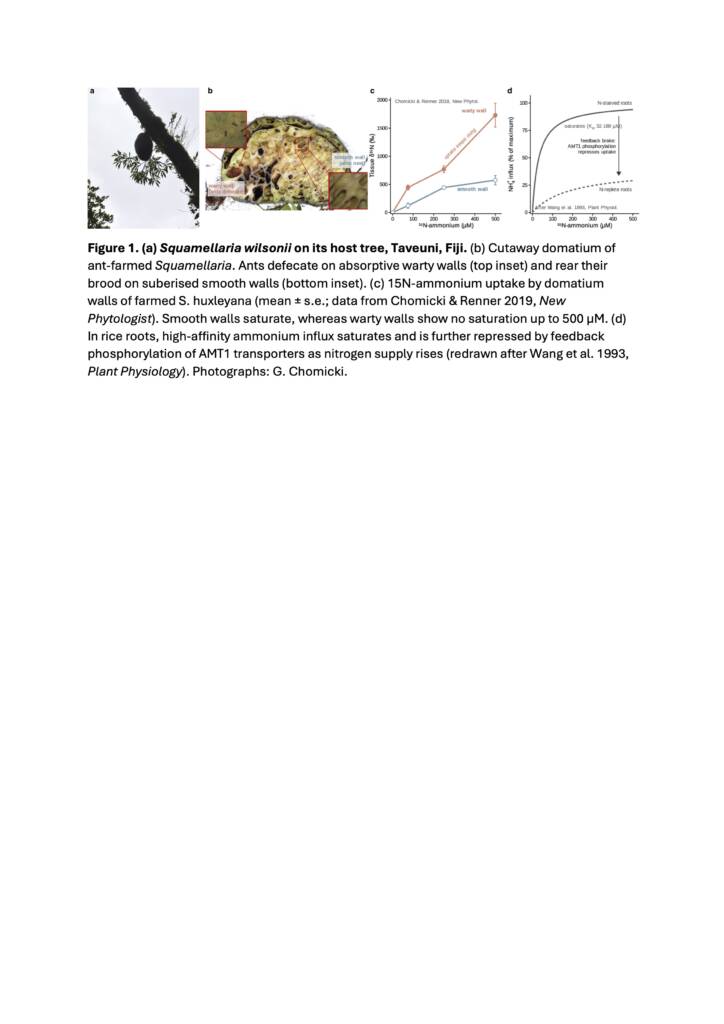
Click on an image to expand
Image Captions
Photographs: G. Chomicki.
Methodology
For Objective 1, you will quantify ammonium, nitrate, urea, uric acid and amino acids in fresh ant waste and on the wart surface, to establish what the ants deliver and what the microbes make of it. You will recover metagenome-assembled genomes from our existing shotgun metagenomes of warty walls, smooth walls and ants of Squamellaria imberbis, annotate their nitrogen pathways (uric acid and urea degradation, ammonia and nitrite oxidation, denitrification) and place the novel lineages phylogenetically. Fieldwork on Taveuni and Vanua Levu in year 2 with M.T. at the South Pacific Regional Herbarium will extend the comparison to four to six farmed and unfarmed Hydnophytinae, and metatranscriptomics of the best-replicated species will show which pathways are active.
For Objective 2, you will trace ¹⁵N through the symbiosis reconstituted in the Durham glasshouse and in the field, measuring the label in plant tissue by isotope-ratio mass spectrometry, following [2,5]. Feeding ant colonies ¹⁵N-labelled food will measure how much ant-derived nitrogen reaches the plant, and applying ¹⁵N-labelled uric acid, ammonium and nitrate directly to the warts, with and without nitrification inhibitors and antibiotics, will show which forms the plant takes up and whether uptake depends on the microbes. Headspace sampling of domatia for nitrous oxide will measure how much nitrogen escapes.
For Objective 3, you will use our comprehensive genomic resources for the Hydnophytinae, which include reference genomes across the radiation and population resequencing of S. imberbis and P. nagasau, to test whether the purine, nitrate and ammonium transporter families and the CIPK23 brake show selection, copy-number change or loss that tracks the gains and losses of ant farming. Selection on purine transporters would point to plants evolving to feed on ant waste directly, and selection on nitrate transporters to plants evolving to feed through microbes. The polymorphism-aware phylogenetic models developed by C.K. [8,9] connect selection within populations to divergence between species, exactly the two timescales this question spans.
All sequence analyses will run on Durham’s supercomputer Hamilton. Sequencing beyond the RTSG is funded by G.C.’s UKRI Frontier Research Grant.
Project Timeline
Year 1
Bioinformatics and HPC training. Chemical profiling of ant waste and wart surfaces, and metagenome-assembled genomes and nitrogen-pathway inventory from the existing S. imberbis metagenomes (Objective 1), written up as a first chapter and publication. ¹⁵N experiments with labelled ant food and with uric acid, ammonium and nitrate applied to the warts, inhibitor and antibiotic treatments and nitrous oxide pilots (Objective 2).
Year 2
Fieldwork in Fiji (Taveuni and Vanua Levu): sampling of four to six species, field 15N and N2O measurements (Objectives 1 and 2). DNA and RNA extraction and sequencing. Start of the comparative and population-genomic analyses with C.K. (Objective 3).
Year 3
Cross-species metagenomes and metatranscriptomes analysed and written up with the isotope data as the second chapter and publication (Objectives 1 and 2). Genome-evolution analyses completed and written up as the third chapter and publication (Objective 3).
Year 3.5
Thesis and publication writing.
Training
& Skills
The supervisory team combines expertise in mutualism evolution, genomics and field ecology (G.C.) with population and phylogenetic genomics (C.K.). You will be trained in bioinformatics, specifically, metagenome assembly and annotation, comparative and population genomics, but also stable-isotope tracing and isotope-ratio mass spectrometry, tropical fieldwork, experimental work with a living ant-plant symbiosis, statistics in R, and use of Durham’s supercomputer Hamilton. You will be trained in field botany by G.C. and M.T. You will benefit from the Chomicki lab, which currently includes six members with a wide range of skills, and from the bioinformatics expertise of the Kosiol group at St Andrews.
References & further reading
1. Chomicki G. & Renner S.S. (2016). Nature Plants 2:16181.
2. Chomicki G. & Renner S.S. (2019). New Phytol. 223:2011-2023.
3. Chomicki G., Kadereit G., Renner S.S. & Kiers E.T. (2020). Proc. Natl. Acad. Sci. USA 117:2535-2543.
4. Campbell L.C.E. et al. (2023). Trends Plant Sci. 28:271-282.
5. Chomicki G. et al. (2025). Science 389:151-156.
6. Treseder K.K. et al. (1995). Nature 375:137-139.
7. Straub T. et al. (2017). Plant Cell 29:409-422.
8. Schrempf D. et al. (2019). Mol. Biol. Evol. 36:1294-1301.
9. Borges R. et al. (2019). Genetics 212:1321-1336.
