

IAP-26-060
Bizarre Love Triangle: the interaction between sex, parasites, and predators in an aposematic insect.
Animals face many contrasting challenges in the wild. They must avoid predators, find food, find mates, cope with competitors, and deal with varying environmental conditions. Typically, though, we tend to study such challenges in isolation, looking individually at the role of climate change, or sexual selection, or anti-predator behaviour for example. Partly this is for convenience, and partly this is to allow us to perform specific experiments, controlling for other ecological or behavioural variables. However, it is becoming clear that understanding how species will respond ecologically and evolutionarily to challenges such as anthropogenic climate change requires multi-factorial approaches. This is particularly true for one crucial component of such responses, the extent to which natural selection and sexual selection align or act in opposition to one another. Put simply, will sexual selection help animals adapt to changing environments, will it hinder adaptive evolutionary responses?
In this project, the successful candidate will work on a system that allows us to consider several sources of natural and sexual selection at once: the aposematic seed bug Spilostethus pandurus. Aposematism is the production of warning colours, smells, or secretions, that warn potential predators that the animal is chemically defended and so a bad choice as a meal. As with many toxic insects, Spilostethus sequesters chemical defences from its food and displays classic black-and-red coloration warning of its toxicity. Aposematism is favoured by natural selection, reducing predation, in this case by avian predators. However, at our field-sites in Sicily, Spilostethus is also attacked by several species of parasitoid fly, that lay their eggs on the bugs, before the fly larvae hatch and burrow into the insect and then consume the bug from the inside (sometimes not fatally, amazingly enough). Anecdotal evidence suggests that parasitism reduces the intensity of the bug’s warning colouration, reducing their anti-predator defences. Finally, we have recently shown that colouration is under sexual selection in both males and females, in a way that appears to align with the natural selection expected from bird predation. However, we do not yet know how parasitism influences mating success, in tandem with, or independently of, the effects on bug colouration.
This project will therefore explore how parasitism influences patterns of natural and sexual selection on colouration and overall reproductive success, using both laboratory and field experiments in St Andrews and Sicily. We will also use field and laboratory experiments to look at the roles of chronic versus acute temperature stress on parasitism, mating, and fertility. Together, these experiments will generate an exemplar study of how different ecological and evolutionary processes interact to shape reproductive success in a warming world.
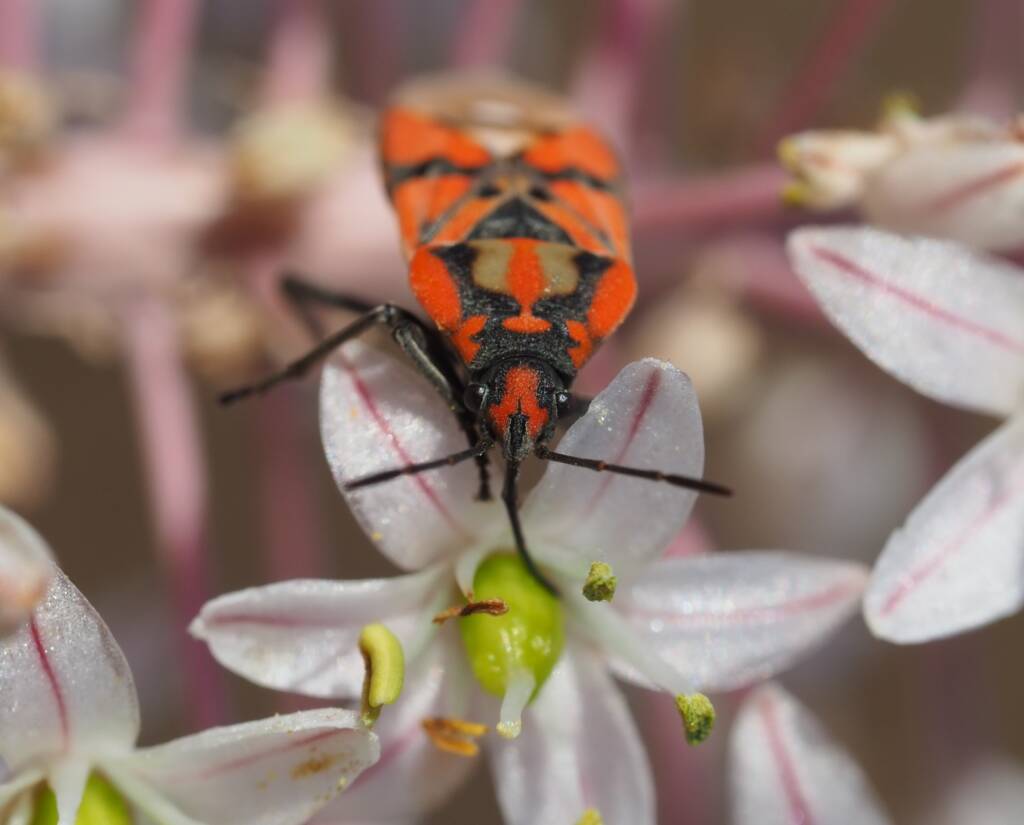
Click on an image to expand
Image Captions
Ophelia Fritsch (IAPETUS-funded PhD student, University of St Andrews)
Methodology
This project will involve a range of research methods, spanning behavioural and ecological techniques and experiments in the field and laboratory.
These will include:
(a) Ecological monitoring and surveying tachinid parasitoid fly diversity, abundance, and prevalence of parasitism rates in the field in Sicily. This will involve fly trapping, fly identification (including use of DNA bar-coding developed for tachinids at St Andrews), and screening of wild-caught bugs (as both late instar nymph and adults). Our current estimates suggest parasitism rates of up to 20%, so they are a non-trivial challenge to Spilostethus in the field.
(b) Behavioural experiments looking at parasitoid host choice in the field with respect to bug developmental stage, size, and colouration.
(c) Behavioural experiments assessing mating success with respect to temperature, body size, colour, and parasitism status in the field and laboratory.
(d) Experimental manipulation of bug toxicity using toxic and non-toxic diets and looking at effects in terms of colouration, predation, parasitism, and mating success.
Depending on the successful candidate’s interests and experience, there will also be opportunities to consider the chemical ecology of parasitism (for instance, does parasitism change the cuticular hydrocarbon – CHC – profile of the bugs?) or the molecular basis of parasitism prevalence (as part of a longer-term project looking at how natural and sexual selection shape genomic evolution in these aposematic insects).
The work will be conducted within the Centre of Biological Diversity (CBD) at the University of St Andrews in collaboration with Durham University. The CBD hosts evolutionary and behavioural ecologists with a broad range of expertise in terms of behaviour, evolutionary genetics, and insect evolution, providing a rich and supportive community for the PhD candidate.
Project Timeline
Year 1
(i) Developing familiarisation with the study system (bug husbandry, experimental techniques)
(ii) Fieldwork in Sicily: fly surveying, parasitism screening, and behavioural experiments. Measurements of colouration of field-collected parasitised vs unparasitised bugs.
(iii) Developing parasitoid rearing in the laboratory and experimental parasitism experiments.
Year 2
(iv) Ongoing laboratory parasitism experiments.
(v) Fieldwork in Sicily: further fly surveying and parasitism screening, followed by experimental parasitism experiments under field conditions
(vi) Laboratory experiments addressing the effects of colouration on parasitism and vice versa.
(vii) Preparation of first manuscripts for publication.
Year 3
(viii) Laboratory experiments exploring the role of temperature and diet on parasitism and mating success.
(ix) Fieldwork in Sicily: final fly and parasitism surveys followed by effects of temperature shock on parasitism, survival, and reproduction.
(x) Completion of existing laboratory experiments and preparation of further manuscripts. Beginning of thesis writing.
Year 3.5
(xi) Completion of final analyses.
(xii) Completion and submission of thesis and final manuscripts.
Training
& Skills
One of the real strengths of the IAPETUS programme is its rich and varied opportunities for academic and non-academic training. The supervisory team in St Andrews and Durham will encourage the student to engage fully with this programme, both for the training itself but also for the cohort building and the beginnings of a professional network that IAPETUS provides, something which has been clear from previous and current IAPETUS students in the Shuker Lab and the CBD more generally. In addition, we will encourage attendance at courses, workshops, and writing retreats as the training needs of the student develop. We will expect the graduating PhD student to have become highly skilled in behavioural experiments, field techniques, statistical analyses, writing and presenting their work, and developing their professional network.
The Shuker Lab has a very strong track record in PhD students going on to academic positions (more than 50% of PhDs, with more than 30% in tenured- or tenure-track positions). In addition, ex-lab members have gone onto professional careers in industry, conservation policy, museums, and science communication.
References & further reading
For background information on our bugs see:
Burdfield-Steel, E.R. & Shuker, D.M. (2014) The evolutionary ecology of the Lygaeidae. Ecology and Evolution, 4: 2278-2301.
For our most recent work on sexual selection in the field, and from an IAPETUS-funded student see:
Fritsch, O.S. & Shuker, D.M. (2025) Sexual selection in wild populations of seed bugs: the role of size in pre-copulatory mate choice by females and males. Journal of Evolutionary Biology, 38: 1519–1532.
For other examples of work please visit:
https://insects.st-andrews.ac.uk/publications
For all other questions and queries, please feel free to contact Dave (david.shuker@st-andrews.ac.uk)
