

IAP-26-061
AI-Driven Digital Twins to Transform Green Infrastructure Design and Performance
The aim of the project is to transform green flood management infrastructure design and performance with a digital twin (DT). The novel neuro-algebraic DT will help evaluate Nature-based Solutions (NBS) performance for urban drainage operation in extreme weather conditions. DT will assist in monitoring Green Infrastructure (GI) operational condition, provide explanatory insights into urban green infrastructure resilience, and automatically generated scenarios to prevent critical states.
Click on an image to expand
Image Captions
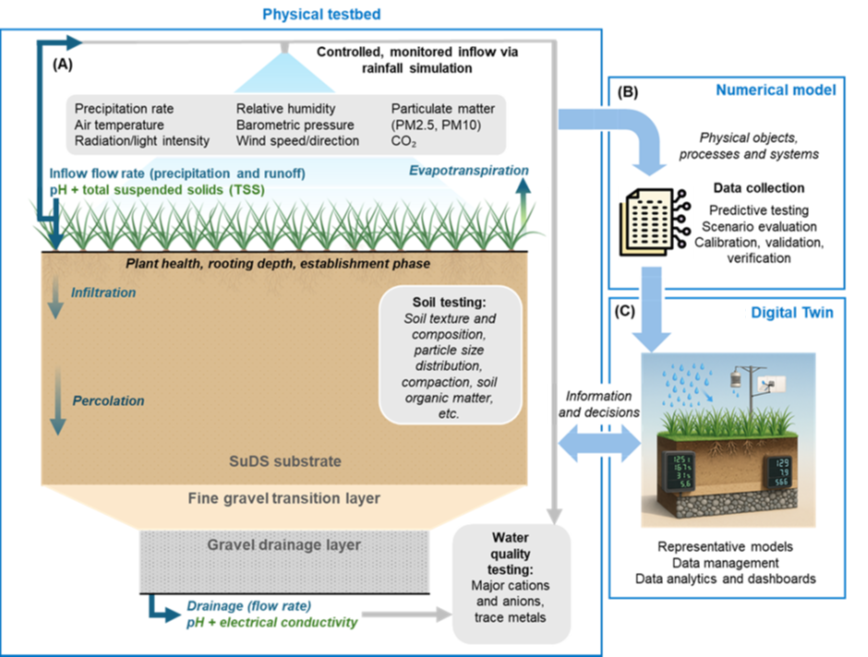
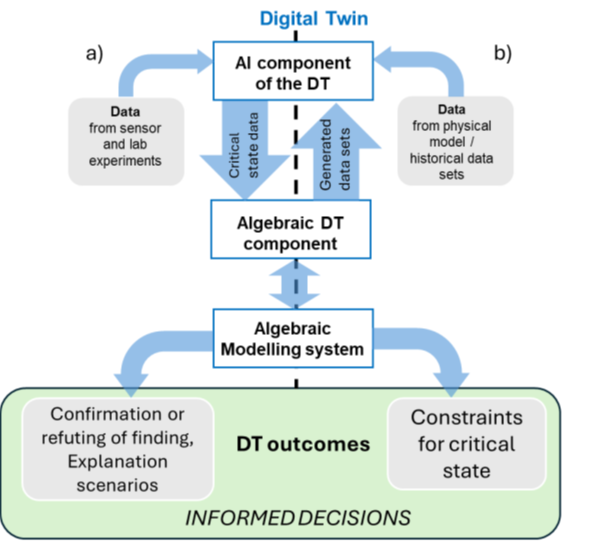
Digital twinning workflow for green drainage infrastructure,Algebraic DT framework
Methodology
The project will focus on building a DT aligned with the ongoing and future physical experimental research on rain garden GI performance at Durham University and HWU. The DT will mimic physical drainage processes in Rain Gardens (RG) based on lab experiments at adjustable lysimeter facility [1] and field GI studies (Durham).
The research will also utilise data from two newly installed and instrumented rain gardens at Durham University (3.6m x 1m x 1m in dimensions). These will provide real-time data (soil moisture, precipitation, temperature, inflow, outflow, etc.) to support digital twin development. Data from the Durham rain gardens provide an opportunity to study how planted drainage features capture runoff, store water and support infiltration. Monitoring their responses to rainfall provide essential baseline and validation data for DT development, linking process-based modelling of water movement within the rain gardens with modelling of the wider drainage system.
Control experimental data will be used from a large-scale multi-compartment lysimeter slope facility model capable of reproducing water infiltration, changes in moisture content and pore-water pressure, soil deformation, crack formation, and landslide development. Controlled external influences, including water input and mechanical loads, can be applied to the model.
The DT will be linked to the system of sensors deployed in the experimental facility to measures infiltration physical parameters and transmit them to the digital twin. The DT comprises two interconnected components:
• Neural component: analyses sensor data, detects anomalies, and predicts the onset of critical states, including landslides, cracking, excessive pore-water pressure, deformation, contamination, and other hazardous processes.
• Algebraic component: uses a formal physics-informed algebraic model to verify AI predictions by modelling physically admissible scenarios of slope evolution.
The algebraic model may confirm the AI prediction by providing a physically justified scenario leading to a hazardous state or reject it as inconsistent with physical constraints.
Preventing Critical States
Unlike systems designed solely to detect hazards, the proposed digital twin also synthesises scenarios for preventing critical states.
The algebraic model examines potential engineering interventions, including drainage, lowering groundwater levels, slope reinforcement, changes in loading, and other protective measures. These interventions are represented as formal actions with defined preconditions, physical constraints, and parameters.
Modelling will identify admissible protection scenarios and calculate parameter ranges within which hazardous developments can be prevented. The proposed solutions can then be tested experimentally using the physical slope model/field GI experiments.
Accounting for Uncertainty
An important feature of the approach is its ability to work with incomplete and uncertain data. Physical soil properties, including permeability, porosity, cohesion, and the angle of internal friction are specified as algebraic constraints within the permissible parameter ranges and parameters’ interdependencies. This enables to analyse a range of physically plausible scenarios, assess risks under different conditions, and identify protective solutions that remain effective despite parameter uncertainty.
Scientific Novelty and Expected Outcomes
The central research idea is to integrate machine learning, formal algebraic modelling, and physical experimentation within a single DT system.
Expected outcomes will deliver:
1. A neuro-algebraic digital twin architecture integrated with the physical slope model.
2. Methods for formally verifying AI predictions and generating explanatory scenarios for hazardous processes.
3. Methods for automatically synthesizing engineering protection scenarios and calculating their parameters.
4. Methods for modelling uncertain physical characteristics using algebraic constraints.
5. Experimental lab/field validation of predictive accuracy, the reliability of formal verification, and the effectiveness of protective scenarios.
Key advantage: moving beyond the prediction of hazardous states towards their physics-based verification and explanation, together with the automated identification of preventive engineering solutions under uncertainty.
The proposed configuration, which combines an experimental physical slope model with a neuro-algebraic digital twin, serves as an experimental prototype for the future deployment of the technology in real-world conditions. It allows methods for monitoring, predicting critical states, and generating protective scenarios to be developed, tested, and validated before being applied to real geotechnical assets.
Project Timeline
Year 1
Consolidate the cutting edge state of GI research based on experimental studies at Durham and Heriot-Watt. Algin with timely industry practice in Nature based solution designs and operation for flood management [2].
Review of digital twinning approach for modelling complex natural and hybrid systems and specifically the algebraic DT [3]. Align with timely industry and governmental practice in DT [4].
Data consolidation (in collaboration with Durham team and ongoing HWU PhD). Collate soil infiltration monitoring data (soil moisture, electrical conductivity, soil temperature, precipitation/inflow and outflow dynamics) from physical experiments for further use in DT and physical modelling. Rainfall inflow and outflow leachate is automatically logged for electrical conductivity and pH, with manual systematic regular and post design storm event water quality sampling.
Familiarise with analytical process modelling of soil infiltration, specifically with HYDRUS 1D – a recognised standard code applied to bioretention modelling [5]. Elements of process-based models HYDRUS 1Dmodel (i.e. HYDRUS) alongside hydrological and hydraulic drainage models (such as SWMM, InfoWorks ICM, etc.) will be used for deterministic numerical computations. This would allow to explore interactions between infiltration, sub-surface water movement and drainage network responses, using monitoring data to inform model development and evaluation Empirical data is inputted into the numerical model framework to allow probabilistic testing and upscaling. Its governing equations for simulating water, heat and solute transport in variably saturated media are well suited for subsequent algebraic DT representation.
Contribute the preliminary research overview and the outcomes to internal NBS research community at Durham Univeristy, Heriot-Watt and across the wider Iapetus network.
Year 2
Design, develop and depoloy a DT for GI infrastructure based on the collated data. Generate viable GI operational scenarios with the DT to scope the widest range of possible uncertainties and boundary conditions. Evaluate critical operational scenarios. Use AI and machine learning algorithms to assimilate continuous monitoring inputs, enabling uncertainty quantification, upscaling across scales and scenario testing under varying climatic and design conditions within complex, dynamic systems. Present the interim findings at a conference (EGU).
Year 3
DT real field deployment at the laboratory slope facility and GI facilities at Durham University. Calibration and field testing. Forecasting validation experiments with the calibrated DT at the field/lab GI facilities.
Explore practical applications for monitoring and protecting natural slopes, road and railway embankments, open-pit mines, dams, and other geotechnical structures. Reach out to relevant stakeholders to make a case for real life applications.
Year 3.5
Write up the thesis.
Disseminate DT deployment outcomes and engage across a wider stakeholder network of GI/Sustainable urban drainage systems designers, constructors and operators (City Councils, contractors, etc.).
Prepare journal publication on DT deployment.
Training
& Skills
Relevant NBS training (Durham)
Relevant data science/DT training (HWU)
Communication, outreach and enterprising/commercialisation training (HWU)
References & further reading
[1] “Green Slope Facility” https://researchportal.hw.ac.uk/en/equipments/green-slope-facility-green-infrastructure-and-sustainable-drainag/[2] UK Government (2025) ‘National standard for Sustainable Drainage Systems (https://www.gov.uk/government/publications/national-standards-for-sustainable-drainage-systems/national-standards-for-sustainabledrainage-systems-suds)[3] O.Letychevskyi, V.Peschanenko, H.Sokolova, Y.Tarasich, V.Volkov, Algebraic Modeling of Molecular Interactions, Communications in Computer and Information Science, 2022, 1635 CCIS, pp. 379–387[4] UK Government (2025) ‘Digital twins – dynamic models that respond to real-time data: Rapid response’ , (https://post.parliament.uk/digital-twins-dynamic-models-that-respond-to-real-time-data/# heading-4)[5] Simunek, Jiri, Jirka & Van Genuchten, Martinus. (1999). Using the HYDRUS-1D and HYDRUS-2D Codes for Estimating Unsaturated Soil Hydraulic and Solute Transport Parameters. Characterization and Measurement of the Hydraulic Properties of Unsaturated Porous Media. 2. 1523-1536.[6] Environmental Digital Twin , Glasgow , https://invest-glasgow.foleon.com/digital-glasgow-strategy/digital-glasgow-strategy-2024-2030/environmental-digital-twin; https://www.glasgow.gov.uk/article/3748/Welcome-to-3D-Urban-Model
