

IAP-26-054
From Flow to Bloom: Explainable Physics-Guided AI for Predicting Compound Hydrological and Water-Quality Extremes
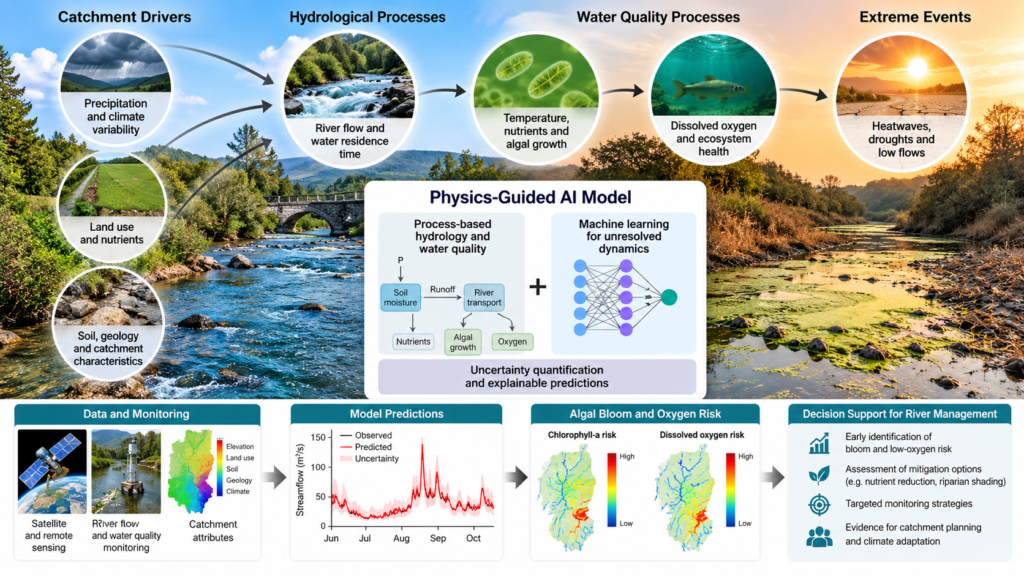
What happens to river ecosystems when heatwaves and drought coincide? Low flows change dilution and residence time, while temperature, sunlight and nutrient inputs affect algal growth and dissolved oxygen. Their combined influence is complex and catchment-specific: warming does not necessarily increase every type of bloom, and river conditions can change rapidly during extreme events. Understanding these interactions is essential to protect freshwater biodiversity and target climate adaptation.
Artificial neural networks (ANNs) can reproduce typical streamflow patterns, but predictions of rare floods, prolonged low flows and conditions outside the training period remain challenging. At the same time, routine chlorophyll-a and dissolved-oxygen monitoring can miss short-lived ecological stress. Process-based river models represent hydrological and biogeochemical mechanisms, yet cannot fully resolve all local processes. This PhD will bring these approaches together to understand when hybrid AI improves environmental prediction, when it fails and what monitoring information is needed.
The project builds on existing local-versus-regional ANN streamflow research and established process-based modelling of water temperature, nutrients, phytoplankton and dissolved oxygen. Its principal scientific contribution will be a transferable, uncertainty-aware approach for investigating how hydrological extremes propagate into freshwater quality risks.
RESEARCH QUESTIONS AND OBJECTIVES
The student will address four questions:
1. Which catchment properties, antecedent conditions and climate drivers control model errors during extreme low flows and heatwaves?
2. Can physics-guided neural differential equations improve predictions of algal biomass and oxygen stress without violating known environmental processes?
3. How do sparse, irregular and event-biased observations affect prediction, uncertainty and interpretation?
4. Which learned relationships transfer between catchments, and when should a model warn that conditions fall outside its reliable range?
Click on an image to expand
Image Captions
Physics-Guided AI for River Health
Methodology
METHODOLOGY
First, the student will assemble a reproducible dataset combining river flow, precipitation, air and water temperature, solar radiation, nutrients, chlorophyll-a or suitable bloom indicators, dissolved oxygen and catchment characteristics. Candidate resources include the National River Flow Archive, ROBIN, CAMELS-GB, regulatory records, meteorological products and existing UKCEH process-model applications, subject to data access. Local and regional ANN models will be re-evaluated alongside conceptual hydrological and process-only water-quality baselines, using tests on unseen years and catchments.
Second, one data-rich river catchment will be selected for detailed research. The student will assess how an existing process model represents hydrological transport, thermal response, algal growth, nutrient cycling and oxygen dynamics during extreme events. They will investigate a hybrid neural ordinary differential equation or universal differential equation approach, allowing carefully selected process terms to be learned from data while maintaining suitable constraints on water balance, positivity, transport and reaction rates. Sensitivity and identifiability testing will determine whether learnable terms are scientifically justified. A simpler non-intrusive residual model will provide a comparison and fallback if full integration is impractical.
Third, the research will investigate rare-event learning and realistic monitoring limitations. The student will define site-appropriate heatwave, low-flow, bloom and oxygen-stress events; test extreme-aware training objectives; and systematically reduce data-rich time series to reproduce typical regulatory sampling intervals and event under-sampling. Model predictions will be checked against independent observations, not only process-model simulations. Uncertainty will be estimated from data, model structure and parameters, with explicit tests for overly confident predictions under unusual climatic conditions.
Finally, selected model components will be tested in contrasting rivers using available observations and simplified-model applications. The student will examine where learned relationships transfer, where local recalibration is essential, and how interventions such as nutrient reduction or riparian shading affect predicted vulnerability. Where relevant, findings will be translated into evidence for targeted monitoring and catchment planning; the primary outcome remains new environmental understanding and reproducible modelling methods, not a production-ready warning service.
PROJECT TIMELINE (3.5 YEARS)
Project Timeline
Year 1
Year 1: Literature review; site and dataset selection; reproduction of ANN findings; process-model baselines; extreme-event definitions.
Year 2
Year 2: Development of constrained hybrid models; verification of process consistency; benchmarking against hydrological and statistical alternatives.
Year 3
Year 3: Sparse-monitoring experiments; uncertainty and climate-shift evaluation; targeted tests in contrasting catchments; research publications.
Year 3.5
Final six months: Research synthesis, thesis preparation, manuscripts and engagement with environmental end users.
Training
& Skills
TRAINING AND SKILLS
The student will receive training in hydrology, aquatic biogeochemistry, environmental statistics, Python/R, numerical differential equations, scientific machine learning, uncertainty quantification, reproducible research and science communication. Catchment and water-sector engagement will provide experience of the limitations and uses of monitoring evidence.
Applicants from environmental sciences, mathematics, engineering, computing or related disciplines are welcome; willingness to develop interdisciplinary skills is more important than prior familiarity with every technique.
SUPERVISION AND COLLABORATION
The proposed lead supervisor is Dr Sandhya Patidar (Heriot-Watt University), with potential scientific co-supervision from UKCEH and additional expertise in AI or freshwater science, subject to agreement. The Rivers Trust is a potential non-academic collaborator for catchment-management advice and a possible student placement; Forth Rivers Trust, SEPA and Scottish Water may be approached as end users.
References & further reading
SELECTED REFERENCES
Hutchins, M. et al. (2026). What controls current and future background vulnerability of rivers to eutrophication and pathogens? Journal of Hydrology, 665, 134713.
Chen, R.T.Q. et al. (2018). Neural Ordinary Differential Equations. NeurIPS.
Rackauckas, C. et al. (2020). Universal Differential Equations for Scientific Machine Learning. arXiv:2001.04385.
