

IAP-26-053
Unlocking tight geothermal reservoirs: coupled experiments, near-wellbore modelling and techno-economics of soft stimulation
Tight Hot Sedimentary Aquifers (HSAs) lie beneath many European cities, including Edinburgh, and could supply low-carbon baseload heat. Their matrix permeability is often in the low-millidarcy range or below. Flow therefore depends on natural fractures and on the condition of the rock around the well. Drilling damage, fines migration and mineral precipitation add a positive skin that can make a geologically viable resource uneconomic.
Soft stimulation can achieve a negative skin without the pressures and seismic risk of hydraulic fracturing. It covers two treatments: dilute acid treatment of the near-wellbore zone, and hydroshearing of critically stressed fractures by controlled pore-pressure cycling. For the sandstones and carbonates that dominate European HSAs, three things are not known. These are how much permeability each treatment creates, how long the gain lasts under in-situ stress and temperature, and when a treatment instead triggers fines release, fracture closure or microseismicity. Without these numbers, operators cannot design treatments and investors cannot price the risk.
This PhD follows soft stimulation from rock sample to investment decision. The student will:
– measure the coupled mechanical, hydraulic and chemical response of stimulated reservoir rock;
– upscale that response to near-wellbore skin in reservoir simulators;
– work with TownRock Energy to test when the productivity gain pays for the treatment.
The project is embedded in GEOGUARD (CETP-2024-00127), a six-partner European project on tight HSAs coordinated by Heriot-Watt. GEOGUARD provides confirmed samples from Lithuania and Scotland, case-study reservoir models and an international network.
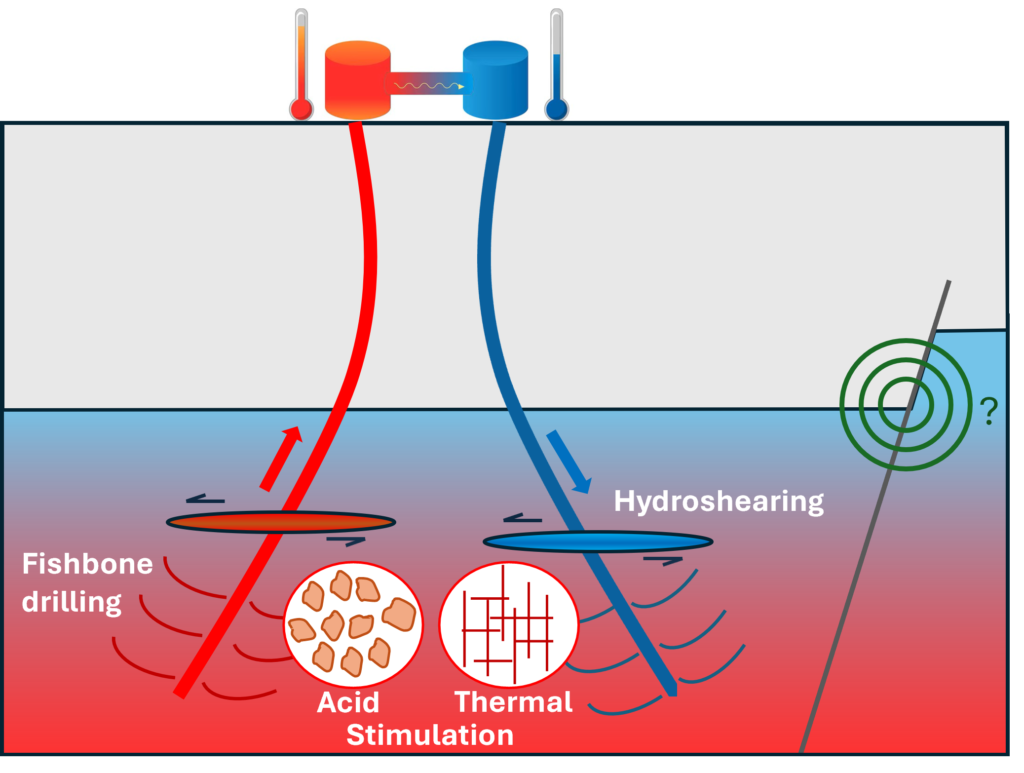
Click on an image to expand
Image Captions
Permeability enhancement techniques
Methodology
1. Coupled experiments (Heriot-Watt and BGS). Samples come from two confirmed GEOGUARD sites:
– Cambrian sandstone core from the Lithuanian case study.
– Kinnesswood Formation sandstone from outcrops around Edinburgh. The Kinnesswood is the geothermal target beneath the Heriot-Watt campus.
The work proceeds in four steps:
– Baseline characterisation. Helium porosity, gas and liquid permeability, mercury intrusion porosimetry, XRD, SEM-EDS and micro-CT. Uniaxial and triaxial strength tests and ultrasonic velocities give the mechanical properties.
– Stimulation tests. Fractured plugs are tested in triaxial flow-through cells at in-situ effective stress and up to 80°C, representing target formation temperatures. Acid treatment varies acid type, concentration and residence time. Hydroshearing applies controlled pore-pressure cycles below the fracturing pressure. Permeability, strain and acoustic emissions are logged continuously, and effluent analysis (if required) is done by ICP-OES and ion chromatography.
– Complementary tests at BGS. These run in the BGS Engineering Geology Laboratories, Keyworth.
– Geochemical modelling. PHREEQC models of effluent chemistry and pre/post mineralogy identify the reactions that control permeability change.
2. Near-wellbore modelling. The measured permeability–stress–reaction relationships define an altered zone around the well. To first order they link to skin through Hawkins’ relation, s = (k/ks − 1) ln(rs/rw). Here ks and rs are the permeability and radius of the altered zone, and rw is the wellbore radius. Radial single-well and doublet models in MRST and/or CMG then resolve how the treated zone evolves under stress and thermal cycling. They also give the resulting productivity index and pumping power over the life of the well. Reservoir properties come from GEOGUARD case-study data.
3. Techno-economics with TownRock Energy. Simulated flow rates feed a doublet cash-flow model of capex, treatment cost, opex, pump power and heat sales. The outputs are levelised cost of heat and NPV. Sensitivity and Monte Carlo analysis identify which uncertainties matter most: skin, treatment longevity or reservoir properties. The result is a decision chart showing when stimulation is worth doing, for which rock and at what cost.
Project Timeline
Year 1
– Literature review and individual training plan.
– Laboratory induction at Heriot-Watt.
– Kinnesswood Formation fieldwork and selection of the Lithuanian core.
– Baseline characterisation of both rock types.
– Training in PHREEQC and MRST.
– First presentation at a GEOGUARD consortium meeting.
Year 2
– Acid and hydroshearing experiments with acoustic-emission and effluent monitoring.
– Placement at the BGS Engineering Geology Laboratories, Keyworth.
– Geochemical modelling of the experiments.
– First paper, on the coupled hydro-chemo-mechanical response.
– Presentation at European Geosciences Union or EAGE Global Energy Transition conferences.
Year 3
– Upscaling to near-wellbore skin and doublet performance in MRST/CMG.
– Placement at TownRock Energy to build the techno-economic model.
– Second paper, on skin evolution and productivity.
Year 3.5
– Integrated decision framework.
– Third paper, on the economics of soft stimulation.
– Thesis submission.
– Results presented to industry through TownRock Energy and the GEOGUARD network.
Training
& Skills
The student will be trained to take a subsurface energy question from rock sample to investment decision. Few graduates are trained across that whole chain, and the skills transfer directly to geothermal, CO₂ and hydrogen storage, mine-water heat, geological surveys and consultancy.
– Experimental rock mechanics: triaxial and flow-through testing at in-situ stress and temperature, pore-pressure cycling and acoustic-emission monitoring (Heriot-Watt GeoEnergy laboratories; BGS Keyworth).
– Petrophysics and mineralogy: porosity, permeability, mercury intrusion porosimetry, micro-CT image analysis, XRD and SEM-EDS.
– Geochemistry: acid–rock reaction experiments, fluid analysis (ICP-OES, IC), and speciation and kinetic modelling in PHREEQC.
– Reservoir simulation: near-wellbore and doublet modelling in MRST (open source) and CMG (industry standard, available at Heriot-Watt University).
– Techno-economics: cash-flow modelling, levelised cost of heat, NPV and Monte Carlo risk analysis, learned with a geothermal developer (TownRock Energy).
– Machine learning/AI and GeoEnergy technologies: The Subsurface Energy Transition and Innovation Centre at Heriot-Watt University provides foundational and expert training on many aspects relevant for data analysis or understanding subsurface technologies
– Professional skills: FAIR data and reproducible code, writing for journals and industry, presenting to academic, industry and public audiences, and working in an international consortium.
The student completes the Iapetus PGCert in Environmental Methods and joins cohort training. Two placements, at a national survey (BGS) and in industry (TownRock), show how research results become data products and investment decisions. Through GEOGUARD, the student works with partners in Austria, Lithuania and Ireland and sees how technical results feed regulation and public acceptance.
A training-needs analysis in the first month sets the individual training plan. RTSG funds the project-specific elements: the BGS placement and a specialist simulation or geothermal course. The supervisory team combines experimental geomechanics and petrophysics (Busch, Forbes Inskip), rock physics at a national survey (Ougier-Simonin), near-wellbore flow modelling (Doster) and industry techno-economics (Smith, TownRock Energy). The student meets the lead supervisor weekly and the full team at least quarterly.
References & further reading
Hawkins, M.F. (1956). A note on the skin effect. Transactions of the AIME, 207, 356–357.
Hofmann, H., Zimmermann, G., et al. (2019). First field application of cyclic soft stimulation at the Pohang Enhanced Geothermal System site in Korea. Geophysical Journal International, 217, 926–949.
Lie, K.-A. (2019). An Introduction to Reservoir Simulation Using MATLAB/GNU Octave: User Guide for the MATLAB Reservoir Simulation Toolbox (MRST). Cambridge University Press.
Parkhurst, D.L. & Appelo, C.A.J. (2013). Description of input and examples for PHREEQC version 3. USGS Techniques and Methods, 6-A43.
Portier, S., Vuataz, F.-D., Nami, P., Sanjuan, B. & Gérard, A. (2009). Chemical stimulation techniques for geothermal wells: experiments on the three-well EGS system at Soultz-sous-Forêts, France. Geothermics, 38, 349–359.
