

IAP-26-113
Under Pressure: comparative assessment of the effects of hydrostatic pressure, and oxygen availability on marine and freshwater animal physiology
Marine and freshwater animals are increasingly exposed to a complex suite of environmental stressors driven by climate change. These include rising temperatures, declining oxygen availability, and changes in hydrostatic pressure (water depth). While the effects of temperature and oxygen have been widely studied in isolation, their interactive influence with hydrostatic pressure remains poorly understood, particularly in the context of coastal marine and freshwater lake ecosystems. This project aims to investigate how oxygen and pressure interact to shape the physiological performance, thermal tolerance, and stress responses of aquatic animals across contrasting environments.
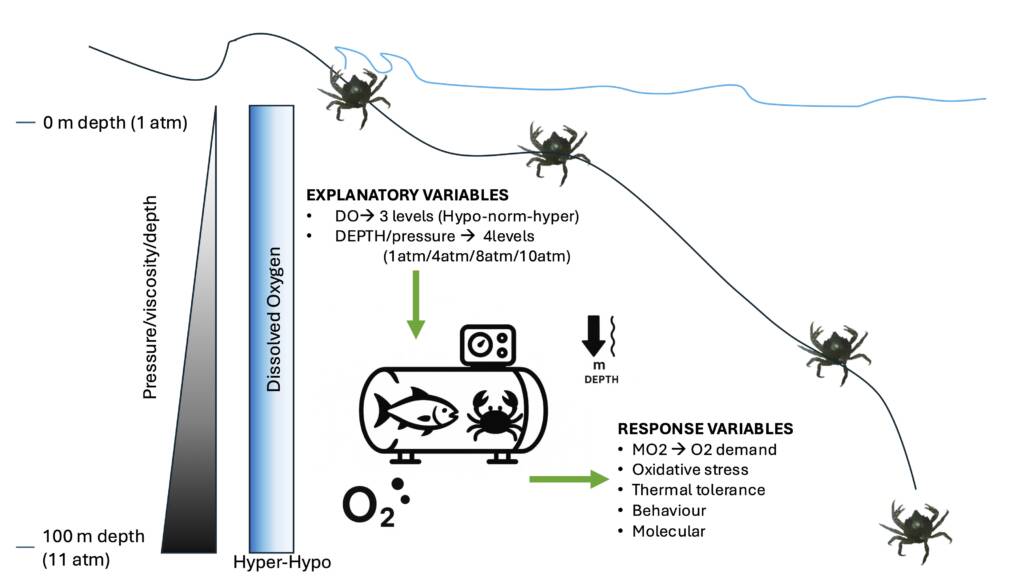
Species inhabiting coastal and shelf marine environments often span vertical ranges of 0–120 meters or more, and experience pressure gradients that exceed 10 atmospheres. Correspondingly, they experience large temperature fluctuations and oxygen variability driven by thermocline and oxycline dynamics. Similarly, deep freshwater lakes present steep vertical gradients in pressure and oxygen, especially in stratified systems where hypolimnetic deoxygenation and seasonal mixing events can impose significant physiological challenges. As climate change intensifies environmental stratification in both systems, oxygen minimum zones are becoming shallower in the ocean and more persistent in lakes, while pressure regimes shift due to altered mixing depths (Fig. 1).
Despite these parallels between hydrostatic pressure and other environmental variables, most physiological studies are conducted under atmospheric pressure and normoxic conditions, potentially overlooking key constraints on acclimation and adaptation. By integrating experimental physiology, molecular biology, and comparative analyses across marine and freshwater taxa, this project will provide novel insights into how pressure and oxygen jointly influence organismal resilience. The comparative approach will help identify shared and divergent strategies for stress tolerance, contributing to a broader understanding of ecosystem vulnerability and informing conservation efforts in both marine and freshwater systems.
Research Questions
1. How do hydrostatic pressure and oxygen availability interact to affect metabolic performance, thermal tolerance, and aerobic scope in marine and freshwater species?
2. Are there species-specific differences in sensitivity to these combined drivers?
3. What are the molecular and cellular mechanisms underpinning tolerance or vulnerability to pressure-oxygen interactions?
4. How might these physiological constraints influence vertical distribution, range shifts, and resilience under future ocean scenarios?
Click on an image to expand
Image Captions
Figure 1. Conceptual scheme of the experimental design exploring the combine effect of pressure and oxygen on eco-physiology of coastal / freshwater species.
Methodology
Species Selection
The project will focus on ecologically relevant aquatic species with broad vertical distributions and different trophic ecologies. The study organisms will be selected based on ecological importance, availability, and feasibility for laboratory experimentation. In the marine ecosystem, we will study Necora Puber as a predator, and Echicus esculentus, as a grazer. In the freshwater ecosystem, we will use Chaoborus flavicans as a predator and Sphaerium corneum as a filter feeder.
Experimental Design
• Pressure Chamber Experiments: Use of high-pressure chamber to simulate depth-related hydrostatic pressures (0.1–12 MPa), in combination with controlled temperature and oxygen levels (hyperoxia, normoxia, hypoxia).
• Thermal Tolerance Assays: Determination of critical thermal maxima (CTmax) and minima (CTmin) under different pressure-oxygen regimes to assess shifts in thermal limits.
• Metabolic Rate and Aerobic Scope: Respirometry to measure oxygen consumption and aerobic capacity across treatments, providing insight into energy budgets and performance windows.
• Biochemical and Cellular Stress Markers: Quantification of heat shock proteins (HSPs), oxidative stress markers (e.g., ROS, antioxidant enzymes), and membrane fluidity indicators.
• Comparative Analyses: Across ecosystems and species from different depth or oxygen regimes to assess evolutionary and ecological patterns in stress tolerance.
Project Timeline
Year 1
• Literature review and project planning.
• Training in experimental and molecular techniques.
• Selection and acclimation of model species.
• Pilot experiments to test pressure-oxygen protocols and assess baseline physiological responses.
Year 2
• Full factorial experiments on pressure/oxygen interactions on adult selected species.
• Collection of physiological and biochemical data.
• Begin RNA extraction and transcriptomic library preparation.
• Comprehensive statistical training and capacity strengthening, data analysis and refinement of experimental protocols.
Year 3
• Full factorial experiments on pressure/oxygen interactions on embryos.
• Complete transcriptomic and qPCR analyses.
• Comparative studies across species or populations.
• Integration of physiological and molecular datasets.
• Begin manuscript writing and thesis drafting.
Year 3.5
• Finalise data analysis and complete thesis.
• Submission of manuscripts to peer-reviewed journals.
• Presentation of findings at national and international conferences.
• Engagement with stakeholders and public outreach activities.
Training
& Skills
The student will receive comprehensive training in:
• Experimental aquatic physiology: including experimental pressured aquaria operation, thermal tolerance assays, and oxygen manipulation.
• Molecular biology and omics: RNA extraction, qPCR, transcriptomics, and bioinformatics.
• Data analysis and modelling: statistical analysis in R, multivariate analysis, and thermal performance curve modelling, including an option for Bayesian analysis.
• Scientific communication: writing for publication, presenting at conferences, and public engagement.
Through Iapetus, the student will also benefit from:
• Cohort-based training in environmental data science, science-policy interface, and interdisciplinary collaboration.
• Opportunities for placements, workshops, and training in transferable skills such as project management, research ethics, and stakeholder engagement.
References & further reading
References
1. Brown, A. & Thatje, S. (2011). Respiratory response of the deep-sea amphipod Stephonyx biscayensis indicates bathymetric range limitation by temperature and hydrostatic pressure. PLoS ONE, 6, e28562.
2. Somero, G.N. (2012). The physiology of global change: linking patterns to mechanisms. Annual Review of Marine Science, 4, 39–61.
3. Somero, G.N. (2022). Solutions: how adaptive changes in cellular fluids enable marine life to cope with abiotic stressors. Marine Life Science & Technology, 4, 389–413.
4. Sokolova, I.M. (2023). Ectotherm mitochondrial economy and responses to global warming. Acta Physiologica, 237, e13950.
Further reading:
1. Brown, A. & Thatje, S. (2014). Explaining bathymetric diversity patterns in marine benthic invertebrates and demersal fishes: physiological contributions to adaptation of life at depth. Biological Reviews, 89, 406–426.
2. Yancey, P.H. (2020). Cellular responses in marine animals to hydrostatic pressure. Journal of Experimental Zoology Part A, 333, 398–420.
3. Oliphant, A. et al. (2011). Pressure tolerance of the shallow-water caridean shrimp Palaemonetes varians across its thermal tolerance window. Journal of Experimental Biology, 214, 1109–1117.
