

IAP-26-065
Forecasting Rusty Rivers: Permafrost thaw and iron release into Arctic rivers
Human-driven climate change is thawing permafrost soils which exposes ancient iron-bearing minerals to oxygen and rusts Arctic rivers (O’Donnell et al., 2024). These iron-laden rivers transport metal contaminants at toxic levels threatening aquatic life and the humans that rely on it.
Permafrost will continue to thaw, with ~ 70 % of permafrost expected to disappear by 2100 if humans do nothing to combat human-driven greenhouse gas emissions (Chadburn et al., 2017). With ongoing thaw and mineral exposure, scientists urgently want to predict where and when Arctic rivers will rust – both to provide short term (months to years) forecasting of changes to water quality and longer term (decades to century) estimates of net-changes to aquatic chemistry (e.g., Dial et al., 2026)
This highly topical PhD project will develop predictive models to determine where and where Arctic rivers will rust. These models will contribute to provision of water quality risk management for local communities threatened by river rusting. In the long-term, this work will contribute to better-informed river and ocean chemistry predictions and policy solutions for local communities.
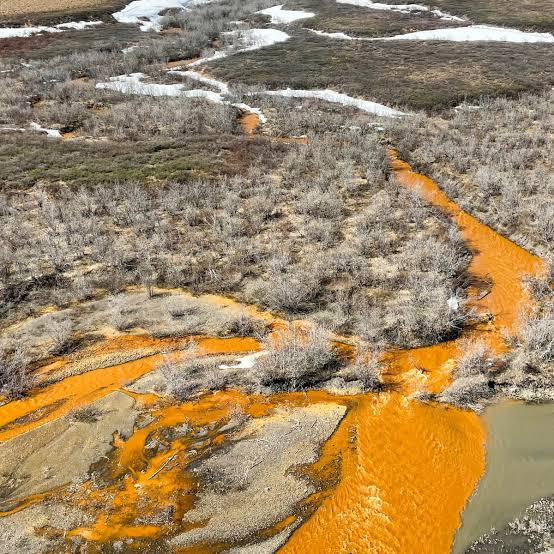
Click on an image to expand
Image Captions
Orange streams in the Brooks Range of northern Alaska. Photograph by Josh Koch/USGS and published in The Guardian article: https://www.theguardian.com/us-news/article/2024/may/22/alaska-rivers-turning-orange
Methodology
The PhD student will apply computational and Earth Observation approaches with Arctic data sets to:
1. Develop and validate statistical and machine learning predictive models for Arctic river iron occurrence for one core, instrumented, Arctic river catchment, comparing alternative modelling approaches.
2. Investigate transferability and generalisation potential of the model with a robust model uncertainty assessment and build optimised, potentially model ensembles, for multiple Arctic river catchments with contrasting underlying geology, topography, hydrology and river geochemistry.
3. Deploy these models to examine patterns of river change in the Arctic in recent years.
Project Timeline
Year 1
The student will develop statistical and machine learning predictive models, which employ the specific topological nature of the catchment area, to identify river rust occurrence in conditions of permafrost thaw and hydrological change. To do this, the student will work with 20+ year time series for permafrost thaw, hydrology and river geochemistry from a catchment with permafrost containing of iron-bearing minerals (Zackenberg Catchment, Northeast Greenland). The Earth Observation component will be delivered from a mix of Sentinel 2 data and higher resolution data made available by ESA to research projects. The student will predict the modelled quantities at future timepoints (forecasting) and un-observed locations (spatial prediction/extrapolation). Alternative modelling approaches will be compared using established and emerging validation approaches appropriate to the spatiotemporal structure of the data and intended prediction tasks (e.g., Roberts et al., 2017).
Year 2
The student will investigate structural, parameter, and scenario uncertainty in the established model and explore methods to quantify uncertainty and improve predictive reliability, including through multi-model ensembles, structured volatility/uncertainty models, sensitivity analyses to investigate environmental controls on river rusting, and model application to multiple global warming scenarios. The reliability of predictive uncertainty estimates will be evaluated across the spatial and temporal dimensions of the dataset. The student will write a manuscript to report the predictive model development and optimisation. The student will communicate their findings at a national conference for Polar Research e.g., The UK Arctic Conference.
Year 3
The student will investigate the spatial applicability and transferability of their predictive model by training their optimised model with data sets from sites with contrasting geology, hydrology, permafrost thermal state and river geochemistry (Bayelva Catchment, Svalbard, Toolik Catchment, Alaska). Catchment-specific and pooled modelling approaches will be compared to assess predictive performance and generalisability, including in catchments excluded from training, considering limits to model applicability (e.g., Meyer and Pebesma, 2021) and broader challenges in validating environmental predictions (Meyer and Pebesma, 2022) The student will write a manuscript on an assessment of past, present and future Arctic river rusting in the Arctic.
Year 3.5
The student will complete writing of manuscripts and present their data at an international conference attended by permafrost scientists who work alongside indigenous Arctic communities impacted by river rusting.
Training
& Skills
This project requires a close integration of environmental science and computational skills, including statistical and machine learning models. The student will obtain skills training on these disciplines from a project team spanning permafrost science, soil and river chemistry (Hirst), statistics and machine learning (Otto) and Earth Observation (Carbonneau). Each advisor will bring specific complementary expertise and training on the relevant concepts and techniques. The student will undertake one field trip to Toolik Field Station to work alongside field scientists to understand environmental context and challenges, and meeting with permafrost scientists at the University of Fairbanks. The PhD candidate will be supported in using the world-class computational facilities at Durham University. The PhD candidate will present their findings to permafrost scientists working with local communities in regions affected by permafrost thaw and river rusting.
References & further reading
O’Donnell, J.A., Carey, M.P., Koch, J.C., Baughman, C., Hill, K., Zimmerman, C.E., Sullivan, P.F., Dial, R., Lyons, T., Cooper, D.J. and Poulin, B.A., 2024. Metal mobilization from thawing permafrost to aquatic ecosystems is driving rusting of Arctic streams. Communications Earth & Environment, 5(1), p.268. https://www.nature.com/articles/s43247-024-01446-z
Chadburn, S.E., Burke, E.J., Cox, P.M., Friedlingstein, P., Hugelius, G. and Westermann, S., 2017. An observation-based constraint on permafrost loss as a function of global warming. Nature climate change, 7(5), pp.340-344. https://www.nature.com/articles/nclimate3262
Dial, R.J., Hanna, C.T., Sullivan, P.F., Cooper, D.J., Tino, C.J., Gregory, D.D., Diamond, C., Rieser, M., Nicolsky, D.J., Hill, K. and Iwahana, G., 2026. Permafrost thaw controls iron flux from wetlands and sulfide-bearing rocks to Arctic rivers and streams. Communications Earth & Environment. https://www.nature.com/articles/s43247-026-03450-x
Gay, B.A., Pastick, N.J., Züfle, A.E., Armstrong, A.H., Miner, K.R. and Qu, J.J., 2023. Investigating permafrost carbon dynamics in Alaska with artificial intelligence. Environmental Research Letters, 18(12), p.125001. https://iopscience.iop.org/article/10.1088/1748-9326/ad0607/meta
Roberts, D.R., Bahn, V., Ciuti, S., Boyce, M.S., Elith, J., Guillera‐Arroita, G., Hauenstein, S., Lahoz‐Monfort, J.J., Schröder, B., Thuiller, W., Warton, D.I., Wintle, B.A., Hartig, F. and Dormann, C.F. (2017) ‘Cross‐validation strategies for data with temporal, spatial, hierarchical, or phylogenetic structure’, Ecography, 40(8), pp. 913–929. Available at: https://doi.org/10.1111/ecog.02881.
Meyer, H. and Pebesma, E. (2021) ‘Predicting into unknown space? Estimating the area of applicability of spatial prediction models’, Methods in Ecology and Evolution, 12(9), pp. 1620–1633. Available at: https://doi.org/10.1111/2041-210x.13650.
Meyer, H. and Pebesma, E. (2022) ‘Machine learning-based global maps of ecological variables and the challenge of assessing them’, Nature Communications, 13(1). Available at: https://doi.org/10.1038/s41467-022-29838-9.
