

IAP-26-020
The Urban Eye – How Light Pollution Reshapes Moth Vision
Background:
Urbanisation imposes novel selective pressures on wildlife, with artificial light at night (ALAN) being a particularly potent force. Moths have been declining in response to increasing ALAN (van Grunsven et al 2020), but it is unclear whether evolutionary adaptations can enable them to persist in this novel environment. A landmark study demonstrated that urban moth populations have evolved a significantly reduced flight-to-light behaviour compared to their rural counterparts, a presumed adaptation to avoid fatal attraction to artificial illumination (Altermatt & Ebert, 2016). Recent work suggests this behavioural shift correlates with changes in flight-related morphology, such as smaller wings (van Langevelde et al., 2018). However, the mechanistic basis and evolutionary trajectory of this adaptation remain unknown.
Project Aims
This PhD project will test the overarching hypothesis that reduced phototaxis in urban moths is underpinned by changes in sensory ecology and has evolved over recent decades. The student will address three core questions:
1. Does eye size and morphology differ between urban and rural moths? Using high-resolution micro-CT scanning (Baird and Taylor 2017), a technique in which our collaborators (Dr. James Windmill, Strathclyde, and Dr. Emily Baird, Stockholm) are world-leading experts, the student will generate 3D reconstructions of compound eyes from urban and rural moth populations. This will allow precise quantification of visual parameters, such as ommatidial count, lens diameter, and eye surface area, to determine if urbanisation is associated with structural changes in the visual system.
2. Do changes in phototactic behaviour and eye morphology have a heritable basis? The student will rear moths from urban and rural populations under identical, controlled conditions. This will disentangle heritable genetic adaptation from phenotypic plasticity by testing whether differences in phototaxis and eye morphology persist across generations reared in a common environment.
3. How has moth eye morphology changed over the past century in response to increasing urbanisation? To directly trace the evolutionary response to ALAN, the student will use micro-CT scanning to examine historical moth specimens held in major natural history collections (e.g., National Museums Scotland). By comparing the eye morphology of specimens collected from the same geographic regions before and during periods of rapid urbanisation, the student can reconstruct the temporal trajectory of morphological change. This will provide a unique, direct measure of evolutionary change, linking the pace of urbanisation to the pace of sensory adaptation


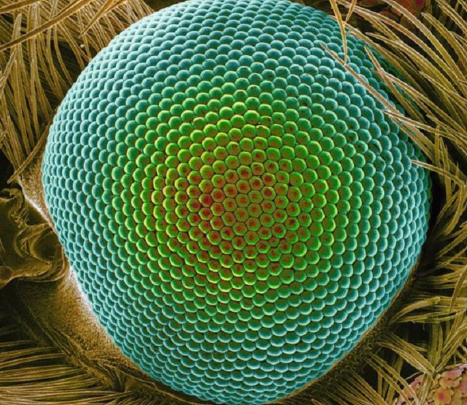
Click on an image to expand
Image Captions
Moths around streetlight – Getty images,Caterpillars from sweep nets – Newcastle University,Moth eye – dailymail.co.uk
Methodology
Fieldwork
Paired urban and rural sites (c. 10 of each) will be selected around Glasgow and Newcastle along a gradient of artificial light at night (ALAN), quantified in GIS from satellite night-time radiance data (VIIRS) and validated on the ground with sky-quality meters. Adult moths will be sampled with standard light traps, and larvae of focal species (e.g. the spindle ermine (Yponomeuta cagnagella), the species studied by Altermatt & Ebert 2016) will be collected by hand to found captive populations. A subset of wild-caught adults will be preserved for micro-CT.
Lab experiment and behavioural tests
Larvae from all populations will be reared to adulthood in a common-garden setting at the University of Glasgow under identical temperature, photoperiod and dark-night conditions, then bred to produce an F1 generation. Where breeding success permits, rearing will continue to the F2 generation to minimise the potential influence of parental environmental effects. Flight-to-light behaviour of wild-caught and F1 adults will be measured in standardised arena assays, recording whether and how quickly individuals approach a light source, with flight paths tracked using infrared video. At the end of the experiment all individuals will be collected for CT scanning and eye measurements. Persistence of urban–rural differences in F1 moths will provide evidence for a heritable or transgenerational componenet in phototactic behaviour and size of eye traits, with F2 comparisons, where available, allowing stronger separation of genetic differences from parental environmental effects. There is also an already established population of cabbage moth (Mamestra brassicae) available for more detailed behavioural studies.
Museum work
Pinned specimens of the focal species with dated, georeferenced labels will be sourced from National Museums Scotland and other UK collections (e.g. Natural History Museum London, Great North Museum: Hancock), spanning c. 1900 to the present. Each collection locality will be matched to historical urbanisation metrics (e.g. land cover and population density from historical maps and census records) and, for recent decades, to satellite ALAN data.
CT scanning and data analysis
Heads of wild-caught, lab-reared, and museum specimens will be scanned non-destructively using micro-CT, supported by Dr Windmill (Strathclyde) and Dr Baird (Stockholm). Eye surface area, volume, ommatidial number and facet diameter will be extracted from 3D reconstructions, using machine-learning segmentation pipelines developed to automate measurements across hundreds of scans. Data will be analysed in R using (generalised) linear mixed models that control for body size, sex and population, testing for effects of habitat, ALAN intensity and rearing generation, and, for museum data, temporal trends in eye morphology in relation to urbanisation/ALAN.
Project Timeline
Year 1
Induction; literature review; auditing PGT-level courses in Key Research Skills (Introduction to Geographic Information Systems (GIS) and Spatial Data, Advanced Generalised Linear Models, Programming in R); training in CT scanning; training in machine learning for image data; pilot field work to identify study sites; field work to collect moths and caterpillars.
Year 2
Housing and rearing of caterpillars; housing and breeding of adult moths; behavioural assays with adult moths; image acquisition via CT scanning; museum visits for historical moth measurements; data analysis for field data; development of machine-learning models for CT image analyses.
Year 3
Behavioural measurements of F1 captive generation; data analysis of CT scanning measurements and behavioural assay data; completion of museum data acquisition, and subsequent analysis of museum data.
Year 3.5
Finalising thesis and manuscript drafting.
Training
& Skills
The successful candidate will be supported by an interdisciplinary cross-institution supervisory team to develop field, laboratory and desk-based skills in:
The scholar will receive comprehensive training: year 1 includes, experimental design, field ecology, museum specimen handling, and micro-CT/3D imaging training. Years 2-3 focus on advanced statistical modelling of morphological time-series data. Years 3-4 include scientific writing retreats and presentation skills development via seminars and conferences. This unique blend of evolutionary ecology, museum science, and high-resolution imaging will prepare the student for diverse careers in academia, conservation, or industry.
• Key Research Skills such as systematic review writing, experimental design, advanced statistics and mapping.
• CT scanning
• Machine-learning for image analysis (in R or Phyton)
• Moth trapping
• Moth housing and rearing
• Behavioural assays
• Machine learning
• Research integrity, open science and data governance
• Communication, leadership and impact
The student will gain experience working as part of a small team in the field, and in problem-solving, resilience and time management and will have the opportunity to gain graduate teaching experience.
All the listed training is related to ecological field work, lab work, advanced data analysis, and report writing, which can be suitable for job positions in both academia and industry.
References & further reading
Altermatt F, Ebert D, Reduced flight-to-light behaviour of moth populations exposed to long-term urban light pollution. Biol Lett 2016, 2: 20160111. https://doi.org/10.1098/rsbl.2016.0111
Baird E, Taylor Gm X-ray micro computed-tomography. Current Biology 2017, 27, R289-R291. https://doi.org/10.1016/j.cub.2017.01.066
van Langevelde F, Braamburg-Annegarn M, Huigens ME, et al. Declines in moth populations stress the need for conserving dark nights. Glob Change Biol. 2018, 24:925–932. https://doi.org/10.1111/gcb.14008
van Grunsven R, van Deijk J, Donners M et al. Experimental light at night has a negative long-term impact on macro-moth populations. Current Biology 2020, 30: R694-R695. https://doi.org/10.1016/j.cub.2020.04.083
