

IAP-26-021
Sentinels of ecosystem change: integrating biochemical tracers and environmental genomics to reconstruct cetacean diet, condition and food-web change in UK shelf seas
UK shelf seas are undergoing rapid ecological change. Climate-driven shifts in forage fish distributions, alongside fishing and other anthropogenic pressures, are reshaping marine food webs. Understanding the consequences for higher predators is a key requirement of the UK Marine Strategy and OSPAR biodiversity assessments, yet robust indicators remain limited.
Cetaceans provide a powerful lens through which to monitor ecosystem change. As upper-trophic-level predators, their diets integrate ecological processes across broad spatial and temporal scales. Since 1992, the Scottish Marine Animal Stranding Scheme (SMASS) and Cetacean Strandings Investigation Programme (CSIP) have systematically examined stranded cetaceans generating an internationally significant archive of stomach contents, frozen and fixed tissues, and associated pathological and demographic data.
This project will combine conventional stomach-content analysis, DNA metabarcoding, and stable isotope ecology to determine whether these archives can be transformed into a quantitative, multi-decadal record of food-web change. Focusing on harbour porpoises and common dolphins, the student will investigate how trophic ecology has changed over the last three decades, whether these changes reflect shifts in prey communities and ecosystem productivity, which dietary tracers provide the most reliable long-term indicators, and how dietary change relates to nutritional condition.
Working closely with SMASS, CSIP and JNCC, the student will generate a curated multi-decadal diet database and develop a transferable framework for assessing cetacean feeding ecology and condition. The project will directly support UK Marine Strategy, OSPAR and ICES assessment processes, providing novel indicators of ecosystem change at upper trophic levels.


Click on an image to expand
Image Captions
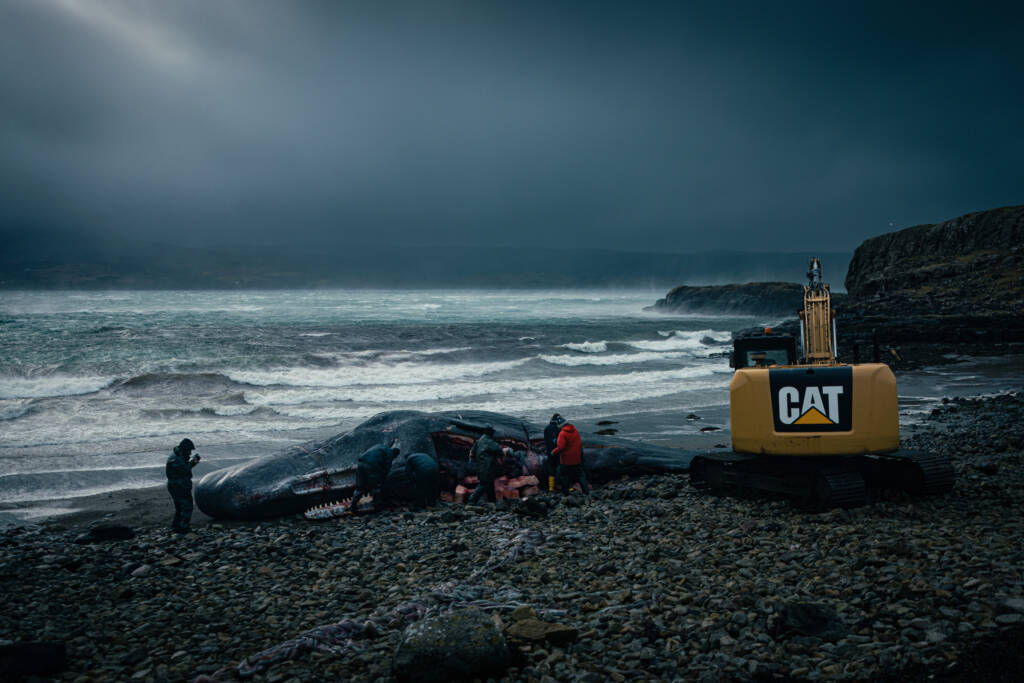
Sperm whale necropsy, Raasay. Credit James Appleton,Humpback whale stranding, Skye. Credit James Appleton,Sperm whale necropsy, Raasay. Credit James Appleton
Methodology
ll material derives from existing post-mortem investigations; no animals are sampled for this project.
Multi-decadal diet database. Stomach-content records from SMASS post-mortem investigations (1992–present) will be recovered, quality-assured and standardised against current prey taxonomy, then linked to demographic, condition, pathology, location and date fields and to environmental covariates (sea surface temperature, and fish survey series from ICES and the Marine Directorate). Comparable CSIP records will extend coverage to UK-wide. Published power estimates for porpoise diet data indicate that c. 118 individuals are required to detect between-group differences with 80% power (Heße et al. 2025); the combined archive exceeds this for several species. Hard-part identification will be undertaken with SMRU (University of St Andrews).
Biochemical tracers of diet and nutritional condition. Bulk δ13C and δ15N will be measured at SUERC on archived skin and muscle, with lipid and Suess corrections applied, and interpreted through isotopic niche metrics and Bayesian mixing models (MixSIAR) parameterised with, where available, regional prey baselines. In parallel, at the Lyell Centre (Heriot-Watt), blubber fatty acid signatures will be characterised and carbon isotope ratios of individual fatty acids measured. Paired with compound-specific amino-acid δ15N, this gives a two-axis reconstruction in which carbon identifies the production source and nitrogen the trophic level, both independent of shifting isotopic baselines — the principal confounder in long-term series. Lipid content and fatty acid class composition additionally index nutritional condition, tested against SMASS pathology records for emaciation and starvation, linking dietary change to its consequences for the animal.
Environmental genomics. DNA will be extracted from archived stomach and intestinal contents and amplified using multiple markers (teleost 12S plus a broader eukaryote marker), following Heße et al.’s (2025) recommendation that single-primer designs miss crustacean and cephalopod prey, with blocking primers to limit predator amplification. Sequencing will be Illumina-based, with processing in established pipelines against curated regional reference libraries. Detection probability, DNA degradation and the relationship between read counts and biomass will be evaluated against paired hard-part data.
Integration, modelling and indicators. A paired sample set analysed by all three methods will underpin a formal comparison of their sensitivity, resolution and temporal window. Bayesian hierarchical models will relate diet and condition metrics to year, region, species and demography, treating stranding-derived sampling bias explicitly as an observation process. Candidate indicators will be trialled with JNCC against UK Marine Strategy and OSPAR needs.
Project Timeline
Year 1
Literature review; training in trophic ecology, stable isotope ecology and environmental genomics, alongside Iapetus cohort training. Compilation, quality assurance and curation of the diet database (Chapter 1). Development of the stratified sampling framework and power analysis; first analyses of the stomach-content records. JNCC induction, with the three-month CASE placement later in the year, comparing diet-derived prey occurrence against independent survey evidence on distribution and abundance. Introductory visits to CSIP, SMRU and the Lyell Centre. Confirmation report and analytical plan.
Year 2
Retrieval and preparation of archived tissues and gastrointestinal-content samples. Stable isotope analyses at SUERC and fatty-acid analyses at the Lyell Centre (Chapter 2), alongside metabarcoding of the validation subset (Chapter 3). First integrated analyses of the paired sample set. Presentation at the European Cetacean Society Conference and submission of the first manuscript (Chapter 1).
Year 3
Completion of laboratory and bioinformatic work. Where appropriate, compound-specific isotope analyses will be used to refine trophic interpretation. Integration of the conventional, biochemical and molecular datasets through Bayesian hierarchical modelling of temporal, spatial and species-level patterns (Chapter 4). Development and testing of candidate indicators with JNCC, building on the placement. International conference presentation and preparation of manuscripts two and three.
Year 3.5
Completion of thesis chapters and submission of remaining manuscripts. Delivery of the curated diet database, analytical workflows and code as open, reusable resources. A guidance note for JNCC, CSIP and ICES WGMME on incorporating multi-tracer diet and condition data into ecosystem assessment. Stakeholder workshop, thesis submission and viva preparation.
Training
& Skills
This project provides training across marine ecology, pathology, epidemiology, surveillance organic biogeochemistry, environmental genomics and quantitative ecosystem science, delivered through the Iapetus DTP and the University of Glasgow with SMASS, CSIP, SUERC, the Lyell Centre, SMRU and JNCC.
Discipline-specific skills: cetacean trophic ecology and post-mortem investigation; stomach-content analysis and prey identification; stable isotope ecology, including compound-specific isotope analysis; lipid biomarker and fatty-acid approaches; DNA extraction from degraded samples, metabarcoding and environmental genomics.
Quantitative skills: reproducible data science in R and Python; bioinformatics; Bayesian hierarchical modelling; dietary mixing models; multivariate community analysis; FAIR and open-data approaches.
Professional skills: science-policy translation through a CASE placement with JNCC; engagement with ICES and OSPAR assessment processes; scientific writing, peer review and conference presentation; stakeholder engagement and public outreach through SMASS.
References & further reading
Heße E et al. (2025) A multi-method approach reveals long- and short-term dietary differences in individual harbour porpoises Phocoena phocoena in the southern North Sea. Marine Ecology Progress Series 755: 115–132. doi:10.3354/meps14787
Kebke AS et al. (2026) The application of stable carbon and nitrogen isotopes to assess the feeding ecology of long-finned pilot whales (Globicephala melas) in Scotland. PLOS ONE 21: e0346340. doi:10.1371/journal.pone.0346340
Lennon R et al. (2025) An approach to using stranding data to monitor cetacean population trends and guide conservation strategies. Scientific Reports 15: 28417. doi:10.1038/s41598-025-12928-1
Williams RS et al. (2025) Sea temperature and pollution are associated with infectious disease mortality in short-beaked common dolphins. Communications Biology 8: 557. doi:10.1038/s42003-025-07858-7
Williamson MJ et al. (2021) Cetaceans as sentinels for informing climate change policy in UK waters. Marine Policy 131: 104634. doi:10.1016/j.marpol.2021.104634
