

IAP-26-063
How does fault geometry control deformation and energy partitioning during earthquakes on normal faults?
Earthquakes release elastic energy stored in the Earth, but only part of this energy is radiated as seismic waves with a significant portion dissipated through friction, fracturing and deformation within the fault zone volume (Kanamori & Rivera, 2006; Cocco et al., 2023). The amount of dissipated energy by on- and off-fault fracturing (i.e., fracture energy) influences rupture propagation characteristics and the amount of energy radiated as hazardous seismic waves (De Paola et al., 2025). Understanding the controls on energy partitioning is therefore fundamental to understanding earthquake behaviour, yet how and where energy is partitioned remains poorly constrained.
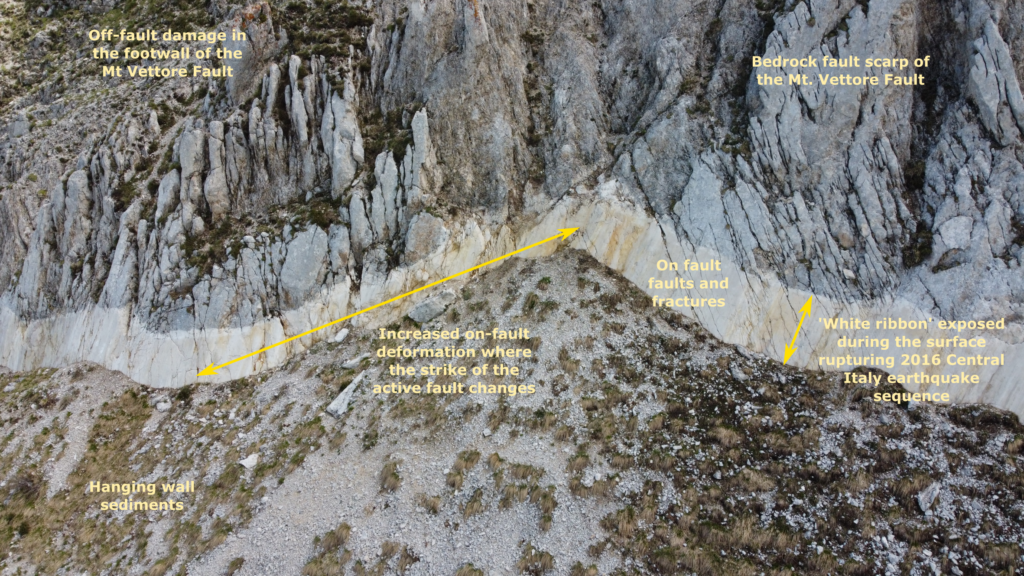
Natural faults are rarely planar and display bends, corrugations, steps, branching and intersecting faults which can alter the distribution of slip and generate heterogeneous deformation and stress concentrations (Faulkner et al., 2010; Cocco et al., 2023; Andrews et al., 2026). Non-planar geometry can promote deformation both within the fault zone and in the surrounding rock (Figure 1), creating additional sinks for earthquake energy (Cocco et al., 2023). However, while the effects of fault geometry on slip and deformation are increasingly recognised, how these variations translate into differences in energy dissipation remains poorly constrained.
Recent work has shown that on-fault deformation across active normal faults varies systematically with slip direction (Andrews et al., 2026), with deformation varying spatially across faults depending on fault plane geometry and the presence of cross faults (Andrews et al., in review). Additionally, experimental studies highlight that fault geometry can influence slip and frictional behaviour (e.g. Lee et al., 2024). This PhD will combine these approaches to answer “how does three-dimensional fault geometry control deformation, and how does this affect energy partitioning during fault slip?”
The project will address three linked objectives:
O1. Establish how fault geometry controls deformation in natural faults: The project will quantify relationships between fault-surface geometry, slip direction and the distribution of on- and off-fault deformation using field observations and virtual outcrop models from the Central Apennines.
O2. Test the effect of geometry and fault-rock properties: Representative geometries identified from natural faults will be reproduced in controlled rock-deformation experiments, progressing from simple planar sawcuts to more complex geometries and natural fault rocks. Measurements of mechanical work, deformation and microstructures will identify how and where energy is dissipated during slip.
O3. Quantify the energy-partitioning effects of fault geometry. Natural and experimental observations will be integrated with modelling and compared to natural examples to establish how geometrical complexity and fault-rock properties link deformation to energy dissipation during normal faulting, and how these processes influence the balance between energy dissipation and seismic radiation.
Click on an image to expand
Image Captions
Figure 1: Drone photograph of an approximately 20 m-long, non-planar section of the Mt. Vettore bedrock fault scarp, Central Apennines, Italy, illustrating the range of on- and off-fault damage associated with active normal faults. The white ribbon represents the surface rupture generated during the 2016 Central Italy Earthquake Sequence.
Methodology
An existing dataset of virtual outcrop models from active normal faults in the Central Apennines will provide the starting point. Analysis will quantify relationships between three-dimensional fault geometry, slip direction and on- and off-fault deformation, identifying geometries and deformation patterns for experimental testing.
Two field campaigns will collect targeted structural measurements, samples and new virtual outcrop models. The first will test and extend relationships identified from the existing dataset, while the second will target unresolved geometries from the field and experimental programme.
Laboratory experiments will investigate the effects of fault geometry and fault-rock properties. Experiments will begin with simple planar sawcuts before introducing increasingly complex geometries identified from the natural fault systems and, subsequently, selected natural fault rocks containing pre-existing deformation. Stress, displacement, mechanical work and acoustic emissions will quantify mechanical behaviour and energy dissipation, while microstructural analysis will characterise the resulting fault rocks and identify the processes responsible for deformation and energy dissipation. A modelling approach similar to that adopted in De Paola et al. (2025) will then be applied to unpick rupture propagation scenarios, with results compared to high-quality datasets of natural earthquakes.
Project Timeline
Year 1
Year 1 will establish the natural and experimental foundations for the project. Existing virtual outcrop models will be analysed to quantify relationships between three-dimensional fault geometry, slip direction and on- and off-fault deformation to inform a field campaign to test and extend these observations. Training in experimental rock deformation will begin with simple planar sawcut experiments to establish baseline mechanical behaviour.
Year 2
Year 2 will use relationships identified from natural faults to investigate the effects of three-dimensional geometry under controlled laboratory conditions. Experiments will progress from simple planar sawcuts to increasingly complex geometries representative of those observed in the Central Apennines. A second field campaign will target unresolved geometries or deformation patterns and collect additional samples and virtual outcrop models. Results from the natural-fault analysis and first field campaign will be developed into a manuscript and presented at a conference.
Year 3
Year 3 will investigate how natural fault-rock properties modify the effects of fault geometry. Selected natural fault rocks and samples containing pre-existing deformation will be introduced into the experimental programme, to test inherited fabrics, damage and fault-rock properties to be tested. These results will then be compared with deformation observed in the natural fault systems to establish how geometry, deformation and fault-rock properties influence energy partitioning during slip. Results from the experimental and natural-fault analyses will be developed into manuscripts and presented at an international conference.
Year 3.5
The final six months will focus on synthesis and thesis completion. Natural and experimental results will be integrated to quantify the relationship between three-dimensional fault geometry, deformation and energy dissipation, and compared with seismological observations of earthquake behaviour and energy partitioning. The synthesis will develop a framework for energy partitioning across non-planar faults and its implications for earthquake rupture and seismic radiation, with results presented at the European Geosciences Union (EGU) General Assembly.
Training
& Skills
This project will provide broad training across field and structural geology, virtual outcrop analysis, experimental rock deformation, microstructural analysis and quantitative data analysis. Training will include fault mapping and slip analysis, UAV surveying and virtual outcrop generation, experimental design and mechanical testing, acoustic-emission monitoring, fault-rock microscopy, and Python-based data processing and visualisation. There will also be scope for the student to develop complementary approaches aligned with their interests, including numerical modelling of earthquake ruptures. These field, laboratory and computational skills will provide a strong foundation for careers in academic research, earthquake and geohazard risk, geological and geotechnical engineering, and the subsurface energy sector.
References & further reading
Andrews et al. (2026). Using fracture scarp intersection lineations as kinematic indicators on active normal fault scarps, Journal of Structural Geology, 210 (9), 105754. https://doi.org/10.1016/j.jsg.2026.105754
Andrews et al. (in review). Interplay between geometry and brittle deformation of bedrock fault scarps, pre-print available here – https://doi.org/10.31223/X5646X
De Paola, N., et al. (2025). Off-fault damage controls near-surface rupture behaviour in soft sediments. Nature Communications, 16, Article 11295. https://doi.org/10.1038/s41467-025-66467-4
Kanamori & Rivera (2006). Energy partitioning during an earthquake. In: Abercrombie, R., McGarr, A., Di Toro, G. & Kanamori, H. (eds), Earthquakes: Radiated Energy and the Physics of Faulting. Geophysical Monograph Series, 170, 3–13. https://doi.org/10.1029/170GM03
Cocco et al. (2023). Fracture Energy and Breakdown Work During Earthquakes. Annual Review of Earth and Planetary Sciences, 51, 217–252. https://doi.org/10.1146/annurev-earth-071822-100304
Faulkner et al. (2010). A review of recent developments concerning the structure, mechanics and fluid flow properties of fault zones. Journal of Structural Geology, 32(11), 1557–1575. https://doi.org/10.1016/j.jsg.2010.06.009
Lee et al. (2024). Fault-network geometry influences earthquake frictional behaviour. Nature, 631, 106–110. https://doi.org/10.1038/s41586-024-07518-6
