

IAP-26-009
Hot spots or homogeneity? Resolving variation in soil CO₂ flux through dense low-cost sensor arrays and radiocarbon analysis.
The release of CO₂ from the soil surface (the ‘flux’) is one of the biggest movements of carbon in Earth’s ecosystems, an order of magnitude larger than current fossil fuel emissions. This flux combines plant roots respiring ‘young’ carbon recently fixed from the atmosphere, and microorganisms decomposing ‘old’ carbon that may have entered the soil decades or millennia ago. The former represents a fast-cycling carbon pool, the latter a withdrawal from a long-term store that cannot be easily replaced. Determining how soils will respond to a changing climate, including for soil health, agricultural sustainability, and carbon budgeting, therefore depends on measuring soil CO₂ flux, how it varies in space and time, and which carbon pool is released.
The current ‘gold standard’ measures CO2 accumulation in a closed chamber on the soil surface, using this value to represent the surrounding area. Soils are not uniform however, so individual measurements do not represent the wider landscape. Because commercial instruments retail at many thousand pounds, previous studies typically deploy a small number of chambers, , either requiring manual measurement across locations, using chambers connected to a single analyser and relocated daily or weekly. The true structure of soil CO₂ flux therefore remains largely unknown, including whether a small proportion of the soil produces a disproportionate share of the total (‘hot spots’), whether the annual release is concentrated in short periods, and how the source of the carbon differs in space and time.
This project aims to resolve these questions, using instrumentation that makes intensive flux measurement affordable for the first time. Working with Gas Sensing Solutions, a leading manufacturer of CO₂ sensors, the student will build an array of low-cost automated flux analysers, developing these from a design already proven through a year of field deployment. Instead of relocating a few chambers, this array will measure many points simultaneously, at a resolution not previously achievable. This will reveal whether hot spots are fixed features or shift through the year, and whether periods of high flux are site-wide or localised.
The array will then be deployed in two systems: A peatland, where older CO₂ is anticipated at lower water levels as aerobic decomposition increases; and a mineral soil, where seasonal variation in root input is expected to introduce a fluctuating ‘young’ carbon component on an underlying ‘old’ decomposition signal. Using SUERC’s Environmental Radiocarbon Facility the student will analyse CO₂ from the highest and lowest flux locations and compare with the soil carbon stored at those same points, showing whether locations releasing more CO₂ are simply respiring faster or are emitting an older, less replaceable carbon source.
Finally, the student will test how far conventional sampling designs can depart from the true flux, and under what conditions they fail. The resulting recommendations on chamber number, placement and measurement frequency will inform carbon accounting, monitoring network design, and the datasets against which global land surface models are evaluated.
Click on an image to expand
Image Captions
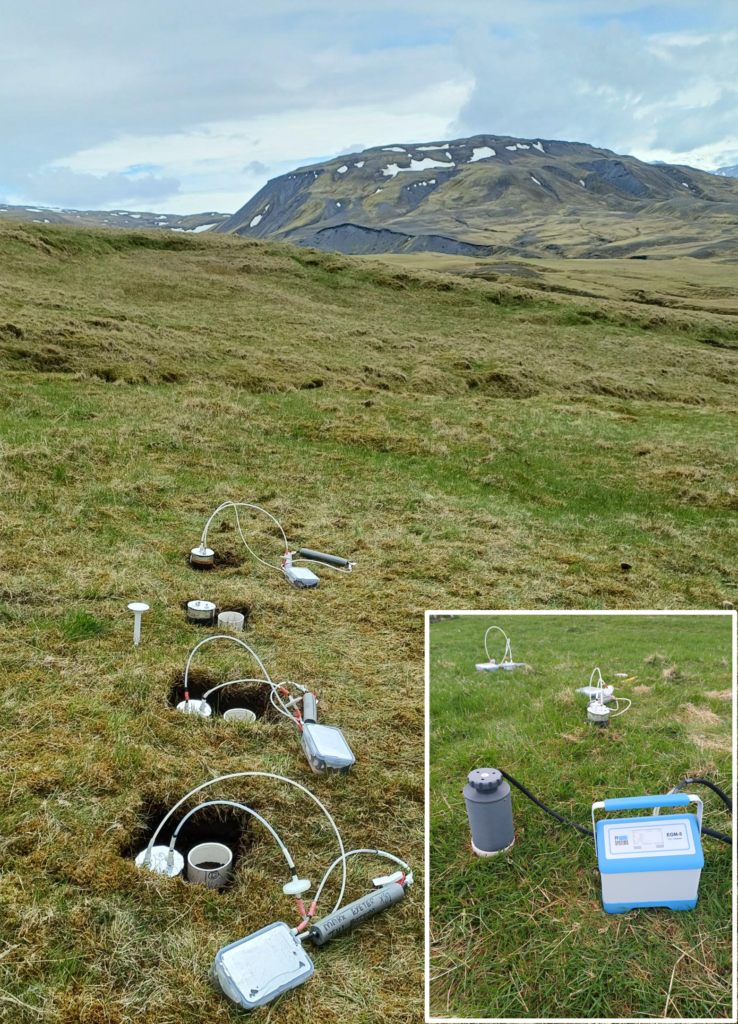
Field deployment of CO2 flux instrumentation in upland environments showing proprietary and low-cost versions (both to be used in the studentship)
Methodology
Instrument development: In year 1 the student will work with the engineering team at Gas Sensing Solutions, and the academic supervisory team, to build and characterise the field instrument array, using an existing and field-validated SUERC automated CO₂ analyser as a base for the design. They will validate the instruments against a reference commercial analyser, establishing accuracy, drift, unit-to-unit variability and performance across the temperature and moisture ranges expected in the field.
Full training and technical support will be given in all hands-on methods and concepts required, to ensure the student can approach the project confidently. Significant flexibility is built in to all project stages, to allow the science to be driven by the student as the project proceeds.
Field deployment: In years 2 and 3 the student will deploy the instrument array at two field sites and measure the spatial and temporal variability of soil CO₂ efflux in organic and mineral soils. The sampling will be designed to accurately capture spatial and temporal variability across each site. Each site will be monitored continuously through multiple seasonal cycles, with water table depth, soil temperature and soil moisture logged alongside using existing instrumentation. The peatland site will be instrumented first (year 2), with the array subsequently relocated to the mineral soil (year 3) and the sampling design informed by the peatland results.
The student will then use this data to: i) determine what fraction of the total flux originates from what fraction of area and time, ii) identify ‘hot spots’ of flux, and whether these are persistent or mobile in a landscape, iii) understand what drives the patterns in the measurements (e.g. water table position in peat, rhizosphere input seasonality in mineral soils).
Radiocarbon measurement: During the field deployment, the student will use the live flux record to determine when and where to collect samples for radiocarbon measurement. This is likely to include hot spots at their most active, locations under contrasting water table positions, and within and outside the growing season. CO₂ will be trapped on molecular sieves in the field and soil cores will be taken for analysis from the same chamber positions. This will allow the student to compare the age of the carbon leaving the soil with that of the carbon stored in the same location, and test whether differences in flux also reflect differences in which pool is being respired.
Analysis: Statistical approaches will be used to quantify how flux varies across space and time, to identify hot spots and assess their persistence, and to determine what fraction of the annual total originates from what fraction of area and time. Isotope mixing models will be used to partition young and old carbon contributions. In the final phase, the complete datasets will be resampled to simulate conventional sampling designs, quantifying the error such designs would have produced and generating the measurement guidance that forms the project’s applied output.
Project Timeline
Year 1
• Training and induction activities. UoG and IAPETUS courses. Training in radiocarbon methods, field instrumentation and spatial statistics
• Placement at Gas Sensing Solutions, instrument build and design refinement with the engineering team
• Characterisation of the low-cost instrument array against a reference commercial analyser
• Literature review and site selection
• Instrumentation of the peatland site, start flux logging at this location
• Begin drafting of paper based on instrument design and validation
Year 2
• Training and induction activities. UoG and IAPETUS courses. Training in radiocarbon methods, field instrumentation and spatial statistics
• Placement at Gas Sensing Solutions, instrument build and design refinement with the engineering team
• Characterisation of the low-cost instrument array against a reference commercial analyser
• Literature review and site selection
• Instrumentation of the peatland site, start flux logging at this location
• Begin drafting of paper based on instrument design and validation
Year 3
• Complete the flux monitoring at the mineral soil site (full annual cycle)
• Sampling of CO2 for 14C analysis across high and low root input periods
• Collect soil cores from the same chamber positions for 14C analysis
• Resampling analysis developed on the field datasets to quantify error in conventional sampling designs
• Return visit to Gas Sensing Solutions to feed deployment experience into instrument design
• Radiocarbon measurement completed
• Conference presentation, drafting of project synthesis paper
Year 3.5
• Papers completion
• Thesis completion
Training
& Skills
• Soil CO2 flux methods (principles and practice of existing designs)
• New instrument design and build
• Testing, validation, calibration, quality assurance
• Experience of industrial placement with GSS
• Radiocarbon training: sample preparation, wet chemistry, use of molecular sieves for CO2 trapping, cryogenic purification, gaphitisation
• Fieldwork skills: instrument deployment, site selection, management of long-term field campaigns
• Fieldwork skills: MSC collection of CO2 for 14C, flux measurements, deployment of temperature, moisture loggers
• Quantitative skills: data analysis, statistical analysis, isotope mixing models
• IAPETUS training programme
• SUERC & UoG researcher development from CoSE (including thesis preparation, scientific writing, paper publication, conference presentation, public engagement/outreach)
References & further reading
Subke, J.A., Kutzbach, L. and Risk, D., 2021. Soil chamber measurements. In Springer handbook of atmospheric measurements (pp. 1603-1624). Cham: Springer International Publishing.
Garnett, M.H., Newton, J.A. and Parker, T.C., 2021. A highly portable and inexpensive field sampling kit for radiocarbon analysis of carbon dioxide. Radiocarbon, 63(4), pp.1355-1368.
Ascough P, Bompard N, Garnett MH, Gulliver P, Murray C, Newton J-A, Taylor C. 2024.14C Measurement of Samples for Environmental Science Applications at the National Environmental Isotope Facility (NEIF) Radiocarbon Laboratory, SUERC, UK. Radiocarbon, 66(5), 1020-1031. doi:10.1017/RDC.2024.9
Garnett MH, Newton J-A, Ascough PL. Advances in the Radiocarbon Analysis of Carbon dioxide at the NERC Radiocarbon Facility (East Kilbride) using Molecular sieve Cartridges. Radiocarbon. 2019;61(6):1855-1865. doi:10.1017/RDC.2019.86
Forbes, E., Benenati, V., Frey, S., Hirsch, M., Koech, G., Lewin, G., Mantas, J.N. and Caylor, K., 2023. Fluxbots: a method for building, deploying, collecting and analyzing data from an array of inexpensive, autonomous soil carbon flux chambers. Journal of Geophysical Research:
Trumbore, S., 2009. Radiocarbon and soil carbon dynamics. Annual Review of Earth and Planetary Sciences, 37, pp.47–66.
