

IAP-26-096
Engineering recovery: how does ecosystem engineering by beavers shape biodiversity, and can we predict where it could deliver the greatest benefits?
Understanding whether ecosystem engineering by beavers can deliver biodiversity benefits is a difficult challenge because ecological responses to disturbance often unfold over decades, far beyond the duration of most ecological studies. The recovery of beavers across Europe provides a natural experiment to test these questions. By creating wetlands, beavers act as ecosystem engineers, altering hydrology, habitat structure and resource availability at landscape scales (Figure 1). While numerous studies have demonstrated short-term positive biodiversity responses to beaver activity (Stringer & Gaywood, 2016), most have relied on snapshots in time, leaving unresolved questions about the long-term dynamics and generality of ecological change following beaver establishment.
Do biodiversity gains continue to accumulate over decades? Does biodiversity follow predictable recovery trajectories? Are biodiversity changes at a few sites replicated across landscapes as beaver populations increase? These are important knowledge gaps, and the plethora of papers on beaver effects on biodiversity provides no consistent consensus. Addressing these questions requires long-term ecological datasets, which are rare. Over more than two decades of research in Scotland, the supervisory team has assembled an extensive long-term dataset of biodiversity change in beaver-engineered landscapes. This project will combine long-term biodiversity datasets with new field observations to examine how beaver-driven natural experiments influence biodiversity through time. The student will investigate how different taxonomic groups respond to ecosystem engineering, identify factors that determine biodiversity and persistence, and predict biodiversity trajectories in different settings. By integrating historical and contemporary datasets across multiple countries, the project will reveal how biodiversity trajectories develop over decadal timescales following ecosystem engineering – patterns that cannot be detected through conventional short-term studies.
The specific aims of this project are to:
• Establish the generality of biodiversity responses. Quantify how biodiversity responds to beaver activity across taxonomic groups, habitat types and geographic contexts, and identify the factors explaining variation among studies using meta-analysis.
• Understand temporal trajectories. Determine how biodiversity changes over time following beaver establishment, and identify the ecological and environmental factors associated with different trajectories using long-term observations.
• Predict biodiversity outcomes. Integrate evidence from the meta-analysis and long-term datasets to develop and independently validate predictive models of biodiversity trajectories following beaver establishment across environmental contexts.
The project will provide the student with access to an exceptional long-term ecological dataset and internationally distributed field sites. By combining quantitative synthesis, long-term ecological data, and predictive modelling, the student will develop advanced skills in statistics, meta-analysis, and community ecology, while addressing fundamental questions about how biodiversity responds to ecosystem engineering. The resulting models will provide a quantitative basis for predicting where and when beaver activity is most likely to deliver biodiversity benefits.
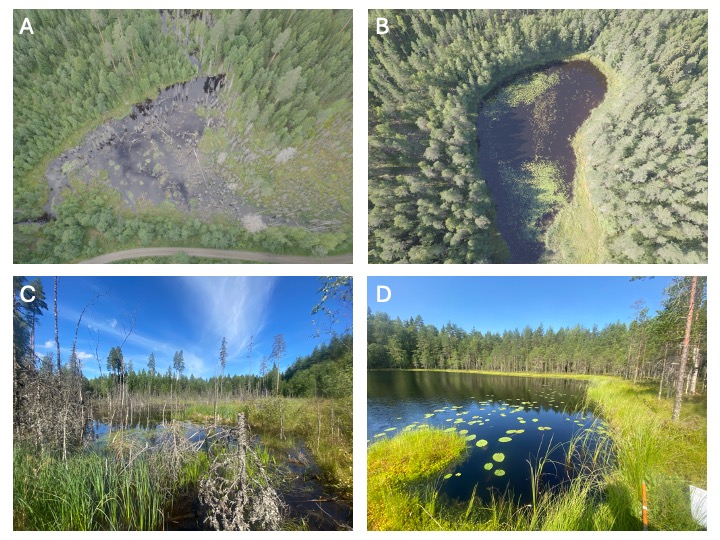
Click on an image to expand
Image Captions
Alan Law
Methodology
The project will be based primarily in Britain, with potential to add sites in Finland. The supervisory team has worked at some of these sites for almost 20 years, e.g. Law et al. (2017, 2026), and have assembled a wealth of supporting data and knowledge via a long-term programme of research and a succession of PhD studentships. Fieldwork will also be conducted at sites where beavers have been newly reintroduced in Britain, with supervisory support provided by the Beaver Trust, to potentially validate predictive models.
The candidate should have an interest in combining field ecology with quantitative approaches to biodiversity research. Experience of ecological fieldwork, plant identification, or ecological data analysis would be advantageous, but the student will be supported to develop these skills during the PhD. The project will provide training in meta-analysis, statistical modelling, spatial analysis, and predictive modelling.
You will first synthesise the literature to identify the factors that explain variation in biodiversity responses to beaver activity. You will then test these relationships against long-term datasets and develop models capable of predicting biodiversity trajectories in landscapes where beavers are newly establishing.
Project Timeline
Year 1
• Literature review and meta-analysis
• Field skills development
• Training needs assessment (e.g. statistical courses)
• Initial site scoping, development of experimental design and data collection
Year 2
• Ongoing sampling campaign
• Integration of early results with existing data
• Exploratory data analyses and start predictive modelling
• Advanced statistical training
• Finland sampling campaign
Year 3
• Opportunistic sampling in UK
• Data exploration, analyses and interpretation
• Draft papers
• Conference attendance to present interim results
Year 3.5
• Refining data analysis
• Paper and thesis writing
• International conference attendance to present developed results
Training
& Skills
The student will benefit from a mix of field and quantitative training, all of which are professional transferable skills. Further skills development will be supported through Iapetus-specific offerings and external courses based on a skills assessment. Example courses include: plant identification, statistical analysis with R, media training; leadership skills; conference skills (e.g., networking, poster and oral presentation skills); Geographic Information Systems (GIS); and grant budgeting/writing. We expect the research findings to be published as journal articles led by the PhD research student in leading environmental journals. Given the strong public and stakeholder interest in beavers, we expect that such articles will attract a high media interest. The student will also present results at conferences including the Scottish Ecology, Environment and Conservation Student Conference, the British Ecological Society annual conference, as well as to local and regional stakeholder and special interest groups to bring the project to a wider audience. The supervisory team are highly experienced in freshwater science, with access to a breadth of facilities at the Universities of Stirling and St Andrews, with inclusive and productive lab groups and PhD cohorts at both institutions. The student will also be expected to engage with large research projects at both universities involving their supervisors.
References & further reading
Law A., Gaywood M.J., Jones K.C., Ramsay P. & Willby N.J. (2017). Using ecosystem engineers as tools in habitat restoration and rewilding: beaver and wetlands. Science of the Total Environment 605–606. https://doi.org/10.1016/j.scitotenv.2017.06.173
Law A., Willby N.J., Spencer T., Bryan D., Foster G.N., Handley L.L., et al. (2026). Wetland landscape transformation by beavers: responses of biodiversity and functional indicators at multiple scales. Landscape Ecology. https://doi.org/10.1007/s10980-026-02303-4
Stringer A.P. & Gaywood M.J. (2016). The impacts of beavers Castor spp. on biodiversity and the ecological basis for their reintroduction to Scotland, UK. Mammal Review 46, 270–283. https://doi.org/10.1111/mam.12068
