

IAP-26-095
The ecology of fear: can restoring trophic connectivity promote woodland regeneration?
Restoring ecosystems is a fundamental priority to address the twin biodiversity and climate crises. In the UK, which has one of the lowest extents of forest cover in Europe, the extent of woodland habitat has increased significantly in recent decades, boosted by tree-planting initiatives and supported natural recolonisation. However, a combination of disease and pests, invasive species and elevated levels of herbivory, alongside stresses from changing climate, provide significant challenges to the health of woodlands and in meeting targets for woodland expansion (Woodland Trust, 2025). Deer numbers in particular have increased significantly over the last 50 years, prompting calls for increased control by culling and, more controversially, through the reintroduction of missing apex predators such as lynx to reinstate natural trophic cascades, a sought-after goal of trophic rewilding.
Textbook examples of trophic cascades across ecosystems from lakes to forests indicate that predator reintroduction can offer an effective route to restoring ecosystem integrity through regulating prey populations. Increased wolf abundance for example has been linked to improved tree recruitment in several North American case studies via reduced browsing pressure due to changes in distribution and vigilance of deer (e.g. Beschta & Ripple, 2019), although some supporting evidence also remains contested.
Populations of apex predators have been expanding in continental Europe now for several decades, aided by legal protection, reintroduction and natural colonisation. Recent studies (Van Beeck Calkoen et al., 2026) suggest the potential to reactivate a behavioural trophic cascade with indirect beneficial effects on woodland structure in line with experience elsewhere, while modelling has separately confirmed the technical feasibility of lynx reintroduction to the UK (Premier et al., 2025). However, the viability and consequences of reestablishing a landscape of fear for woodland vegetation dynamics in human-dominated areas and from which apex predators have long been absent are very poorly understood.
In this project we focus on tree regeneration as a measure of woodland health and as a potential benefit indicator of differences in herbivore pressure. The objectives will be to:
1. Design and implement an appropriate methodology based on conventional or novel approaches to assess spatial variation in the extent of tree regeneration at different scales and the relative contribution of deer activity versus other environmental drivers.
2. Experimentally manipulate deer herbivory using established deterrents alongside predator scent cues to quantify effects on sapling development.
3. Working in a European context with project partners explore if there are causal links between apex predator activity and woodland structure and quality via effects on herbivory by ungulates.
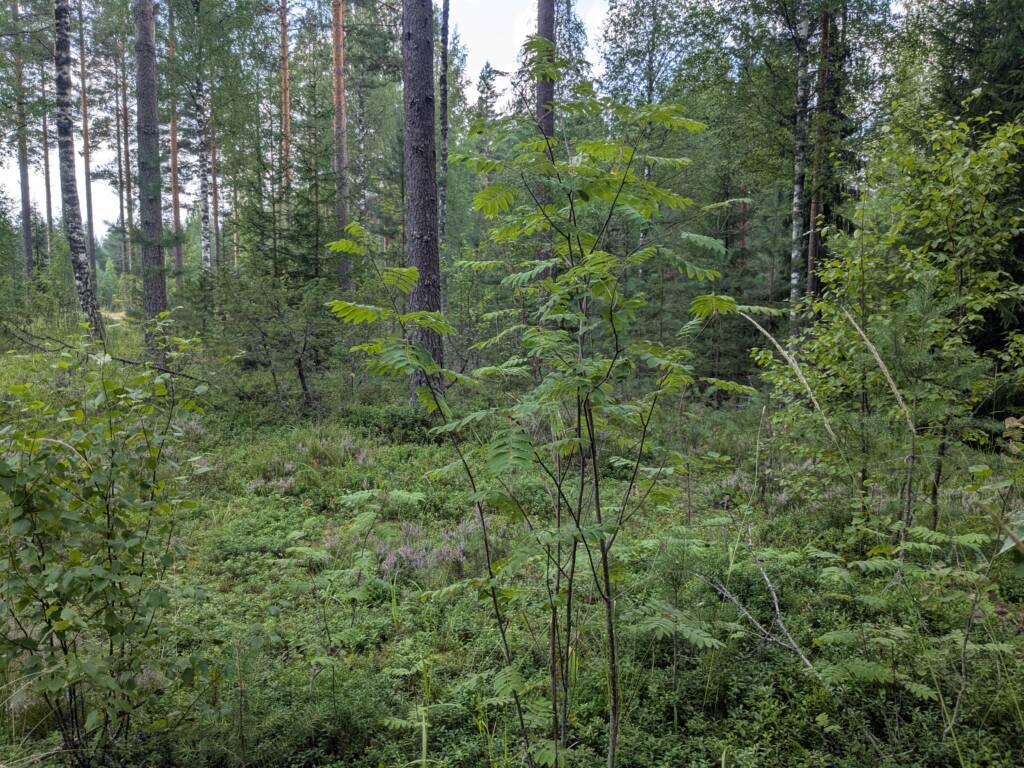
Click on an image to expand
Image Captions
Vibrant sapling layer regeneration, Evo, Finland (Nigel Willby)
Methodology
The project is a product of partnerships with rewilding organisations developed over several decades of research on the ecological effects of beavers and is an evolution of our past work on the novel consequences for woodland structure of interactions between reintroduced herbivores and high deer densities (Wilson et al., 2022) combined with a history of research on modern woodland ecosystems (Weaver et al., 2026). The first two objectives will focus on woodland landscapes within the Scottish Highlands at locations to be identified in consultation with Trees for Life.
Objective 1 will trial and implement a robust and repeatable method for quantifying baseline regeneration rates and evidence of browsing on different tree species in forested plots. This will be applied across locations where deer densities vary due to culling, habitat, topography and fencing but consequences for woodland vegetation are poorly known. As part of this Objective there will be the opportunity to explore drone-based LiDAR and other imagery and terrestrial laser scanning to establish differences in woodland regeneration at contrasting scales.
For objective 2 we will replicate a recent field experiment undertaken in Bavaria (Van Beeck Calkoen et al., 2026) which evaluated perceived predation risk of deer to different combinations of native carnivores achieved via urine and scat dosing and the resulting effects on browsing intensity of planted saplings. Fixed plots, including controls and those treated with predator urine, will be planted with a mix of saplings of native tree species present locally which will then be monitored regularly for evidence of browsing. Trail cameras and dropping counts will be used to quantify behavioural responses of red and roe deer, including changes in distribution and vigilance. Outcomes will be compared with fenced plots from which ungulates are fully excluded and those treated with current commercially available deer deterrents. In parallel to this experiment a network of trail cameras will be used to collect baseline data on deer vigilance to contextualise how this varies in the absence of predation risk and in relation to local habitat.
Objective 3 will benefit from a partnership with University of Helsinki and will be based in Evo, an extensive area of boreal forest in southern Finland. Here, lynx coexist with a range of ungulates (Malcangi et al., 2026) but related changes in ungulate distribution may have cascading effects on woodland structure. The project will explore differences in tree regeneration and browsing intensity in simple and structurally complex woodland habitat (which ambush predators prefer) or with increasing distance from lynx tracks, relative to variation in deer densities caused for example by proximity to deer feeding stations or imposed by enclosures.
Project Timeline
Year 1
Literature review; introduction to study sites and site managers, learn sampling and surveillance methods and plan sampling design and experimental set up for Obj1 and Obj 2; stakeholder liaison, training needs assessment (e.g. statistical or identification courses). Implement sampling regime
Year 2
Ongoing sampling campaign. training course on analysis of movement data, processing of camera imagery, integration with existing data. UK workshop/conference presentation of interim findings. Outreach to build support for project. Plan and implement Finnish sampling campaign. Draft paper 1
Year 3
Opportunistic sampling, Data exploration for Obj 3, analysis and interpretation of full dataset. Integration of additional external datasets. Draft paper 2. Present at national conference
Year 3.5
Thesis writing. International conference attendance to present results. Briefings on key findings for non-academic audience. Viva training.
Training
& Skills
The student will benefit from training covering a mix of field, lab and advanced analytical skills including processing and analysis of trail camera and vegetation data. Development will be further supported through Iapetus specific provision and external courses. Example courses include; statistical analysis with R, media training; insights to industry; leadership skills; conference skills (e.g., networking, poster and oral presentation skills); Geographic Information Systems; grant writing. The research findings will be published as journal articles led by the research student in leading ecology journals. Given the strong public and stakeholder interest in the subject area we expect that such articles will attract a high media interest. The student will also present results at conferences including the Scottish Ecology, Environment and Conservation Student Conference, British Ecological Society annual conference, as well as to local and regional stakeholder special interest groups to bring the project to a wider audience. The student will benefit from inclusive and productive lab groups and PhD cohorts at Stirling and Glasgow and will have the opportunity to engage with related large research projects at both institutions.
References & further reading
Beschta et al. 2018 Trophic cascades at multiple spatial scales shape recovery of young aspen in Yellowstone. Forest Ecology & Management 413 https://doi.org/10.1016/j.foreco.2018.01.055
Malcangi, F., Graco-Roza, C., Lindén, A., Sundell, J. and Loehr, J. (2026), Habitat complexity and prey composition shape an apex predator’s habitat use across contrasting landscapes. Ecography e08132. https://doi.org/10.1002/ecog.08132
Premier et al. 2025. Exploring the ecological feasibility of restoring Eurasian lynx to Great Britain using spatially explicit individual-based modelling. Journal of Environmental Management 389 https://doi.org/10.1016/j.jenvman.2025.125646
Van Calkoen et al. 2026 Experimental evidence for large carnivore risk cues reducing deer browsing intensity in a temperate forest. Journal of Applied Ecology 63 https://doi.org/10.1111/1365-2664.70267
Weaver J et al. 2026 Deer activity limits tree recruitment in woodland creation sites. Journal of Applied Ecology 63 https://doi.org/10.1111/1365-2664.70417
Wilson et al. 2024 Tree felling by beaver promotes regeneration in riparian woodlands whilst increasing resource availability for deer. Forest Ecology & Management 562 https://doi.org 10.1016/j.foreco.2024.121910
Woodland Trust 2025 State of the UKs woods and trees, 2025. https://www.woodlandtrust.org.uk/publications/2025/06/state-of-uk-woods-and-trees-2025/
