

IAP-26-062
The origin of animals: Building a precise timeline from the geological record
Moulting animals (ecdysozoans) comprise over half of living animal species. The radiation of their constituent phyla – including arthropods, nematodes and priapulid worms – is a key component of the Cambrian ‘explosion’ half a billion years ago. The developmental trajectories and body plans defined in this radiation persist to this day, but the evolutionary processes behind this burst of innovation remain obscure.
Exceptionally preserved Cambrian fossils provide a direct window on the evolutionary steps that underpin the group’s immense morphological and taxonomic diversity. However, many key taxa remain incompletely characterised, and are difficult to place amidst the uncertain relationships of early ecdysozoans, thus hindering the determination of the origin and diversification processes of this major group of animals.
This project will use X-ray tomographic investigation to characterize the internal morphology of fossils from the earliest Cambrian. Insights from evolutionary developmental biology will inform morphological phylogenetic analysis, and thus place these fossils in the context of early ecdysozoan evolution. By integrating developmental and genomic information from extant taxa with new fossil evidence, alongside embryo fossils such as Markuelia, the project will investigate how key body-plan innovations emerged during the Cambrian radiation. The project will ultimately resolve the evolutionary and developmental processes that gave rise to morphological complexity and diversity in one of the most successful animal groups on Earth.

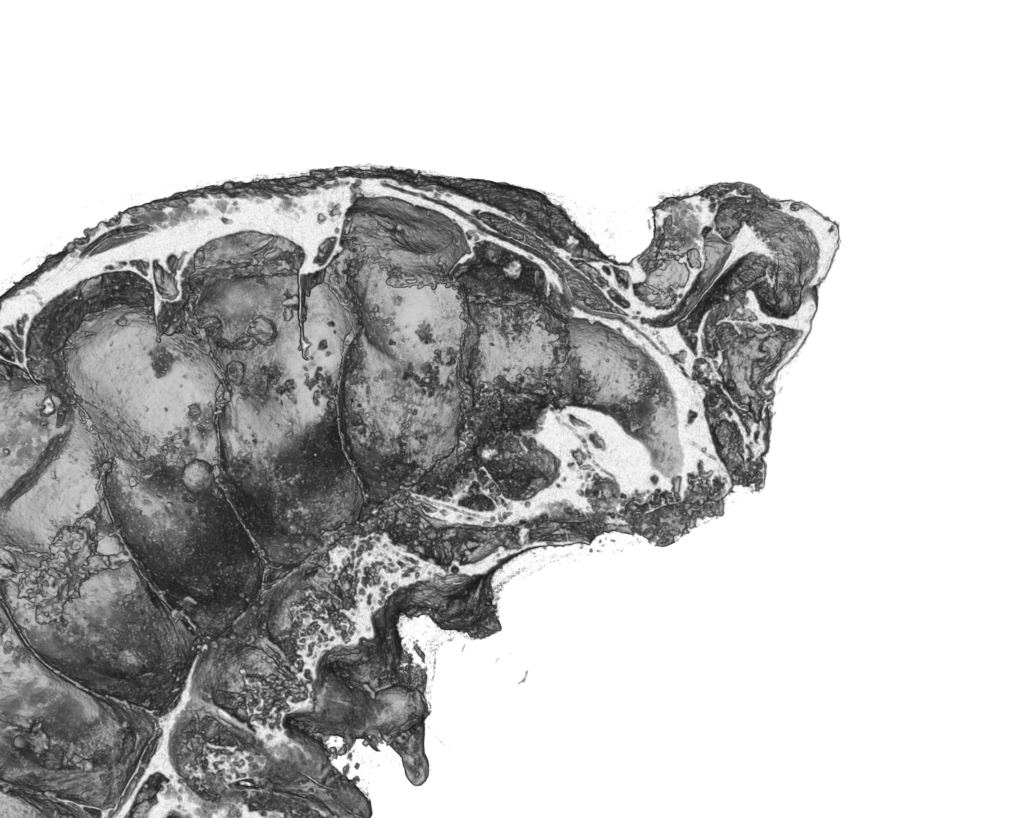
Click on an image to expand
Image Captions
External CT render of an embryonic Cambrian ecdysozoan, Youti yuanshi,Section showing corresponding internal anatomy in an embryonic Cambrian ecdysozoan, Youti yuanshi
Methodology
The project will combine palaeontological, phylogenetic and evolutionary-developmental genomics approaches.
Existing and newly generated microCT datasets of phosphatised Cambrian fossils will be segmented and reconstructed to recover external and internal anatomy. Newly identified anatomical features will be compared with extant ecdysozoans and annelids and incorporated into an expanded morphological character matrix. This will test whether presumed Fortunian ‘annelids’ may in fact include ecdysozoan relatives; and test whether potential pre-adult ‘priapulans’ could sit deeper in the ecdysozoan tree. Together, these analyses may inform the earliest steps towards assembling the ecdysozoan body plan, and will constrain the diversity that this group had (or had not) attained by the earliest Cambrian period.
To capitalize on these observations, these fossils will be included in a growing phylogenetic dataset that includes representatives of all ecdysozoan phyla, alongside a comprehensive representation of Cambrian ecdysozoans. Developmental data will be used to test and refine models of homology, with the resulting character formulations facilitating direct tests of the timing and sequence of morphological and developmental innovation. These tests will build upon a comprehensive phylogenetic analysis of early ecdysozoan evolution, which will employ state-of-the-art methods for morphological data, including new models and statistical approaches developed by the supervisory team.
The student will receive training in evolutionary developmental biology, virtual palaeontology, image segmentation, phylogenetic methods and statistical analysis, working closely with supervisors at Durham and St Andrews as well as international collaborators. The student may choose to engage in field collection to obtain biological comparative material, and to undertake fieldwork or collections visits to obtain palaeontological data in China.
Project Timeline
Year 1
– Training in microCT segmentation, phylogenetics and reproducible research methods.
– Segmentation and analysis of existing Xinliscolex and Qinscolex datasets.
– Development and expansion of ecdysozoan morphological character matrix.
– Presentation of initial results at a national conference.
Year 2
– Analyse additional fossil material from the Kuanchuanpu Biota and related collections.
– Characterise newly recognised anatomical features and assess homologies with comparable living taxa. This will be aided by comparisons to developmental genomics data that includes the rapidly expanding array of cell type and developmental Gene Regulatory Network reconstructions from burgeoning single cell RNAseq programmes alongside the increasingly dense coverage of high-quality ecdysozoan whole genome sequences that are publicly available.
– Undertake preliminary phylogenetic analyses.
– Prepare first manuscript for publication.
Year 3
– Complete phylogenetic analyses and macroevolutionary synthesis.
– Integrate developmental, genomic and fossil evidence, including evaluation of embryo fossils such as Markuelia.
– Test hypotheses concerning the origins of major ecdysozoan body-plan features.
– Submit further manuscripts.
– Present findings at international conferences.
Year 3.5
– Preparation of thesis; publication of papers.
Training
& Skills
By the end of the PhD, the student will have developed expertise in assembling, analysing and sharing large biological databases; time-calibrating fossil records; reconstructing evolutionary histories; and integrating biological and Earth-system datasets within reproducible computational workflows.
The student will be trained to apply phylogenetic and macroevolutionary analysis using Smith’s expanding ‘TreeSearch’ R ecosystem. The student will gain experience in applying probabilistic age-modelling approaches developed through Smith’s StratoBayes research programme, enabling direct quantification of uncertainty in evolutionary timescales. An existing collaboration with Tom Nye (Newcastle) to train the student to model morphological evolution.
Smith’s extensive experience in developing open-source statistical software and datasets will introduce the student to FAIR best practice for data sharing and analysis. Specialist training courses (e.g. HPC use via Durham Advanced Research Computing; Palaeontological Association methodological workshops) will support the student as they gain experience using R-based analytical workflows, statistical modelling and the development of reproducible computational pipelines. The student will have further opportunity to develop and apply skills in teaching and training through contributing to Smith’s undergraduate Research Skills course.
Ferrier (St Andrews) will be able to provide ready access to living comparative material either via the Scottish Oceans Institute, Gatty Marine lab, or via established international contacts to known sources (e.g. priapulids via Kristineberg marine station). He will also advise the student in comparative genomic analyses with a focus on developmental control genes, to provide a powerful complement to the morphological reconstructions and hypotheses generated during the project.
Wang (Universität Kassel & Northwest University, Xi’an) will train the student in the collection, preparation and imaging of phosphatized Cambrian fossils, and teach the student to interpret their anatomy and preservation.
Training in general skills, beyond that available through the Iapetus programme, will be delivered by Durham’s Centre for Academic Development; the supervisors will support the student to present research and develop academic networks at national and international conferences. The student will join fortnightly interdisciplinary meetings of Smith’s research group, comprising Earth scientists, archaeologists and mathematicians. The complementary skills of the supervisory team will impute a highly transferable quantitative skillset applicable across academia, industry and data-intensive research sectors.
References & further reading
CHIPMAN, A.D., FERRIER, D.E.K. et al. 2014. The first myriapod genome sequence reveals conservative arthropod gene content and genome organisation in the centipede Strigamia maritima. PLoS Biology 12(11):e1002005.
HARVEY, T. H. P., DONG, X.-P. and DONOGHUE, P. C. J. 2010. Are palaeoscolecids ancestral ecdysozoans? Evolution & Development, 12, 177–200.
LIU, Y.-H., QIN, J.-C., WANG, Q., MAAS, A., DUAN, B.-C., ZHANG, Y.-N., ZHANG, H., SHAO, T.-Q. and ZHANG, H.-Q. 2019. New armoured scalidophorans (Ecdysozoa, Cycloneuralia) from the Cambrian Fortunian Zhangjiagou Lagerstätte, South China. Papers in Palaeontology, 5, 241–260.
SMITH, M. R. and CARON, J.-B. 2015. Hallucigenia’s head and the pharyngeal armature of early ecdysozoans. Nature, 523, 75–78.
SMITH, M. R. and YANG, B. 2026. Directional biases in morphological evolution: implications for phylogenetic models. Systematic Biology, syag063, online ahead of print
