

IAP-26-077
Timing Giant and Critical Mineral Systems: A case study of the Central African Copperbelt
Critical raw materials including copper (Cu) and cobalt (Co) underpin the low-carbon energy transition, advanced technologies and economic resilience [1,2]. Yet the geological processes responsible for the exceptional metal endowment of giant Cu-Co mineral systems remain incompletely understood. Understanding how these mineral systems formed and evolved through geological time is therefore a fundamental scientific challenge with important implications for resources exploration.
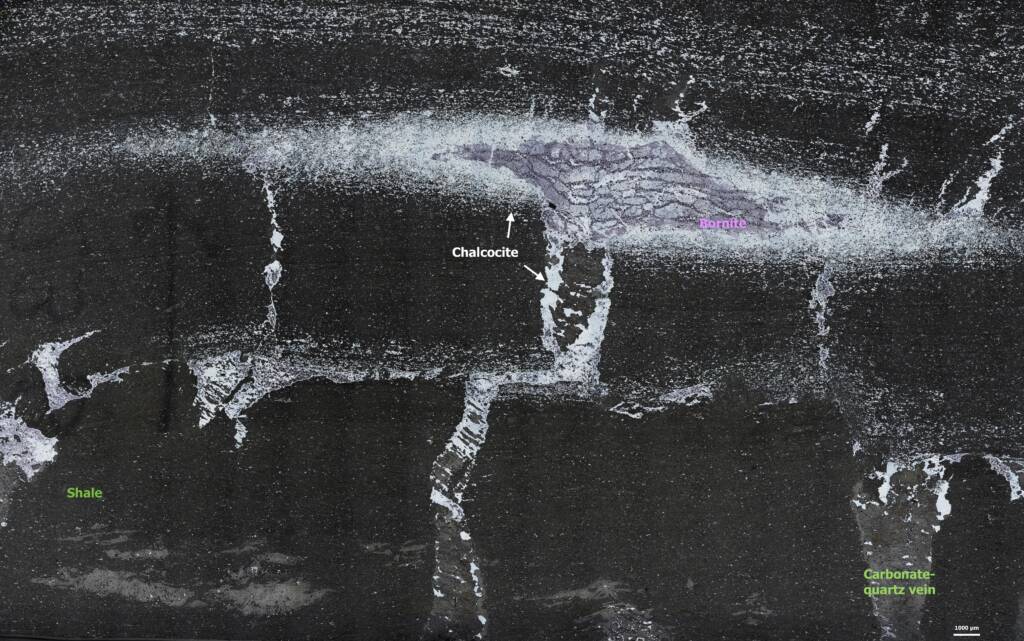
The Central African Copperbelt (CACB), extending across the Democratic Republic of the Congo (DRC) and Zambia, is the world’s most prominent sedimentary rock-hosted Cu-Co province [3]. Despite extensive research, the timing and relative importance of successive mineralising events remain debated [4–10]. This project will investigate the Fungurume deposits in the Tenke–Fungurume Mining district, DRC. Recent petrographic observations by the research group have identified early disseminated and stratiform sulphides crosscut by vein-hosted sulphides, followed by later Cu-rich, chalcocite-dominant assemblages that locally overprint earlier mineralisation [12] (Figure 1). These relationships provide an opportunity to investigate how successive mineralising events shaped the present-day distribution of Cu and Co.
The project will test the hypothesis that later Cu-rich mineralisation locally modified and potentially upgraded earlier Cu-Co ores, with the extent of modification controlled by host-rock properties and fluid pathways. By integrating petrography, geochronology and quantitative mineralogical and geochemical analyses, the project will establish the timing of mineralising events and assess how they contributed to the present-day metal inventory.
The research will address three questions:
1) When did the principal mineralising events occur, and how are they related?
2) How did later Cu-rich mineralisation modify the distribution of Cu and Co?
3) What do these relationships reveal about the formation and preservation of giant Cu-Co mineral systems?
Click on an image to expand
Image Captions
Figure 1. Photomicrograph showing extensive chalcocite mineralisation replacing and overprinting earlier bornite, occurring as disseminations in the shale wall rock and within carbonate–quartz veins.
Methodology
• Mineralisation history and sample selection
Existing drill core, geological information and assay data will guide the selection of representative samples spanning contrasting mineralisation styles and grades and stratigraphic units. Optical microscopy, scanning electron microscopy (SEM) and mineral chemical analyses will establish the paragenetic sequence, focusing on early stratiform and crosscutting vein-hosted carrollite (Co₂CuS₄)–chalcopyrite (CuFeS₂)–bornite (Cu₅FeS₄) assemblages and later chalcocite (Cu₂S)-rich mineralisation.
Host rock lithology, hydrothermal alteration and textural evidence for fluid pathways will be documented to investigate geological controls on mineralisation. This work will establish the framework for selecting suitable samples for geochronology and comparing early and late mineralising events.
• Geochronological constraints
Rhenium (Re)-Os geochronology will be the principal method for dating selected sulphide generations associated with early stratiform and later vein-related mineralisation and the chalcocite-overprinting events. Petrographic characterisation and preliminary geochemical screening will identify suitable sulphide targets. Analyses will be undertaken through Durham University’s specialist Re-Os laboratory.
Hydrothermal apatite and monazite identified in association with sulphide assemblages [12] will be assessed for complementary U-Th-Pb dating at the National Environmental Isotope Facility of British Geological Survey (BGS). These analyses will be prioritised where suitable minerals are available and their ages can resolve uncertainties left by the sulphide chronology.
All ages will be evaluated alongside petrographic relationships and analytical uncertainties. Mineral dates will not automatically be interpreted as ore formation ages; their significance will depend on evidence that the dated minerals formed during, or were reset by, the relevant hydrothermal event.
• Quantitative mineralogy and geochemical comparison
Micro-X-ray fluorescence (micro-XRF) mapping will be carried out at BGS to visualise Cu, Co, Fe, S and other informative elements in selected drill core samples. Elemental maps will be integrated with mineral identification, mineral chemistry and existing drill core assays to compare early and late mineralisation [12].
The investigation will focus on representative samples preserving clear relationships between earlier sulphides and crosscutting veins or overprinting assemblages (Figure 1). Mineral textures, phase proportions and elemental distributions will be used to assess how later Cu-rich mineralisation modified the existing ores.
Where precursor assemblages can be reasonably reconstructed, mineral proportions and Cu-Co contents will be compared to distinguish redistribution from additional metal input. Comparisons will consider host-rock composition and initial mineralisation. Quantitative estimates of metal gains or losses will be attempted where representative compositional data and reliable precursor constraints permit mass balance calculations.
• Integrated interpretation
Geochronological, mineralogical and geochemical results will be combined into an event-based model for the Fungurume deposits. This model will evaluate how successive mineralising events influenced Cu-Co distribution and preservation within the broader geological evolution of the CACB. The findings will improve understanding of the processes responsible for exceptional metal endowment and inform exploration models for sedimentary rock-hosted Cu-Co deposits.
The core programme comprises petrography, targeted Re-Os sulphide geochronology and micro-XRF-based quantitative mineralogy comparison. Uranium-Th-Pb dating and detailed mass balance calculations are complementary investigations, conditional on sample suitability and data quality.
Project Timeline
Year 1
Review existing data; select representative samples; establish the mineral paragenesis using petrography, SEM and mineral chemistry; and identify and prepare suitable samples for geochronological analysis.
Year 2
Undertake targeted Re-Os dating and assess suitable apatite and monazite for U-Th-Pb dating. Relate preliminary age results to the mineralisation sequence, and prepare the first manuscript where results permit.
Year 3
Complete micro-XRF mapping and quantitative mineralogical characterisation; integrate these results with drill core assays to evaluate Cu-Co distribution in relation to host rock lithology and fluid pathways, where feasible, assess metal gains or losses. Prepare further manuscripts.
Year 3.5
Finalise the integrated geological model, evaluate exploration implications, complete publications and thesis chapters, and submit the thesis.
Training
& Skills
The student will receive interdisciplinary training in economic geology, ore petrography, isotope geochronology and quantitative mineralogy and geochemistry, gaining hands-on experience through Durham University’s specialist Re-Os laboratory and the British Geological Survey’s geochronology and micro-XRF facilities.
By integrating geological observations with geochronological and geochemical data, the student will develop technical expertise alongside transferable skills in quantitative data analysis, critical thinking, problem-solving, project management, interdisciplinary collaboration and scientific writing and presentation. The project will connect fundamental research on giant Cu-Co mineral systems with the global challenge of securing critical mineral resources, preparing the student for careers in academia, geological surveys, mineral exploration and resource assessment.
References & further reading
[1] NRC (2008), Minerals, Critical Minerals, and the US Economy. National Academies Press.[2] IEA (2026), Global Critical Minerals Outlook.[3] Hitzman et al. (2012), The Central African Copperbelt.[4] Selley et al. (2005), A New Look at the Geology of the Zambian Copperbelt.[5] Muchez et al. (2015), Mineralium Deposita, 50, 437–447.[6–9] Sillitoe et al. (2017); Muchez et al. (2017); Hitzman & Broughton (2017); Sillitoe et al. (2017), Mineralium Deposita, 52.[10] Saintilan et al. (2018), Scientific Reports, 8, 14946.[11] Rosenfels & von der Heyden (2022), Ore Geology Reviews, 140, 104627.[12] Cazorla-Martínez, Zhou et al. (2026), Economic Geology, submitted.
