

IAP-26-101
The impacts of marine heatwaves and other anthropogenic stressors on kelp forest ecosystems
Kelp forests are the UK’s largest marine vegetated habitat, occupying ~ 12,000 km2 of shallow, coastal rocky reef (Yesson et al 2015). Found on all but the most exposed coastlines, kelp forests are highly productive three-dimensional habitats that support elevated biodiversity and provide human society with a wealth of ecosystem services including fisheries, nutrient and carbon cycling, coastal defence and tourism (Smale et al, 2013). Indeed, it has been estimated that the value of North Atlantic kelp forests is US$128 billion a year (Eger et al 2021). At the same time, kelp forests globally, are being subject to a range of anthropogenic stressors including climate change, invasive species and eutrophication, which has resulted in declines in kelp forest abundance in 38% of global ecoregions (Krumhansl et al 2016). UK kelp forests have historically been relatively resilient to change, however, there is increasing evidence that kelp forest structure is altering in response to climate warming (Smale et al 2025; Salland et al 2026).
Marine heatwaves (MHWs), periods of anomalously warm water sea temperatures, have increased in intensity, frequency and duration over the last 100 years and are increasingly being seen as key drivers of ecosystem change (Wernberg et al, 2025). For example, the Ningaloo Nino in 2011 led to the loss of kelp along 800 km of the coastline of Western Australia (Wernberg et al, 2016). Similar losses of kelp have been observed in Norway and Spain in response to climate warming and altered biotic interactions (increased competition and grazing) (Moy & Christie, 2012; Barrientos et al 2025). Indeed, it is becoming increasingly apparent that changes in biotic interactions are reducing the resistance of natural ecosystems to climate warming, including MHWs.
The UK has experienced two extreme MHWs in the last three years, however, there is only anecdotal evidence for its impact on marine ecosystems, with suggestions that recent MHWs have led to die offs of kelp and oysters, seabird breeding failures, changes in fisheries catches and an increase in warm water species. It is therefore imperative to set up monitoring sites to collect empirical evidence of the impacts of MHWs.
The proposed studentship will therefore investigate the impacts of MHWs on kelp forests ecosystems at the same time as exploring how changes in biotic interactions may alter the resistance of kelp forests to MHWs. The project will use a combination of in-situ surveys, manipulative experiments and modelling approaches to understand how kelp tipping points that could lead to the loss of UK kelp forests.
Click on an image to expand
Image Captions
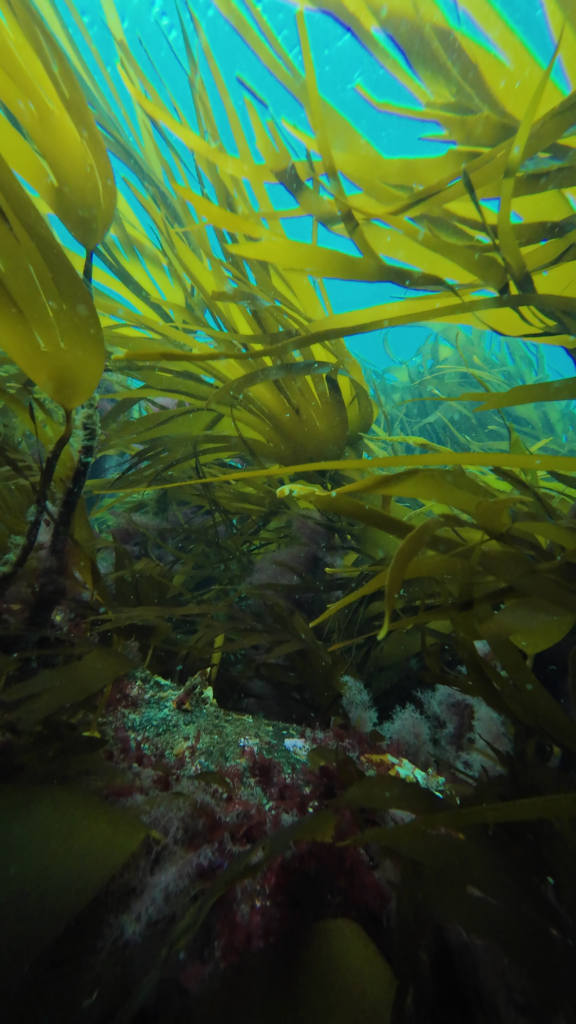
UK Kelp forest
Methodology
In-situ surveys
We have data extending back to 2021 on the structure of kelp forests in NE England (Catherall et al, 2026) and data back to 2014 for other regions in the UK (Smale et al 2016, Smale et al 2026). In NE England, annual surveys will continue at these sentinel sites to extend the data series and to provide a comparison in the case that a MHW occurs in these locations over the duration of the studentship. If there are no MHWs in NE England during the course of the studentship (unlikely) sampling will occur at locations where we have access to long-term data. Surveys will collect data on kelp density, morphology and associated diversity (fish, urchins, large crustacea).
Manipulative experiments
Temperature-controlled mesocosms will expose kelp to control and MHW conditions with each temperature treatment crossed with biotic stressor (e.g. high and low light, grazer presence and absence). Experiments will investigate different MHW intensities and structure (e.g. ramp-up rates, duration). Response variables will include survival, growth, tissue erosion and photosynthetic performance. Recovery measurements will distinguish reversible stress from persistent or delayed damage over the experimental period. Experiments may also look MHW responses of key components of kelp forests e.g. herbivores.
Species Distribution Modelling
Using data from in-situ surveys and manipulative experiments as well as projections of future climate states, a hybrid species distribution and process-based population model (SDM-PB) will predict changes in kelp density. SDM-PB will connect abundance predictions to experimentally supported responses to heat and grazing/light, providing a biological basis for projections under conditions poorly represented in current observations.
Project Timeline
Year 1
The first 6-months will focus on a review of the literature to refine the research questions and produce a literature review which will form the basis of the introductory thesis chapter. Fieldwork will be undertaken during the summer months at sentinel sites in NE England and opportunistic fieldwork will take place if a MHW occurs at sites where historic data exists. Manipulative experiments will examine the impacts of MHWs and grazing on kelp. IAPETUS training as well as other identified training will take place.
Year 2
Year 2 will also involve fieldwork during the summer at sentinel sites in NE England with opportunistic fieldwork if a MHW occurs at sites where historic data exists. Manipulative experiments will examine the impacts of MHWs and changes in light on kelp. Over the winter months the outcomes of experiments undertaken in year 1 will be written up for publication. Training in hybrid process-based species distribution modelling will take place.
Year 3
Year 3 will again involve fieldwork during the summer at sentinel sites in NE England with opportunistic fieldwork if a MHW occurs at sites where historic data exists. Data from the field surveys and in-situ sampling will be combined with climate projections to undertaken hybrid process-based species distribution modelling. Outcomes of year 2 experiments will be written up for publication.
Year 3.5
The last 6 months will focus on thesis write up and the preparation of the modelling chapter for publication.
Training
& Skills
The student will receive training in the analysis of spatial data, statistical analysis, modelling, experimental design and field and laboratory techniques. In addition they will develop skills in project management, communication to a varied audience, team work and networking. Where appropriate outside training will be undertaken e.g. in hybrid process-based species distribution modelling. If additional funding can be found and it is of interest to the student then there may be opportunity to gain professional qualifications in scientific diving if required.
References & further reading
Yesson et al (2015) doi:10.1017/S0025315414001453
Smale et al (2013) doi:10.1002/ece3.774
Eger et al (2021) doi:10.1038/s41467-023-373885-0
Krumhansl et al (2016) doi:10.1073/pnas.1606102113
Smale et al (2025) doi:10.1111/ddi.70042
Salland et al (2026) doi:10.1002/ecog.08280
Wernberg et al (2025) doi:10.1038/s44358-025-00058-5
Wernberg et al 2016 doi:10.1126/science.aad8745
Moy & Christie (2012) doi:10.1080/17451000.2011.637561
Barrientos et al (2025) doi:10.1016/j.jenvman.2024.123734
