

IAP-26-093
The Blueprint for Marine Biomineralization in a Changing Climate
Contribute to our understanding of the ocean’s feedback mechanisms on atmospheric CO2 through application of novel engineered microfluidics systems and comparative omics analyses to investigate calcification proteins and their evolutionary history.
Rapid climate change due to anthropogenic CO2 emissions is having a substantial impact on the marine system. This is particularly true for organisms which calcify, as ocean acidification (OA) progressively challenges their ability to produce their calcium carbonate shells.
This project will focus on a key calcifying taxon, the foraminifera. Foraminifera are protists which, via their sinking shells, are responsible for 21-80% (1,2,3) of the carbonate that reaches the deep ocean. This sinking of carbonate is the principal means by which inorganic carbon is introduced into the deep ocean, exceeding the sinking of organic fixed carbon by about six-fold. Therefore, it plays a significant role in the removal of carbon from the active ocean-atmosphere carbon pool (4,5). How ongoing ocean acidification (OA) and warming will affect the size of the foraminiferal carbonate sink in coming decades is presently poorly understood. This is largely because the molecular mechanisms controlling biomineralization in the foraminifera and the influence of the ocean physicochemical conditions remain unresolved.
Molecular mechanisms of biomineralization in foraminifera include the production of an organic membrane and its (semi) enclosure in a privileged space for calcite nucleation to occur, seawater vacuolization, pH changes, transmembrane ion transport, and carbon-concentrating mechanisms (6,7,8). All are key to understanding foraminiferal biomineralization, its evolution and adaptability to a changing climate.
In situ and experimental observations of calcification in different species of foraminifera (9,10,11) demonstrate that they can respond differently to changes in pH/pCO2. This is reflected in emerging models of biomineralization-related transmembrane ion transport, which have identified differences between species (12). These species represent evolutionary lineages that originated during different geological periods, when oceanic conditions, including pCO₂ and Mg/Ca ratios, differed substantially (13). This raises the question of whether the differences observed today reflect these contrasting evolutionary histories, and whether evolutionary history influences how foraminifera will respond to future climate change.
Using transcriptome and shell proteome data generated in the laboratories of CB and AS, together with publicly available datasets from EMBL-EBI and NCBI, this project will investigate the molecular basis and evolution of foraminiferal biomineralization. The project will focus on the planktonic foraminifer Orbulina universa and the benthic foraminifer Ammonia sp. T6, for which shell proteome datasets are available, while extending comparative analyses to other foraminiferal species with different evolutionary histories.
The overarching aims of this project are to:
(i) Investigate the evolutionary conservation and diversification of biomineralization-related genes across foraminifera. Conduct comparative genomics/transcriptomics using newly generated and publicly available datasets to identify orthologous genes associated with biomineralization, compare their sequences and evolutionary relationships, and investigate these patterns in the context of foraminiferal phylogeny and geological history.
(ii) Determine the functional roles of shell proteins in regulating mineral nucleation. Analyse existing extracted shell proteins from Orbulina universa using novel microfluidic systems to investigate the effects of individual proteins and protein combinations on calcite nucleation under different experimental conditions, identifying proteins and protein interactions that promote or inhibit mineral formation.
(iii) Integrate functional and evolutionary evidence to develop a mechanistic understanding of foraminiferal biomineralization. Combine shell proteomic, experimental and comparative sequence data to relate the functional properties of candidate shell proteins to their evolutionary conservation and diversification, identifying potential links between protein evolution and differences in calcification mechanisms across foraminiferal lineages.
As a PhD student on this project, you will have opportunity to develop your bioinformatics skills for omics analyses and develop some microengineering and Raman/SEM microscopy skills across the labs in Stirling and Glasgow Universities. You will also join a multidisciplinary international community working of foraminiferal research.
Click on an image to expand
Image Captions
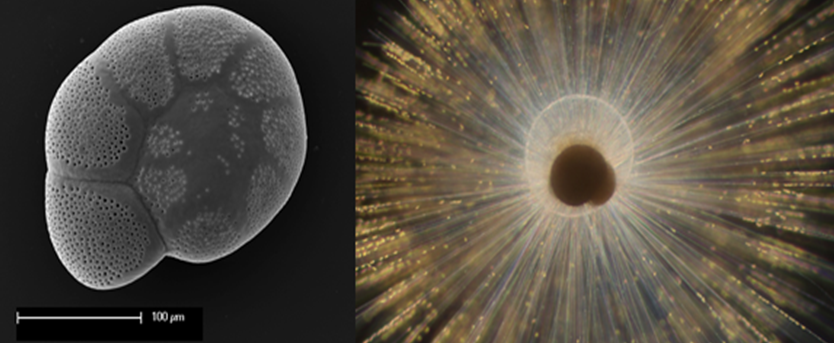
The benthic foraminifera Ammonia T6 (SEM image, left), and the model planktonic foraminifera Orbulina universa (light microscope image, right) with dinoflagellate symbionts arrayed along its calcite spines. (Images Clare Bird and Jennifer Fehrenbacher.)
Methodology
This project will focus on two main methodological areas. Firstly, a range of bioinformatics tools will be utilised to interrogate and interpret proteomics data to understand what kinds of proteins are in the shell proteome. You will make predictions of protein function using Interproscan and advanced protein structural predictions (e.g. alpha fold) and classify protein biophysical properties relevant for biomineralization using ProminTools. For evolutionary work, you will use a comparative transcriptomics approach with tools such as OrthoFinder and BUSCO to identify shared genes across taxa to reconstruct the evolutionary history of key proteins.
Secondly, purpose-designed microfluidic platforms combined with real-time Raman spectroscopy will be used to test how purified shell proteins and shell membranes affect calcite nucleation. This approach allows us to image nucleation of calcite under different conditions, such as pH, temperature, pCO2, and magnesium/calcium ratios.
Project Timeline
Year 1
The focus will be on developing your knowledge about foraminifera and biomineralization, and you will be trained in, and use bioinformatics tools for working with the available shell proteome data, to characterise the proteins identified in each available shell proteome fraction and their potential roles in biomineralization. You will rank them according to potential relevance for biomineralization. This will inform the order in which you carry out the experimental analysis of the protein fractions and will also inform the comparative omics investigation for orthologues. You will also learn how to build, set-up and run the microfluidics system in Glasgow, ready for turning your attention to this in your second year.
Year 2
During the second year, with microfluidics training completed, you will run your microfluidics experiments to test the nucleation capabilities of the shell protein fractions. Informed by the proteome analysis carried out in year 1 you will assess the proteins’ biomineralization roles using both lines of evidence.
Early in year 2 you will complete training at NEOF, as well as by your Stirling supervisors, in comparative omics. You will then investigate orthologous genes across wide ranging taxa and evolutionary history. You will attend and present your work at the Gordon Biomineralization conference in 2028 and complete your first manuscript on key biomineralization proteins.
Year 3
Completion of the comparative omics investigation, and integration and analysis combining all data to develop a mechanistic understanding of foraminiferal biomineralization. Attend Forams 2023 conference in Poland and present your work. Manuscript writing (orthologous biomineralization proteins and the influence of evolutionary history on biomineralization mechanisms).
Year 3.5
The last six months will be focused on thesis and manuscript writing (as above).
Training
& Skills
This PhD will principally be held in the vibrant and multidisciplinary research environment of the School of Life and Environmental Sciences (SoLES) at the University of Stirling, where several groups are working on marine biomineralization. You will be part of a multidisciplinary international research team that have been working together on marine biomineralization and climate change for several years. You will become part of the evolution, molecular and microbial research group, EvoMoB, made up of various academics and their groups across SoLES and will be able to attend regular lab group meetings, along with the weekly seminar series giving informal and formal opportunities for research presentation. You will also participate in the yearly Postgraduate Conferences held in SoLES. You will receive training in subject specific and generic skills. Specific skills will include bioinformatics tools for proteomic and transcriptomic analyses, via the supervisory team at Stirling and through specific training courses as required (NEOF).
You will work at the University of Glasgow under the supervision of Prof Huabing Yin in the Advanced Research Centre where you will be trained in the production and use of the microfluidics systems, and Raman microscopy.
More generic skills will include the Stirling R and statistics course and Iapetus DTP training. You will also be expected to participate in training opportunities in a range of research and transferable skills offered at Stirling University, for example scientific communication skills (written and verbal) for successful manuscript writing and presentation at conferences. You will be expected to attend conferences to develop networking skills and to further develop your presentations skills.
References & further reading
1. Schiebel, R.: Planktic foraminiferal sedimentation and the marine calcite budget, Global Biogeochemical Cycles, 16, https://doi.org/10.1029/2001gb001459, 2002.
2. Schiebel, R., Barker, S., Lendt, R., and Thomas, H.: Planktic foraminiferal dissolution in the twilight zone, Deep Sea Research Part II: Topical Studies in Oceanography, 54, 676–686, https://doi.org/10.1016/j.dsr2.2007.01.009, 2007.
3. LANGER, M. R.: Assessing the Contribution of Foraminiferan Protists to Global Ocean Carbonate Production1, Journal of Eukaryotic Microbiology, 55, 163–169, https://doi.org/10.1111/j.1550-7408.2008.00321.x, 2008.
4. Cartapanis, O., Galbraith, E. D., Bianchi, D., and Jaccard, S. L.: Carbon burial in deep-sea sediment and implications for oceanic inventories of carbon and alkalinity over the last glacial cycle, Clim Past, 14, 1819–1850, https://doi.org/10.5194/cp-14-1819-2018, 2018.
5. Hayes, C. T., Costa, K. M., Anderson, R. F., Calvo, E., et al.: Global Ocean Sediment Composition and Burial Flux in the Deep Sea, Global Biogeochem Cy, 35, https://doi.org/10.1029/2020gb006769, 2021.
6. Toyofuku et al. 2018. Proton pumping accompanies calcification in foraminifera. Nature Comms. doi: 10.1038/ncomms1414
7. Nagai, Y., Uematsu, K., Chen, C., Wani, R., Tyszka, J., and Toyofuku, T.: Weaving of biomineralization framework in rotaliid foraminifera: implications for paleoceanographic proxies, Biogeosciences, 15, 6773–6789, https://doi.org/10.5194/bg-15-6773-2018, 2018.
8. Tyszka, J., Bickmeyer, U., Raitzsch, M., Bijma, J., Kaczmarek, K., Mewes, A., Topa, P., and Janse, M.: Form and function of F-actin during biomineralization revealed from live experiments on foraminifera, Proc National Acad Sci, 116, 201810394, https://doi.org/10.1073/pnas.1810394116, 2019.
9. Moy, A. D., Howard, W. R., Bray, S. G., and Trull, T. W.: Reduced calcification in modern Southern Ocean planktonic foraminifera, Nature Geoscience, 2, https://doi.org/10.1038/ngeo460, 2009.
10. Zarkogiannis, S. D., Antonarakou, A., Fernandez, V., Mortyn, P. G., Kontakiotis, G., Drinia, H., and Greaves, M.: Evidence of Stable Foraminifera Biomineralization during the Last Two Climate Cycles in the Tropical Atlantic Ocean, J Mar Sci Eng, 8, 737, https://doi.org/10.3390/jmse8100737, 2020.
11. Keul, N., Langer, G., Nooijer, L. de, and Bijma, J.: Effect of ocean acidification on the benthic foraminifera Ammonia sp. is caused by a decrease in carbonate ion concentration, Biogeosciences, 10, 6185–6198, https://doi.org/10.5194/bg-10-6185-2013, 2013.
12. François, D., Reichart, G.-J., and Nooijer, L. J. de: Open or closed: pH modulation and calcification by foraminifera, Sci. Adv., 11, eadq8425, https://doi.org/10.1126/sciadv.adq8425, 2025.
13. Nooijer, L. J. de, Sampedro, L. P., Jorissen, F. J., Pawlowski, J., Rosenthal, Y., Dissard, D., and Reichart, G. J.: 500 million years of foraminiferal calcification, Earth-Sci. Rev., 243, 104484, https://doi.org/10.1016/j.earscirev.2023.104484, 2023.
Prada, F., Haramaty, L., Livnah, O., Shaul, R., Abramovich, S., Mass, T., Rosenthal, Y., and Falkowski, P. G.: Proteomic characterization of a foraminiferal test’s organic matrix, Proc. Natl. Acad. Sci., 121, e2417845121, https://doi.org/10.1073/pnas.2417845121, 2024.
Ujiié, Y., Ishitani, Y., Nagai, Y., Takaki, Y., Toyofuku, T., and Ishii, S.: Unique evolution of foraminiferal calcification to survive global changes, Sci. Adv., 9, eadd3584, https://doi.org/10.1126/sciadv.add3584, 2023.
