

IAP-26-131
Refugee camps: climate change, one-health, and solidarity.
According to the UN Higher Commission for Refugees (UNHCR) approximately 21 % of refugees (9.3 million people) live in some kind of settlement, including temporary settlements built for displaced people, commonly referred to as “refugee camps”. Such refugee camps can vary considerably in terms of their size, age, administrative status, and the rights that their residents are allowed to exercise. Refugee camps are designed as temporary settlements built to provide immediate safety, protection, and basic aid to people fleeing war, violence, or persecution. However, some camps have persisted for decades with several generations of people born into settlements that were only ever meant as a temporary emergency resource. Consequently, there is a clear distinction between refugees in immediate need of lifesaving services to reduce suffering, e.g., emergency food and water, medical aid and shelter, and longer-term refugees in need of services, and greater agency of their lives. Importantly, longer-term refugee camps often generate resentment amongst local citizens, especially when refugees are perceived to receive greater support than surrounding communities, and when the presence of a camp places important strains on scarce resources such as water, firewood, and agricultural land.
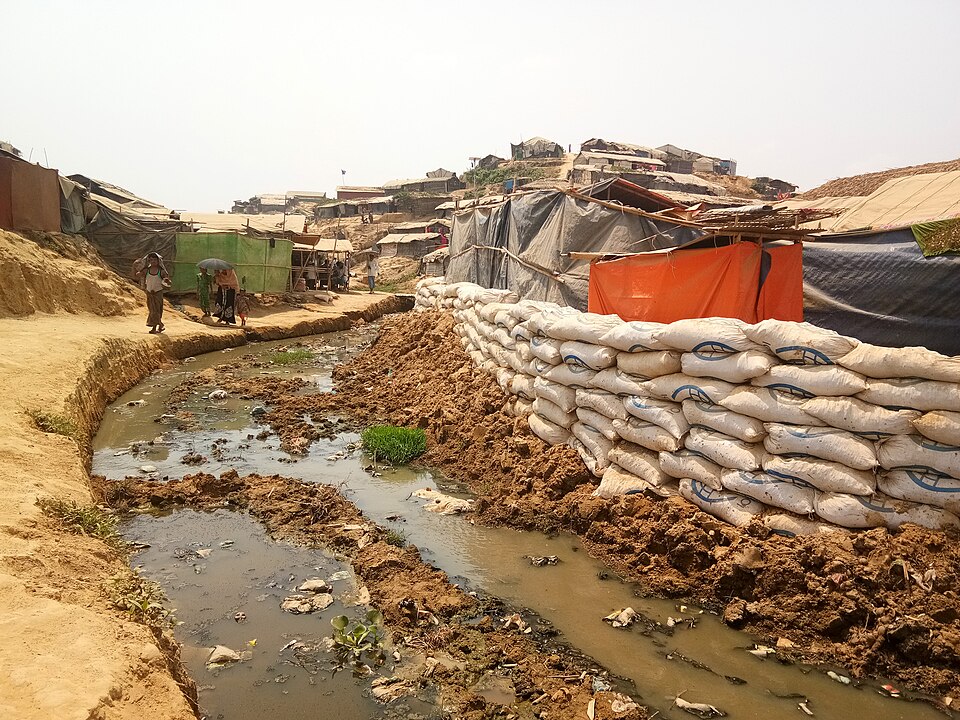
The Kutupalong mega-camp network in Cox’s Bazar, Bangladesh, is the world’s largest and most densely populated refugee settlement, hosting nearly one million Rohingya refugees who fled from violence and persecution in neighbouring Myanmar in 2017. These camps were rapidly established by clearing over 2,500 hectares of forest to build shelters and source firewood; this deforestation has destabilised the sandy, clay-based soil in this hilly area, and increased flooding and erosion within the site. Cox’s Bazar sits directly on historical cyclone tracks in the Bay of Bengal, where climate change is generating fewer but significantly more intense, destructive tropical storms and unpredictable rain bursts. However, camp regulations require shelters to be built of temporary materials like bamboo and tarpaulin which puts them at significant risk during high winds and storm surges. Furthermore, the camp network at Cox’s Bazar suffers from extreme heat (with common heatwaves over 40°C), water scarcity, and saltwater intrusion into drinking water resources.
Refugee camps are clearly a stressed and stressful environment for both humans and the ecological systems which they have become entwined with. However, whilst acknowledging the psychological complexities of refugees, and the structural barriers inherent in refugee camps, evaluating how refugee camps perform within a one-health and ecological framework could improve outcomes for both human and environmental health and give refugees far more agency about the environment they find themselves living in.
Therefore, the overarching aim of this project is to explore the human-environment interactions within the refugee camps at Cox’s Bazar in Bangladesh. Specifically, the objective of this PhD is for the student to quantify metrics for both human health and environmental sustainability in a refugee camp, and by exclusively using participatory approaches explore the potential to co-develop and design context-specific, situation-sensitive, and environmentally sustainable approaches to challenges at the interface of human and ecological health in refugee camps. This could include climate smart, small-scale agroecology/agroforestry approaches for on-site food production systems, sustainable waste management systems (including circular economy approaches and sustainable sanitation systems), and ecological restoration of degraded land.


Click on an image to expand
Image Captions
Rohingya refugee camp in Ukhiya, Cox’s Bazar. Image by Md shameem ul islam via Wikimedia Commons (CC BY 4.0),Rohingya Refugees Camp in Ukhia, Cox’s Bazar. Image by Cpt Raju, via Wikimedia Commons (CC BY 4.0),Rohingya Refugees Camp in Ukhia, Cox’s Bazar. Image by Seyyed Mahmoud Hosseini, via Wikimedia Commons (CC BY 4.0),Sandbags in Balukhali refugee camp, Cox’s Bazaar, to prevent flooding during the monsoon season. Image by N. Hossain.
Methodology
By using an interdisciplinary approach, this project will tackle an emerging and globally significant issue, and the studentship will uniquely link public health, environmental sustainability, and social anthropology within a multidisciplinary sustainable development and humanitarian framework. The project will adopt methods and theories from both the natural and social sciences and will employ both qualitative and participatory approaches with a significant level of engagement with local communities. However, the actual direction of the research will be determined by the student’s own strengths and interests within the subject area of ‘environment and health’, where, for the purposes of this project, the one-health agenda is defined as widely as possible.
The field research will be based in the refugee camps of Cox’s bazar in Bangladesh, where our partner (icddr,b) and project co-supervisor (Dr Hanifi) have worked since its inception in 2017. Proof of concept experimental designs, lab work and any controlled environment research (e.g., soil, water or crop science) will be carried out at the University of Stirling, where the student will be based. The overlapping experimental phases of the project will take 36 months to complete, with the remaining time being allocated to writing the thesis and papers for publication, attending conferences and networking with stakeholders.
Project Timeline
Year 1
Following a critical review of the literature, the student will conduct a global meta-analysis on all published studies (including the grey literature) on environmental sustainability metrics at refugee camps; this will provide the first global dataset quantifying human-environment interactions across these diverse geographic settings. This piece of work, together with engagement with a range of agencies (UNHCR, WFP, UNICEF, UNRWA) and NGOs, will provide the framework necessary to design the core activities for the fieldwork.
Year 2
Field mission to Cox’s Bazar, Bangladesh. This first field visit will involve significant engagement with refugee communities and camp coordinators (focus groups, walking interviews, surveys, etc) together with extensive ecological surveying and mapping to test for water and soil quality (e.g., microbial and pathogen indicators, antimicrobial resistance, metrics for contamination and pollutants, waste management, land degradation, etc). This will provide the required information to identify and plan mitigation or intervention strategies, and subsequent development and design of context-specific, situation-sensitive environmentally sustainable and resilient systems to target quantifiable challenges in refugee camps. During this phase of the project the student will begin to develop and test these systems back in the UK.
Year 3
Continue developing and testing the chosen system and optimising it for use in the field. Second field mission to Cox’s Bazar to integrate your system(s) and collect data on its performance within the context of a refugee camp. Data and analyses from the research will then be used for the production of a Policy & Practice briefing paper. By delivering socio-policy relevant recommendations for joint human health and environmental management in refugee camps, this studentship will have significant and far-reaching implications for international agencies such as the UNHCR, governmental regulators and public health organisations.
Year 3.5
The remaining time being allocated to writing the thesis and papers for publication, attending conferences & networking with stakeholders
Training
& Skills
This studentship will provide a platform to build an interdisciplinary research career in sustainable development, humanitarianism, and environmental/public health. Extensive skill development in field work will include comprehensive training in sampling and monitoring techniques, while the student will also benefit from working closely with experienced field researchers in Bangladesh. The studentship will broaden the scope of the applicant’s skills base by providing specialist training in ecological and environmental science, population health, participatory research and community engagement. The student will develop broad expertise in research science, including microbiological techniques and soil and water science, together with skills in the social sciences & applied geography.
References & further reading
Al Meselmani, M.A., Wright, H.C., Cameron, D.D., Ryan, A.J., (2020). How scientists and refugees brought green to the Desert Garden. Nature Reviews Earth & Environment, 1, 439-439.
Bashar, S., Bernell, D., (2026). Stranded ecosystems: mitigating environmental impacts of Rohingya refugee camps in Cox’s Bazar. Journal of Environmental Planning and Management, 69, 2325-2343.
Fransen, S., Werntges, A., Hunns, A., Sirenko, M. and Comes, T., (2024). Refugee settlements are highly exposed to extreme weather conditions. Proceedings of the National Academy of Sciences, 121, p.e2206189120.
Liu, J., Zevenbergen, C., Lu, J., Qi, Q., Veerbeek, W., Chowdhury, S.W. and Qian, L., 2026. Land-use governance of borderland protected areas under refugee expansion and climate threats: evidence from Teknaf, Bangladesh. Land, 15, 1024.
