

IAP-26-099
Quantifying the Freshwater Extinction Risk driven by Pollution: Ecotoxicology to inform global targets
Freshwater ecosystems support a disproportionate number of species for the area that they cover[1] and provide essential ecosystem services[2]. However, freshwater biodiversity is declining more rapidly than terrestrial or marine equivalents[3], for which a primary driver is aquatic pollution. The Convention on Biological Diversity’s Global Biodiversity Framework (GBF) seeks to reduce pollution (Target 7), to support its critical priority of reducing species extinction risk. Tracking progress against this goal increasingly utilises the Species Threat Abatement and Restoration (STAR) metric[4]. STAR quantifies opportunities to reduce global extinction risk through threat reduction, and recent methodological advances[5], allowed the inclusion of freshwater taxa for the first time[6]. However, STAR is limited by profound data gaps regarding the scope, severity, and mechanisms of threat, with 90-100% of severity scores absent in IUCN Red List assessments for pollution threats to freshwater taxa.
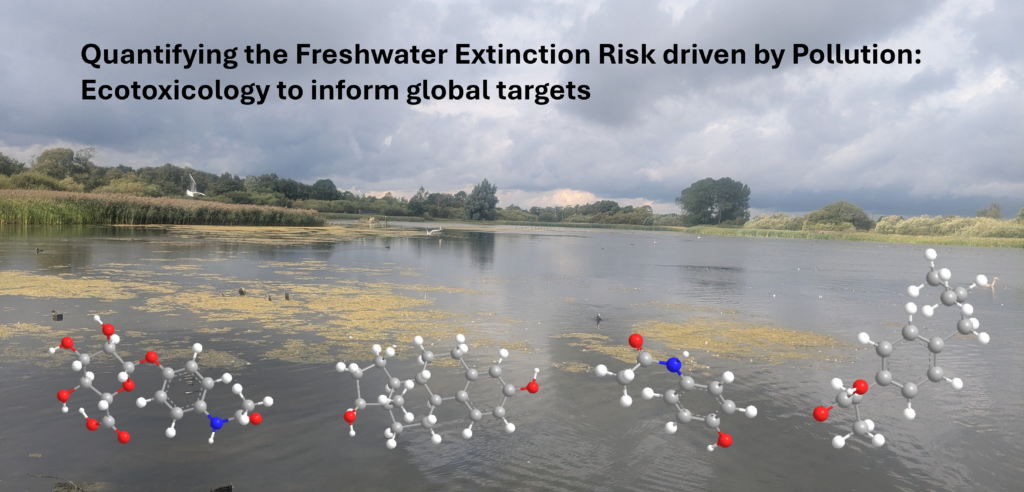
Although there is considerable understanding of the extent and intensity of pollution[7] and the bioremediation potential of plant communities[8], this knowledge has not yet been combined to fill those data gaps that are crucial to estimating the true contribution of pollution to freshwater species’ extinction risk. Furthermore, the habitats and plant communities already studied do not represent the full diversity of habitats in which freshwater species occur. Finally, in nature, organisms are never exposed to single compounds; instead, they navigate a complex “pharmaceutical soup” containing non-steroidal anti-inflammatory drugs (NSAIDs) like paracetamol and ibuprofen alongside endocrine-disrupting chemicals (EDCs) like estradiol. A critical knowledge gap exists regarding how these compound mixtures are processed in naturally-occurring habitats.
This interdisciplinary project will bridge this gap by combining Newcastle University’s expertise in global biodiversity policy, species extinction risk metrics, and analytical/medicinal chemistry with freshwater ecology and plant biology from University of Stirling.
By combining pollutant intensity maps, habitat-specific bioremediation potential, and new toxicokinetic data, this project will fill critical evidence gaps and improve estimates of freshwater extinction risk from pollution. Such knowledge will directly support the implementation of the GBF.
Click on an image to expand
Image Captions
Dr M. A. Carroll, Newcastle University
Methodology
The project will employ a tiered approach, combining global-scale biodiversity informatics with highly controlled, mechanistic laboratory ecotoxicology.
Task 1: Global Spatial Informatics and Knowledge-Gap Mapping
The student will initially undertake a comprehensive assessment of freshwater macroinvertebrates and their threats and habitats represented within STAR input datasets. The student will combine species-level data with spatial chemical-monitoring datasets to map where confidence in pollution threat severity and habitat bioremediation potential is weakest. This macroecological baseline will identify priority regions, understudied habitats and chemical classes.
Task 2: Mechanistic Ecotoxicology, Mixture Toxicity, and Toxicokinetics
To generate precise supplementary data on understudied habitats, laboratory-based experiments will focus on functionally representative plants grown in a hydroponic system compatible with low concentrations of organics[9] e.g. amber glass, Teflon collars and pipework.
Single-Compound Baselines: Establish baseline bioaccumulation data for acute and chronic concentrations for paracetamol, ibuprofen (link to existing literature) and estradiol at environmentally relevant concentrations.
Pharmaceutical Mixtures: Evaluate the additive, synergistic, or antagonistic impacts of realistic multi-class pharmaceutical cocktails by running factorial co-exposures of three test compounds.
Toxicokinetics & Metabolism: The student will deploy high-performance liquid chromatography-mass spectrometry (LC-MS/MS) to track the time-course depletion of parent compounds in the water. Crucially, tissue extraction protocols will be developed to identify and map in-vivo metabolic breakdown products, biotransformation rates, and bioaccumulation within the different plant species.
Task 3: Macroecological Modelling and Metric Integration
The empirical data generated in Task 2 will be combined with existing data from the literature to formulate pollution severity scores for species occurring in freshwater habitats. The student will evaluate how integrating these refined severity scores with pollution intensity maps alters spatial STAR scores and global conservation priorities, translating raw laboratory chemistry into actionable policy tools.
Project Timeline
Year 1
Foundations, Informatics & Protocol Validation
• Refine workplan
• Literature Synthesis: Complete a comprehensive literature review of the bioremediation potential of pharmaceutical compounds in different freshwater habitats.
• Core Technical Training: hydroponics (system design and construction), ecotoxicological experimental design, geospatial biodiversity informatics, and advanced statistical programming (R and/or Python).
• Map knowledge gaps in habitat-level bioremediation potential by assessing STAR-input datasets, global surface water monitoring networks, and existing quantitative estimates of habitat-level bioremediation potential.
• System Optimization: Identify understudied habitats and using appropriate plant species validate a corresponding model hydroponics system for studies under controlled laboratory conditions
Year 2
Core Empirical Testing & Toxicokinetic Assays
•Analytical Chemistry: Conduct controlled laboratory ecotoxicology experiments quantifying persistence, biotransformation and bioaccumulation of contaminants after single and repeated exposure to single compounds (e.g. paracetamol) and multi-class mixtures (paracetamol + ibuprofen + estradiol).
• LC-MS/MS to track the time-course depletion of parent compounds in the water[10].
• As changes in the non-visible spectrum of leaves occur prior to classical indicators of plant stress. Hyperspectral Imaging will be investigated as a diagnostic tool due to the low concentrations typically encountered[11].
• Dissemination & Writing: Present empirical toxicological findings at a national conference (e.g., British Ecological Society or SETAC UK).
Year 3
Continue experiments & Predictive Modelling
• Model Integration: Integrate collected and existing data to generate refined pollution sensitivity estimates.
• Macroecological Modelling: Combine refined sensitivity estimates and pollution exposure data to assess impacts on STAR scores and freshwater conservation priorities.
• Present insights at a major international conference (e.g. International Congress on Conservation Biology).
Year 3.5
Submission
• Complete thesis (writing and publishing throughout the project will be encouraged)
• Optional policy packaging: prepare summary brief for IUCN Species Survival Commission Freshwater Conservation Committee and GBF Target 7 stakeholders
Training
& Skills
This project, at the interface of analytical environmental chemistry, quantitative macroecology, and global conservation policy, will provide the student with the transdisciplinary training critical to the understanding of complex systems. Collaborative work between Newcastle, the Iapetus network and existing partners will further enhance this training.
Technical & Laboratory Skills
• Advanced Analytical Chemistry: liquid chromatography-mass spectrometry (LC-MS/MS), sample preparation, compound trace analysis in water and biological tissues.
• Toxicokinetics & Ecotoxicology: Advanced experimental design for multi-stressor/mixture testing.
• Aquatic Hydroponic culture: Maintaining closed indoor aquaria systems which include the necessary replicates of Biotic Treatment Protocols, and the associated Abiotic and Blank control systems.
Quantitative & Data Science Skills
• Programming & Modelling: Statistical programming in R and/or Python
• Open Science & Reproducible Workflows: version control (GitHub), data reproducibility, best practices, validated protocols
• Spatial & Multivariate Statistics: Spatial analysis using GIS tools, alongside multivariate modelling of complex biological and toxicological datasets.
Professional & Science-to-Policy Transferable Skills
• Scientific Publishing: Writing for high-impact peer-reviewed international journals.
Policy Translation: Translating scientific outputs into accessible policy briefs (e.g., for the UK Environment Agency or IUCN).
References & further reading
[1]Reid, A.J. et al. (2019). Biol. Reviews, 94, 849-873.[2]IPBES Global Assessment on Biodiversity and Ecosystem Services (2018)[3]WWF (2026) Living Planet Report 2026 – The Science of Hope. WWF, Gland, Switzerland.[4]Mair, L. et al. (2021). A metric for spatially explicit contributions to science-based species targets. Nature Ecology & Evolution, 5, 836-844.[5]Ridley, F.A. et al. (2026). Conservation Biology, 40, p.e70163.[6]Ridley, F.A. et al. (in prep). Threat abatement potential long overlooked: how inclusion of marine and freshwater modifies conservation priorities[7]Boxall, A.B.A. et al. (2012). Environmental Health Perspectives, 120, 1221-1229.[8]Esterhuizen, M. et al. (2022). Front. Microbiol., Pharmaceutical Pollution in Aquatic Environments: A Concise Review of Environmental Impacts and Bioremediation Systems, 13, 869332.[9]Dordio, A. et al. (2011). Int. J. Environ. Anal. Chem., 91, 654-667.[10]Žabka, D., et al. (2023). J. ChromB., 1223, 123717.[11]Williams, D., et al. (2017). Plant Methods, 13, 7.
