

IAP-26-051
Isolation in Paradise – How Arc-Continent Collision and Tectonic Uplift Have Influenced Species Diversification in New Guinea
This project focuses on understanding the link between geological events and species evolution in one of Earth’s most biodiverse and tectonically active regions – New Guinea (Jønsson et al., 2026). New Guinea is located where the Australian and Pacific plates meet and has undergone several periods of mountain-building in the last 10 million years, forming some of the youngest mountain ranges on Earth, during the collision of volcanic island chains with continental crust of the Australian Plate (Webb et al., 2020). Many of the mountain ranges formed during these collisions are home to endemic species (those found no-where else on Earth). Because of this, New Guinea serves as a fantastic natural laboratory for studying how arc–continent collision zones impact the evolution of unique species. One of these collision zones is in the Cyclops Mountains along the northern coast of New Guinea, which will act as the case study location for this project. These mountains likely formed within the late Miocene and have remained as an isolated highland since their uplift. Importantly, the Cyclops Mountains (along with other northern coast ranges in New Guinea) retain many of the unique species that evolved throughout their uplift (e.g., Attenborough’s Long-beaked Echidna; Morib et al., 2025). This isolation of endemic species is similar to what we see in the modern-day Bismarck Archipelago and Solomon Islands, suggesting that, whilst New Guinea forms an interconnected landmass at the present-day ancient seaways may have existed between and blocked connectivity across these mountain ranges.
To better understand the links between tectonics and species isolation and diversification in New Guinea this project will utilize a combination of tectonic, palaeogeographic, and palaeoenvironmental reconstruction embedded into a numerical landscape evolution modelling framework to determine the geological events that may act as drivers of endemic species evolution. The student will work with samples collected from the Cyclops Mountains to extract thermochronological data from zircon and apatite grains within metamorphic and sedimentary rocks. This will be coupled with biostratigraphic data from surrounding sedimentary basins to track the uplift history of the Cyclops Mountains. The student will then integrate existing tectonic and palaeogeographic reconstructions with global sea-level and palaeoenvironmental data to understand the position and extent of ancient seaways that existed between incoming island arcs and the New Guinea mainland. Finally, these data will constrain and validate a landscape evolution model of the Cyclops Mountains that to bridge their geological evolution with their physiographic and palaeo-geographic surface expression through time. The output of this model can then be used as input in species evolution models to investigate the effects of fluctuating landmass isolation and connectivity on species exchange across both New Guinea and the Asian-Australasian biogeographic corridor.
Ultimately, this project will provide new data that will be of interest to a variety of scientific disciplines. It will further inform geologists on the rate and style of recent island arc collision zones which can be compared to ancient examples. It will provide climate and environmental scientists with constraints on the development of palaeo-ecosystems within tropical collision zones. It will also support evolutionary biologists who are studying the development of endemism in tropical regions along with dispersal patterns across the Asian-Australasian biogeographic corridor. Together this will provide the student with a uniquely strong grounding in cross-disciplinary scientific techniques and scientific communication to diverse audiences.
Click on an image to expand
Image Captions
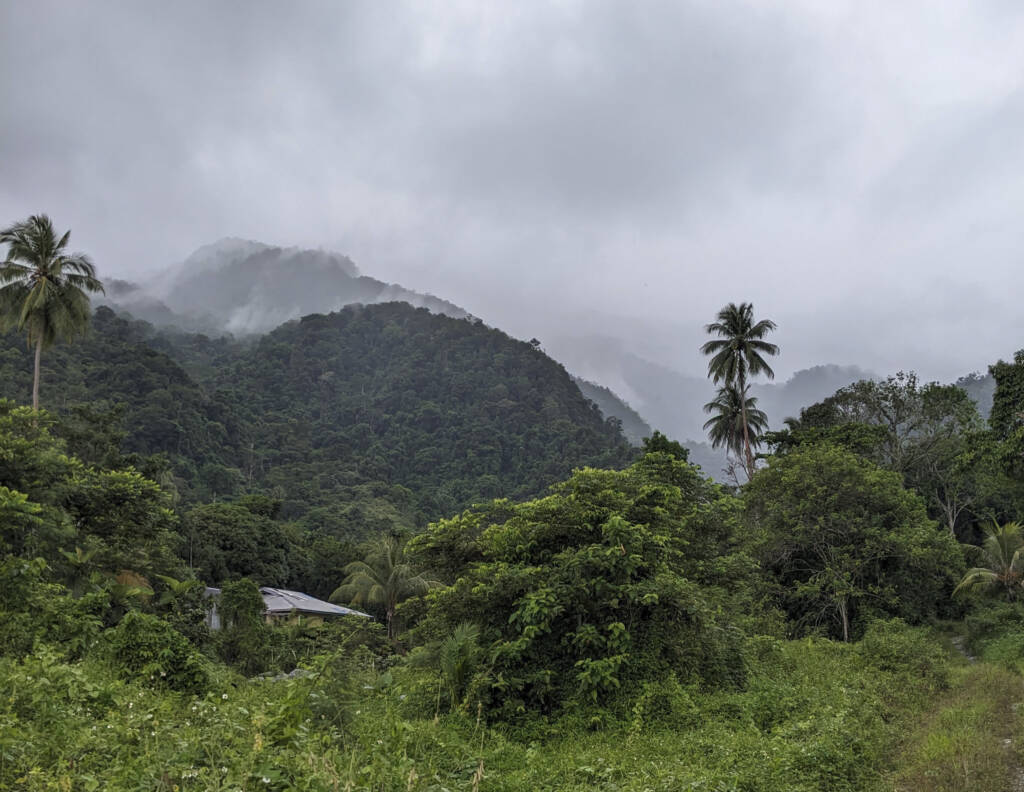
Photo from the Cyclops Mountains
Methodology
Tectonics and uplift rates: Existing tectonic and palaeogeographic models will be utilized to determine the approximate age and location of collision and uplift events that may have impacted the Cyclops Mountains. Newly collected samples will then be analysed by the student for geochronology and thermochronology age data that will provide the timing and rate of uplift for key formations across the mountain range. This will include U-Pb, (U-Th)/He, and fission track analysis of apatite and zircon grains at the University of Glasgow.
Palaeoenvironmental change: Published biostratigraphic, palynological, global sea-level, and chemical weathering data will be integrated to determine changes in climate, sea-level, and ecosystems in the Cyclops Mountains during their uplift since the Miocene. Onshore data will be integrated with data from recent IODP expeditions from offshore New Guinea (Exp. 363; Rosenthal et al., 2017) to further reconstruct erosion rates and climatic variation. These data will be further integrated into the TABS (temporal altitudinal biogeographic shifts) software to determine the impact that land bridge connection and destruction has on species dispersal (De Groeve et al., 2025).
Landscape evolution modelling: Using the data and reconstructions generated throughout the project, landscape evolution models of the Cyclops Mountain and northern New Guinea will be generated to display the progressive collision and uplift of these mountains from the Miocene to Recent. Initial models will be generated using latest landscape evolution modelling algorithms (e.g., Landlab, FastScape, Badlands) before being integrated with biological species evolvers / habitat simulators (either SpeciesEvolver or Gen3SIS) that can be used to track biological responses such as speciation, dispersal, or extinction based on the known biota of the Cyclops Mountains.
Project Timeline
Year 1
In the first year, the focus will be on organising existing information into a consolidated and comprehensive understanding of the wider geological history of New Guinea. This will involve integrating data from published literature and producing a thorough review on regional tectonics, mountain-building events, and their implications for biodiversity. During this period, training will also begin in mineral separation, appropriate sample selection, and geochronology. Core academic skills such as literature review writing, presentation skills, and research dissemination will be developed along with any basic requirements for future landscape evolution modelling (e.g., coding / GIS). Initial mineral separation of zircon and apatite minerals from samples previously collected in the Cyclops Mountains will begin and the first geochronology and thermochronology data will aim to be produced before the end of year 1.
Year 2
A substantial portion of the year will be dedicated to sample preparation and analysis (totalling ~20 samples), this will include U-Pb, (U-Th)/He, and fission track analysis of apatite and zircon
grains at the University of Glasgow. The student will also begin collating and integrating previously published palaeo-environmental and biostratigraphic data that will help to define the parameters for landscape evolution models that not only track tectonic processes but also palaeo-vegetation and altitude. The student will also have frequent opportunities to network with a wide array of biogeographers that study the unique biota of New Guinea and are frequent collaborators of the supervisory team, this will help the student to relate their geological findings to the broader picture of species dispersal in the Cyclops Mountains and New Guinea. Findings and insights from this work will be presented to the wider community at a national conference (e.g. TSG).
Year 3
In the final year of the project, the focus will shift to integrating all available data into a defined landscape evolution model of the Cyclops Mountains over the last 10 million years. This will be generated using the latest landscape evolution modelling algorithms (e.g., Landlab, FastScape, Badlands) and will be placed in a broader regional context by comparing with previously published tectonic and palaeogeographic reconstructions of New Guinea. Once complete this model will be integrated with biological species evolvers / habitat simulators (either SpeciesEvolver or Gen3SIS) that can be used to track biological responses such as speciation, dispersal, or extinction based on the known biota of the Cyclops Mountains. This will be further supported by published datasets and the biogeographer network established in Year 2. The resulting models and interpretations will be presented at a major international conference such as EGU.
Year 3.5
The final 6 months of the project will focus on finalising the writing of the thesis, as well as finishing off any papers in progress
Training
& Skills
The student will benefit from laboratory and analytical facilities hosted within both Heriot-Watt University and the University of Glasgow. This will include direct training from the supervisory team in mineral separation, geochronology, thermochronology (Max Webb & Amy Gough) and landscape evolution modelling (Paul Eizenhoefer). The student will join the active and growing Southeast Asia Research Group (SEARG) at Heriot-Watt and will benefit from informal training and support from post-docs and other PhD students within the group. There, will also be the opportunity to work from the University of Glasgow and interact with other students working on landscape evolution modelling under Paul Eizenhoefer. Additional training workshops may be attended by the student where opportunities arise (for example, a bi-annual Sedimentary Provenance Analysis workshop held at Goettingen University, Germany). Finally, Heriot-Watt University also hosts the SET-IT research centre that provides interdisciplinary geoscience-related training to students, recent examples have included machine learning and coding, science communication, petrography skills, and career planning.
References & further reading
De Groeve, J., Rijsdijk, K. F., Rentier, E., Flantua, S. G., & Norder, S. (2025). Temporal Altitudinal Biogeographic Shifts (TABS): R package for reconstructing biogeographic shifts in terrestrial and marine habitats over time. ARPHA Preprints, 6, e151900.
Jønsson, J. K. A., Webb, M., Fotheringham, J., Gunawna, I., Haryoko, T., Iova, B., Melia, S., Nagombi, E., Reeve, A. H., Blom, M. P. K., Irestedt, M., Rijsdijk, K. F. (2026). A new palaeo-
tectonic model of New Guinea and its consequences for understanding Indo-Pacific avian diversity in space and through time. Frontiers of Biogeography.
Morib, G., Tilker, A., Davranoglou, L. R., Anasari, S. D., Balázs, A., Barnes, P. A., … & Kempton, J. A. (2025). Attenborough’s echidna rediscovered by combining Indigenous knowledge with camera-trapping. npj Biodiversity, 4(1), 19.
Rosenthal, Y., Holbourn, A., & Kulhanek, D. Expedition 363 Scientists (2017). Expedition 363 preliminary report: Western Pacific warm pool. Proceedings of the International Ocean Discovery Program, 363.
Webb, M., White, L. T., Jost, B. M., Tiranda, H., & BouDagher-Fadel, M. (2020). The history of Cenozoic magmatism and collision in NW New Guinea–New insights into the tectonic evolution of the northernmost margin of the Australian Plate. Gondwana Research, 82, 12-38.
