

IAP-26-034
Female choice, genetic effects, and the experience of pregnancy in live-bearing and egg-laying lizards
The evolution of mate choice has a major impact on dispersal strategies, fitness and, in the case of small populations, conservation and viability. This shapes the genetic landscape of a species and has impacts for the evolution of life history traits and behavioural strategies. For example, female lizards are often polyandrous and multiple paternity can elevate female fitness by providing more genetically diverse offspring, dilute the cost of mating with an incompatible or genetically inferior male, and bet-hedge against insufficient or poor-quality sperm (Laloi et al 2011). However, there is also evidence that multiple mating incurs some costs and risks for females. Extensive work has explored these costs and benefits but the proximate impact of genetic compatibility between males and females has rarely been considered in natural context.
The consequences of multiple paternity for females are relevant not only for mating and offspring but also during pregnancy. Genetic compatibility between mates may influence maternal physiological experience during pregnancy. Genetic compatibility between mates may influence maternal physiological costs because developing embryos expose females to paternally derived antigens during pregnancy. Thus one complexity of polyandry may be how it affects immunological costs associated with carrying genetically variable offspring. In viviparous reptiles, prolonged maternal-foetal contact is expected to expose females to paternally infuenced embryonic tissues, potentially generating immune interactions analogous to those observed in mammals. In oviparous reptiles, the period of maternal-foetal contact is shorter but nonetheless might have significant impact (Uller et al. 2006). These mechanisms may contribute to differences in reproductive costs between oviparity and viviparity and could therefore influence the evolution of reproductive mode (Smout et al. 2026).
The Eurasian common lizard, Zootoca vivipara, is a fascinating model system for the evolution of reproductive choice, outcomes and consequences. It is one of the only reproductively bimodal species, meaning that different lineages are either viviparous or oviparous. Amazingly, we have identified and characterised a case where these two parity modes are found in the same location and even hybridise (Recknagel et al. 2021). Not only the mode of reproduction differs between oviparous and viviparous lizards, but female investment also differs, such as the number and size of offspring (Recknagel and Elmer 2019). Thus oviparous, viviparous, and hybrid individuals are faced with different life history choices, mate choice, and costs of reproduction.
This project will study how oviparous and viviparous females differ in their reproductive strategies that impact parity mode evolution, particularly regarding the molecular and immunological response to pregnancy. To do so we will leverage this powerful comparison of lizards of two different parity modes that are living in the same environment, which mitigates confounds. This research will answer the following questions:
- How does maternal immunological and molecular response to incubation of embryos change during the time course of pregnancy?
- At what time points and in what ways do oviparous and viviparous females differ in their response to pregnancy?
- How do male-female genetic compatibility and polyandry influence the molecular and immunological costs of reproduction in oviparous and viviparous females?
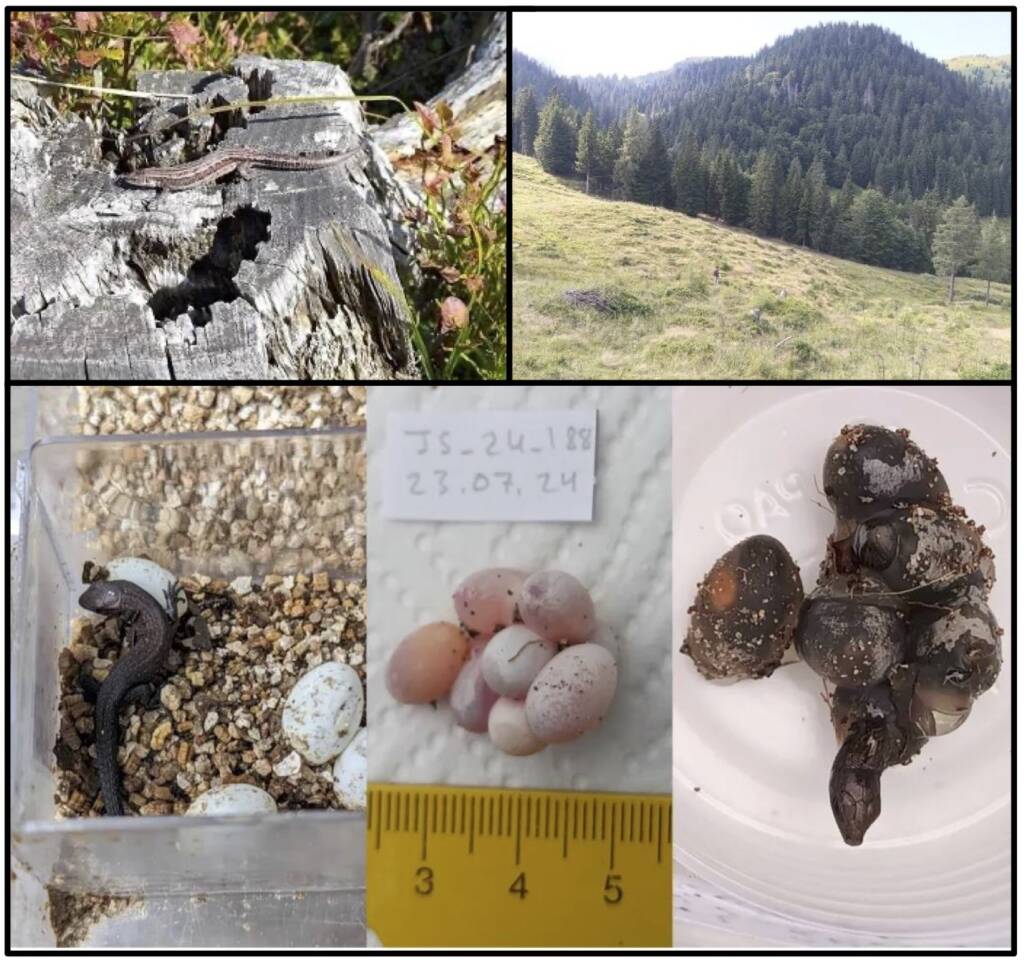
Click on an image to expand
Image Captions
Common lizards and their habitat. Oviparous, hybrid, and viviparous offspring. (Photos: J. Smout, M Uzzell)
Methodology
The project, led and conducted by the student, will integrate organismal biology and molecular analysis. An extensive set of samples and data already are in hand, and these will be augmented during the project.
In the field, lizards will be collected from a wild population and monitored over the breeding period to generate comprehensive data on females, their experience of pregnancy, and their reproductive output (clutches). Mating decisions of females will be inferred from molecular approaches conducted in the lab, such as genetic analysis of offspring using genomic approaches with new and existing data (low coverage whole genome sequencing or ddRADseq).
Reproductive output of females of different parity modes will be examined in context of female traits, genetic background, and oviparity/viviparity.
Immunological and gene expression analyses will be conducted based on non-invasive transcriptomic analysis during the course of females’ pregnancy. Known biomarkers of stress and maternal-foetal communication will be explored and compared across time and populations. Pregnancy response will be analysed in context of parity mode and multiple paternity.
Project Timeline
Year 1
Literature review, transferrable skills training and development, molecular biology training and optimising protocols using existing bank of samples, fieldwork in Austria (ca 4 months)
Year 2
Molecular biology and analytical approaches for parentage analysis, optimising biomarkers of pregnancy, fieldwork in Austria (ca 4 months), transferrable skills training and development.
Year 3
Molecular analysis of parentage and pregnancy in context of life history; manuscript/thesis chapter writing; transferrable skills training and development; conference presentation.
Year 3.5
Data analysis; manuscript/thesis chapter writing; transferrable skills training and development; conference presentation
Training
& Skills
The student will receive well-rounded training in integrative biology, supported by the supervisory team (Elmer, Ritchie, Boonekamp) with expertise in evolutionary biology, reproductive biology, mate choice, and life history and will join an on-going and externally funded research project studying the ecology and evolution of reproduction. Training in fieldwork, lab work and analysis will be provided and additional opportunities supported. In the field, the student will learn sampling, husbandry, and morphological analyses for squamates. In the lab, the student will develop advanced molecular skills in genomic and transcriptomic data generation. In analytical skills and interpretation, the student will develop advanced skills in genetic and gene expression analyses in life history context. The student will be supported to develop critical thinking skills, conduct high quality research, disseminate results (through conferences, seminars, and manuscripts), and build a well-rounded profile. The student will join an active and engaged research group with opportunities for discussion, support, and a collegial scientific environment.
References & further reading
Laloi, D., Eizaguirre, C., Fédérici, P., & Massot, M. (2011). Female choice for heterozygous mates changes along successive matings in a lizard. Behavioural Processes, 88(3), 149-154.
McLennan D, Recknagel H, Elmer KR, Monaghan P. Distinct telomere differences within a reproductively bimodal common lizard (Zootoca vivipara) population. Functional Ecology. 2019;33:1917-1927.
Moran, P. A., Ritchie, M. G. & Bailey, N. W. (2017). A rare exception to Haldane’s rule: Are X chromosomes key to hybrid incompatibilities? Heredity 118: 554-562.
Recknagel, H., & Elmer, K. R. (2019). Differential reproductive investment in co-occurring oviparous and viviparous common lizards (Zootoca vivipara) and implications for life-history trade-offs with viviparity. Oecologia, 190, 85-98.
Recknagel, H., Carruthers, M., Yurchenko, A. A., Nokhbatolfoghahai, M., Kamenos, N. A., Bain, M. M., & Elmer, K. R. (2021). The functional genetic architecture of egg-laying and live-bearing reproduction in common lizards. Nature Ecology and Evolution, 5(11), 1546-1556.
Richard, M., Losdat, S., Lecomte, J., de Fraipont, M., & Clobert, J. (2009). Optimal level of inbreeding in the common lizard. Proc Biol Sci, 276(1668), 2779-2786.
Rodríguez-Muñoz Rolando, Boonekamp Jelle J., Fisher David, Hopwood Paul and Tregenza Tom 2019 Slower senescence in a wild insect population in years with a more female-biased sex ratio. Proc. R. Soc. B.28620190286
Smout, J. L., Bain, M. M., McLaughlin, M., & Elmer, K. R. (2026). Gene expression and alternative splicing throughout the reproductive cycle of a viviparous lizard reveal novel genes for pregnancy and convergence with squamates and mammals. Molecular Ecology, 35(14), e70469.
