

IAP-26-103
Fault Reactivation and Mine-Water Geothermal Systems
Abandoned coal mines are increasingly considered as a low-carbon geothermal resource1, but their long-term behaviour is strongly influenced by the legacy of mining-induced deformation2. Faults that were disturbed or reactivated during mining may remain mechanically sensitive during subsequent mine-water rebound, as rising pore pressures reduce effective normal stress and potentially promote renewed slip. Later geothermal operation introduces further hydraulic perturbations through abstraction and reinjection, which may either stabilise or destabilise these structures depending on the magnitude and direction of pressure change.
This PhD will investigate the coupled relationship between mine-water pressure, fault reactivation and fault-controlled hydraulic connectivity. A central hypothesis is that fault movement does not only respond to changing mine-water pressures, but may itself modify fault permeability and therefore alter groundwater flow between mine workings or mine-water blocks. This creates a potentially important feedback between fluid pressure, fault stability and mine-water circulation.
The project will combine structural and hydrogeological interpretation, geological field observations, mine-water and seismicity datasets, and coupled numerical modelling. Case studies from UK coalfields may be complemented by collaboration with Polish mining regions, where active or recently operated mines and higher levels of mining-related seismicity could provide valuable comparative datasets. The research will assess how fault reactivation may influence geothermal feasibility, operational performance and long-term subsurface risk.
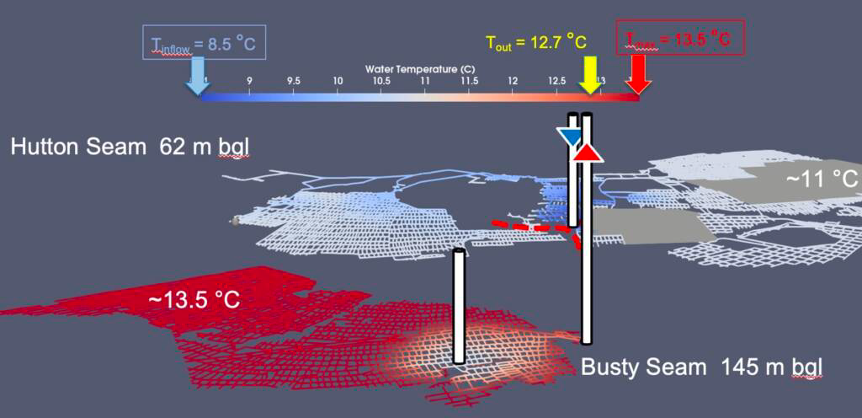
Click on an image to expand
Image Captions
Calculated heat extraction scenario for the Durham coal fields. Results created with the GEMSToolbox modelling tool (Mouli-Castillo et al., 2024).
Methodology
The project will use an interdisciplinary combination of numerical modelling, field investigation and rock-mechanics analysis to understand how mine-water rebound and geothermal operation influence the reactivation and hydraulic behaviour of faults in former coal-mining regions.
A major component will involve developing and applying numerical models using GEMSToolbox3, an open-source modelling framework for mine-water geothermal systems (see Figure). The student will construct conceptual and numerical models of selected mine systems to investigate how changes in mine-water pressure during post-mining rebound, abstraction and reinjection alter stresses acting on faults. These simulations will explore when faults may become reactivated, and how fault movement could in turn modify permeability, hydraulic connectivity and mine-water flow. Sensitivity and uncertainty analyses will be used to identify the geological and operational parameters that exert the strongest controls.
The modelling will be closely linked to field-based case studies in the UK and in a major European coalfield in Germany or Poland, providing experience across contrasting geological and mining settings. Fieldwork will involve structural geological observations, characterisation of fault zones, interpretation of mine plans and geological data, and integration with available mine-water levels, pumping records, seismicity and other monitoring datasets. Where suitable material can be collected, laboratory rock-mechanics experiments may be undertaken to constrain frictional, strength and permeability properties of representative fault rocks and surrounding strata.
The project will therefore provide training across computational geoscience, structural geology, hydrogeology and rock mechanics. By combining real-world observations with process-based modelling, the student will develop a quantitative framework for assessing feedbacks between fluid pressure, fault reactivation and groundwater flow, with direct relevance to the safe and effective development of mine-water geothermal energy.
Collaboration with the Mining Remediation Authority (MRA) will provide access to mine system data, licensing insights, and operational experience. A three-month internship at the MRA will enable the student to work across environment, engineering, and policy teams, gaining industry-relevant skills and contributing to real-world MWGE development.
Project Timeline
Year 1
Foundations and initial case-study development: literature review on fault reactivation, mine-water rebound and geothermal operation; select UK and international case studies; compile geological, mine-plan, hydrogeological and seismicity datasets; undertake initial field reconnaissance; begin structural interpretation and develop baseline GEMSToolbox models; identify suitable samples and laboratory approaches.
Year 2
Integrated field, laboratory and modelling work: undertake detailed fieldwork in the UK and Germany/Poland; collect and characterise fault and host-rock samples; begin rock-mechanics and permeability experiments; refine numerical representation of faults in GEMSToolbox; calibrate models against mine-water levels, pumping histories and available deformation or seismicity data; start investigating fault response during mine-water rebound.
Year 3
Geothermal scenarios, comparison and synthesis: complete outstanding field or laboratory work; model abstraction and reinjection scenarios and their influence on fault stability; investigate feedbacks between fault reactivation, permeability and hydraulic connectivity; conduct sensitivity and uncertainty analyses; compare UK and European case studies; develop implications for mine-water geothermal design and risk assessment; prepare publications and thesis chapters.
Year 3.5
Thesis completion: integrate the field, laboratory and modelling results; complete thesis writing; finalise figures, appendices and publications; internal review and revisions; submit the PhD thesis and prepare for the viva.
Training
& Skills
The project provides broad, interdisciplinary training across geoscience, energy systems, and policy. The student will develop skills in:
• Hydrogeological and geothermal modelling;
• Structural geology and fieldwork;
• Python programming and probabilistic analysis;
• GIS-based spatial data processing;
• Academic writing and communication.
The student will join the Department of Earth Sciences’ dynamic postgraduate community (~50 research students) and collaborate with the Durham Energy Institute, and academic supervisors.
Participation in IAPETUS training will enhance transferable skills in project management, communication, and interdisciplinary collaboration. The MRA internship offers direct experience in applied geothermal development, regulation, and stakeholder engagement—key assets for future research or professional roles in the energy transition.
References & further reading
1) https://www.bbc.co.uk/news/articles/cw0k08p482jmo
2) Donnelly, L.J. (2006), A review of coal mining induced fault reactivation in Great Britain, QJEGH, 39, 5 – 50, https://doi.org/10.1144/1470-9236/05-015
3) Mouli-Castillo, J., van Hunen, J., MacKenzie, M., Sear, T. and Adams, C., 2024. GEMSToolbox: A novel modelling tool for rapid screening of mines for geothermal heat extraction. Applied Energy, 360, p.122786.
