

IAP-26-037
Environmental Change, Compound Hazards and Community Resilience in Tropical Delta Socio-Ecological Systems
Deltas are dynamic, low-lying depositional systems formed through the interaction of riverine and marine processes, including sediment transport, tides and waves (Kästner and Hoitink, 2019). Their fertile alluvial soils and complex waterways support diverse ecosystems and provide important resources for human settlements, agriculture, aquaculture and fisheries. Deltaic environments often support biologically rich habitats, including mangrove forests, tidal wetlands and intertidal areas that provide essential ecosystem services (Renaud, at al., 2016). These services include carbon storage, habitat provision, sediment retention, water filtration and coastal protection against hazards such as erosion, storm surges and flooding (Gómez-Baggethun et al., 2019; Sun et al., 2025). Consequently, deltas hold considerable ecological, economic and social importance. However, their environmental characteristics and the benefits they provide vary according to local geomorphology, hydrological conditions and ecosystem composition (Anthony et al., 2025).
Indonesia contains extensive deltaic environments distributed across regions including eastern Sumatra, the northern coast of Java, Kalimantan and southern Papua. Kalimantan, on the island of Borneo, contains several major delta systems, including the Mahakam Delta in East Kalimantan, the Kayan-Sembakung Delta in North Kalimantan and the Kapuas Delta in West Kalimantan (Hidayat et al., 2016; Seftianingrum et al., 2020). These environments support mangrove ecosystems and provide important resources for local communities, whose livelihoods may depend on capture fisheries, aquaculture and other ecosystem-based activities. Fish, shrimp and crabs are among the resources supporting livelihoods and local economies. The ecological condition of these delta systems is therefore closely connected to community wellbeing, resource availability and the long-term sustainability of local economic activities.
Despite their ecological and socio-economic importance, deltas are among the environments particularly vulnerable to environmental change. Climate change, sea-level rise, land subsidence, changes in river discharge and sediment supply, and human activities can interact to alter delta morphology, inundation patterns and ecosystem conditions (Overeem and Syvitski, 2003). In Kalimantan, pressures associated with industrial development, pollution, mangrove degradation and aquaculture expansion may further affect the integrity of delta ecosystems (Fawzi and Husna, 2021; Priyono, 2022; Subiyanto, 2025). These environmental changes can have consequences beyond physical landscape transformation, potentially affecting fisheries and aquaculture productivity, access to natural resources, livelihood security and community responses to environmental hazards. Understanding these interactions is therefore important for developing approaches to sustainable delta management and strengthening community resilience.
Deltas can be understood as coupled socio-ecological systems in which environmental processes, ecosystem conditions and human activities interact to shape exposure, vulnerability and responses to environmental hazards (Brondizio et al., 2016; Hagenlocher et al., 2018). Previous research has developed frameworks for assessing multi-hazard risks in deltaic systems and demonstrated the importance of considering both social and ecological vulnerability (Hagenlocher et al., 2018). Subsequent work has highlighted the need to incorporate ecosystem services more systematically into delta risk assessments, recognising the connections between environmental conditions, ecosystem functions and human wellbeing (Peng, at al., 2023). Nevertheless, understanding how environmental change, ecosystem dynamics and livelihood dependence interact within specific local contexts remains an important research challenge, particularly in communities that rely directly on delta ecosystems for their livelihoods.
Research in Indonesia has demonstrated the value of combining geospatial analysis with community-based approaches to investigate coastal change and adaptation. For example, Nguyen et al., (2022) examined shoreline change and community-based adaptation in Brebes Regency, highlighting the importance of accounting for physical coastal processes and stakeholder coordination when addressing coastal erosion. More recently, Mustofa et al., (2026) integrated community knowledge with spatial evidence to examine coastal risks and adaptation priorities in Demak, Indonesia. These studies demonstrate the complementary contributions of environmental observations and community knowledge to understanding coastal change and informing locally relevant adaptation. However, further investigation is needed into how environmental change and interacting hazards relate to ecosystem dynamics, livelihood dependence and community adaptation over time within tropical delta socio-ecological systems.
This project will investigate the interactions between environmental change, selected interacting hazards, ecosystem conditions and community responses in a tropical delta in Indonesia. By integrating Earth-observation data and geospatial analysis with community-based research, the project will examine how environmental pressures affect local ecosystems and livelihoods, how communities understand and experience these changes, and how local ecological knowledge and adaptation practices shape responses to environmental change. Through spatial comparison, qualitative analysis and the integration of environmental and community-derived evidence, the research aims to develop a more contextualised understanding of socio-ecological vulnerability, resilience and adaptation. The findings will contribute to understanding how environmental monitoring and community knowledge can inform more locally appropriate approaches to sustainable delta management.
Research Gap
Although existing frameworks have advanced multi-hazard risk and vulnerability assessment in deltaic social-ecological systems, challenges remain in representing the context-specific relationships between environmental change, ecosystem services and community vulnerability (Hagenlocher et al., 2018). Research has also demonstrated the value of combining remote-sensing-derived environmental information with local knowledge to support coastal adaptation in Indonesia (Mustofa et al., 2026). However, further investigation is needed into how temporal patterns of environmental change and interacting hazards relate to ecosystem conditions, livelihood dependence and community adaptation within specific delta contexts. In particular, understanding how community experiences and local ecological knowledge complement or challenge spatially derived environmental evidence may provide deeper insight into the processes shaping socio-ecological vulnerability and resilience. This project will investigate these relationships through an integrated analysis of Earth-observation data and community-based research in a selected tropical delta.
Research Aim
This project aims to investigate how environmental change, interacting hazards and human activities shape vulnerability and resilience in tropical delta socio-ecological systems, integrating Earth-observation data and community knowledge to improve understanding of environmental change and inform sustainable management.
Research Questions
• Environmental change and Hazards
Research Question (RQ1): How have environmental conditions, ecosystems and selected interacting hazards changed across the study area, and what are their implications for the delta’s socio-ecological systems?
Objective 1: Characterise the spatial and temporal patterns of environmental and landscape change using Earth observation, geospatial analysis and relevant environmental records.
• Community experiences and adaptation
Research Question (RQ2): How do communities experience and interpret environmental change, and how do livelihood dependence, local ecological knowledge and adaptation practices shape their responses?
Objective 2: Examine community experience of hazards and ecosystem change, including perceived impacts of livelihood, resources use and adaptation strategies.
• Integration and Resilience
Research Question (RQ3): How can Earth-observation-derived environmental indicators and community knowledge be integrated to explain patterns of socio-ecological vulnerability, resilience and adaptation?
Objective 3: Integrate environmental and community-based evidence to investigate the relationships between environmental change, livelihood vulnerability and resilience, and identify implications for sustainable delta management.
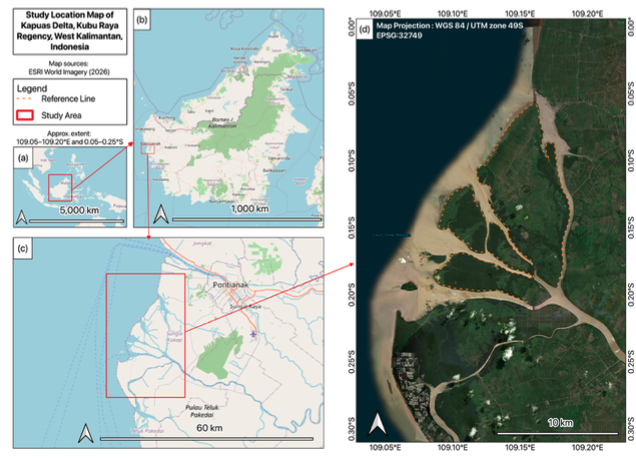
Click on an image to expand
Image Captions
Study Site Location Map Sulastri Prihandini
Methodology
Firstly, RQ1 will be addressed through the analysis of multi-temporal satellite imagery and pertinent environmental records to characterise landscape transformation, mangrove dynamics, flood extent, and coastal transformation. This approach will facilitate the identification of spatial and temporal patterns of environmental change and areas where interacting environmental pressures may be particularly pronounced. Secondly, RQ2 will be examined through semi-structured interviews, participatory mapping, and, where appropriate, focus group discussions to investigate how communities perceive and experience environmental change, comprehend hazard impacts, rely on local ecosystems, and respond to changes in resource availability. These methodologies will also explore community knowledge, livelihood impacts, and local adaptation practices. Lastly, RQ3 will be addressed through the integration of Earth-observation-derived environmental indicators and community knowledge using spatial comparison, qualitative thematic analysis, and participatory interpretation. This approach will examine where community observations align with remotely sensed environmental patterns, where they provide complementary information that satellite data cannot capture, and how environmental and social processes interact to shape socio-ecological vulnerability, resilience, and adaptation. The integrated findings will provide insights into locally appropriate approaches to sustainable delta management.
This research is proposed within tropical delta environments in Indonesia, where rapidly changing river-coastal systems support substantial ecological functions and community livelihoods while facing increasing climatic and anthropogenic pressures. A specific delta system will be selected according to ecological characteristics, community accessibility, governance context, data availability, and suitability for participatory research. Building on the previous MSc research in the Kapuas Delta in the West Kalimantan of Indonesia, Borneo Deltas provide potential study cases with relevant geographical context, although the final study site will be refined through further literature review and discussion with prospective supervisors.
Expected Outcomes
The Expected outcomes from this project are including:
– A documented spatial and temporal assessment of selected environmental changes and hazards.
– An understanding of community knowledge, experiences, livelihood implications and adaptation practices.
– An integrated socio-ecological interpretation of vulnerability and resilience.
– Recommendations for incorporating environmental and community-based evidence into sustainable delta management.
Project Timeline
Year 1
1. Year 1: Literature review, research design and preliminary environmental assessment
Conduct a comprehensive literature review on tropical delta socio-ecological systems, compound environmental hazards, community resilience and the integration of Earth-observation data with community knowledge. Develop the conceptual framework and refine the research questions, study-site selection and scope of the environmental hazards to be investigated. Establish the methodological design for the remote-sensing analysis and community-based research, including research ethics approval and arrangements for fieldwork in Indonesia. Compile relevant satellite imagery and environmental records, assess data availability, and undertake preliminary spatial analysis to identify key patterns of environmental and landscape change. Establish initial contacts with relevant local stakeholders and research partners where feasible.
Milestones: Refined conceptual framework and research questions; completed research design and ethics applications; preliminary environmental assessment; and a detailed plan for community fieldwork.
Year 2
2. Year 2: Environmental analysis and community-based fieldwork
Conduct systematic analysis of multi-temporal satellite imagery and relevant environmental records to characterise landscape change, mangrove dynamics, flood extent and coastal change in the selected tropical delta. Identify areas where interacting environmental pressures may be particularly important. Undertake fieldwork involving semi-structured interviews, participatory mapping and, where appropriate, focus group discussions to investigate community experiences of environmental change, hazard impacts, livelihood dependence, local ecological knowledge and adaptation practices. Organise and document the environmental and qualitative datasets for subsequent integration.
Milestones: Preliminary spatial and temporal assessment of environmental change completed; community fieldwork undertaken; and environmental and qualitative datasets prepared for analysis.
Year 3
Complete any outstanding fieldwork and conduct thematic analysis of interview, focus-group and participatory-mapping data. Integrate community-derived evidence with Earth-observation results and environmental records through spatial comparison and qualitative interpretation. Examine where community observations correspond with remotely sensed patterns, where local knowledge reveals environmental changes or livelihood impacts not captured by satellite data, and how environmental processes, ecosystem conditions and human activities interact to shape vulnerability and resilience. Where feasible, discuss preliminary findings with relevant community representatives or stakeholders to strengthen contextual interpretation. Develop the key findings and their implications for adaptation and sustainable delta management, while preparing thesis chapters and research publications.
Milestones: Environmental and community-based analyses completed; integrated socio-ecological findings developed; and draft research chapters and publications prepared.
Year 3.5
Synthesise the research findings across all work packages and finalise the analysis of environmental change, interacting hazards, community experiences, vulnerability and resilience. Complete the discussion of the project’s theoretical, methodological and applied contributions, including implications for sustainable delta management. Revise and finalise thesis chapters, incorporate supervisory feedback, and prepare manuscripts for journal submission where appropriate. Communicate the findings to relevant academic and non-academic audiences through presentations, research outputs or stakeholder dissemination activities, subject to feasibility. Complete the final thesis submission within the funded studentship period.
Milestones: Final integrated analysis completed; thesis finalised and submitted; and research findings prepared for academic and relevant stakeholder dissemination.
Training
& Skills
The student will be trained by the supervisory team to become an independent researcher in coastal geomorphology and remote sensing. Specific training will cover field surveying (RTK-GNSS, drone photogrammetry), satellite image processing in Python and Google Earth Engine, uncertainty quantification and statistical modelling, and the qualitative methods and research ethics needed for the management chapter. This will be complemented by Iapetus training in scientific and transferable skills (writing, presentation, data management and science communication). The student will gain training in qualitative methods and participatory GIS.
References & further reading
Anthony, E. et al. (2025) ‘A 7000-year record of human influence on Global River Deltas: Geomorphology, stratigraphy, the Anthropocene overprint and future’, Earth-Science Reviews, 271, p. 105302. Available at: https://doi.org/10.1016/j.earscirev.2025.105302.
Fawzi, N.I. and Husna, V.N. (2021) ‘Aquaculture Development Monitoring on Mangrove Forest in Mahakam Delta, East Kalimantan’, IOP Conference Series: Earth and Environmental Science, 750(1), p. 012002. Available at: https://doi.org/10.1088/1755-1315/750/1/012002.
Gómez-Baggethun, E. et al. (2019) ‘Changes in ecosystem services from wetland loss and restoration: An ecosystem assessment of the Danube Delta (1960–2010)’, Ecosystem Services, 39, p. 100965. Available at: https://doi.org/10.1016/j.ecoser.2019.100965.
Hagenlocher, M. et al. (2018) ‘Vulnerability and risk of deltaic social-ecological systems exposed to multiple hazards’, Science of The Total Environment, 631–632, pp. 71–80. Available at: https://doi.org/10.1016/j.scitotenv.2018.03.013.
Hidayat, H. et al. (2016) ‘Hydrology of inland tropical lowlands: the Kapuas and Mahakam wetlands’. Available at: https://doi.org/10.5194/hess-2016-388.
Kästner, K. and Hoitink, A.J.F. (2019) ‘Flow and Suspended Sediment Division at Two Highly Asymmetric Bifurcations in a River Delta: Implications for Channel Stability’, Journal of Geophysical Research: Earth Surface, 124(10), pp. 2358–2380. Available at: https://doi.org/10.1029/2018JF004994.
Mustofa, I. et al. (2026) ‘Integrating local knowledge into community-led Green coastal adaptation on the northern coast of Demak, Indonesia’, Frontiers in Climate, 8, p. 1931894. Available at: https://doi.org/10.3389/fclim.2026.1931894.
Nguyen, D.C. et al. (2022) ‘Annual output energy harvested by building-integrated photovoltaics based on the optimized structure of 2-terminal perovskite/silicon tandem cells under realistic conditions’, Solar Energy, 241, pp. 452–459. Available at: https://doi.org/10.1016/j.solener.2022.06.018.
Overeem, I. and Syvitski, J. (2003) ‘Dynamics and Vulnerability of Delta Systems’, Global Environmental Change, 13(1), pp. 69–73. Available at: https://doi.org/10.1016/S0959-3780(02)00081-X.
Peng, Y., Welden, N. and Renaud, F.G. (2023) ‘A framework for integrating ecosystem services indicators into vulnerability and risk assessments of deltaic social-ecological systems’, Journal of Environmental Management, 326, p. 116682. Available at: https://doi.org/10.1016/j.jenvman.2022.116682.
Priyono, K.D. (2022) ‘IDENTIFICATION OF MANGROVE CHANGES IN THE MAHAKAM DELTA IN 2007-2017 USING ALOS/PALSAR AND LANDSAT’, International Journal of GEOMATE, 23(96). Available at: https://doi.org/10.21660/2022.96.3312.
Renaud, F.G., Szabo, S. and Matthews, Z. (2016) ‘Sustainable deltas: livelihoods, ecosystem services, and policy implications’, Sustainability Science, 11(4), pp. 519–523. Available at: https://doi.org/10.1007/s11625-016-0380-6.
Seftianingrum, R. et al. (2020) ‘Floral Composition of the Kayan-Sembakung Delta in North Kalimantan (Indonesia) in Different Disturbance Regimes’, Journal of Coastal Research, 36(4), p. 741. Available at: https://doi.org/10.2112/JCOASTRES-D-18-00145.1.
Subiyanto, Y. (2025) ‘Conversion of Mangrove Forests in the Mahakam Delta (East Kalimantan): Threats to Fisheries and Coastal Erosion’, KnE Social Sciences, 10(26), pp. 471–479. Available at: https://doi.org/10.18502/kss.v10i26.20026.
Sun, B. et al. (2025) ‘Dual impacts of human activities on land cover and carbon storage in the Yellow River Delta (1986–2023)’, Ocean & Coastal Management, 267, p. 107655. Available at: https://doi.org/10.1016/j.ocecoaman.2025.107655.
