

IAP-26-026
Development of foraminifera palaeoproxy calibrations for application over glacial/interglacial time scales
Foraminifera are single-celled marine protists which produce calcite shells called tests (Figure 1a). The geochemistry of the tests is influenced by the environmental conditions prevailing at the time the organism lived e.g. the Mg content is influenced by seawater temperature(1) while d18O reflects both temperature and seawater d18O (an indicator of global ice volume, 2). Tests are preserved in ocean sediments and the analysis of these geochemical palaeoproxies is a common method to reconstruct past seawater environment. Planktonic and benthic foraminifera tests are globally distributed, permitting reconstruction of past water mass temperatures and ocean circulation patterns (2). These palaeoproxies are instrumental in shaping our understanding of past climate and critical in validating global climate models for predicting 21st century climate change.
Palaeothermometer calibrations are typically calculated by correlating the chemistry of modern specimens with local environment. Calibrations can also be calculated by synthesising CaCO3 in vitro under varying conditions, but significant offsets are observed between synthetic and biogenic calibrations e.g. the temperature dependence of Mg/Ca is ~3% per °C in inorganic calcite, but ~10% per °C in modern foraminiferal calcite (3). The origin of these differences, termed ‘vital effects’, is unclear, however foraminifera calcite precipitates in a biological environment from calcification media which may have significantly different trace element chemistry, [Ca2+], pH and [dissolved inorganic carbon] (DIC) to that of seawater (4}. The trace element and isotope chemistry of CaCO3 synthesised in vitro is significantly affected by precipitating fluid DIC and pH (5,6) and CaCO3 precipitation rate (5), suggesting that these factors interplay in biological environments to control CaCO3 geochemistry. In addition, foraminifera calcite forms in the presence of biomolecules e.g. proteins, polysaccharides and lipids (7) which also influence CaCO3 geochemistry (5) and may from via CaCO3 precursors (8).
Applying palaeoproxy calibrations from modern analogues to fossil specimens also assumes that relationships between seawater temperature and biocarbonate chemistry have not changed across time. This is an unlikely assumption. For examples, changes in seawater pCO2, as occurred over glacial-interglacial time scales, influences both the DIC and biomolecules in tropical coral calcification media (9), and thereby affects CaCO3 geochemistry. Therefore palaeoproxy relationships have probably varied throughout geological time. Correcting geochemical proxy data to the correct calibration is essential for the accurate reconstruction of past climate records and forecasting future global change. The aim of this research is to develop palaeoproxy calibrations for foraminifera calcite that can be applied to fossil specimens of different ages. The calibrations will be applied to published palaeoproxy compilations e.g. (10) to produce accurate estimates of past seawater temperatures.

Click on an image to expand
Image Captions
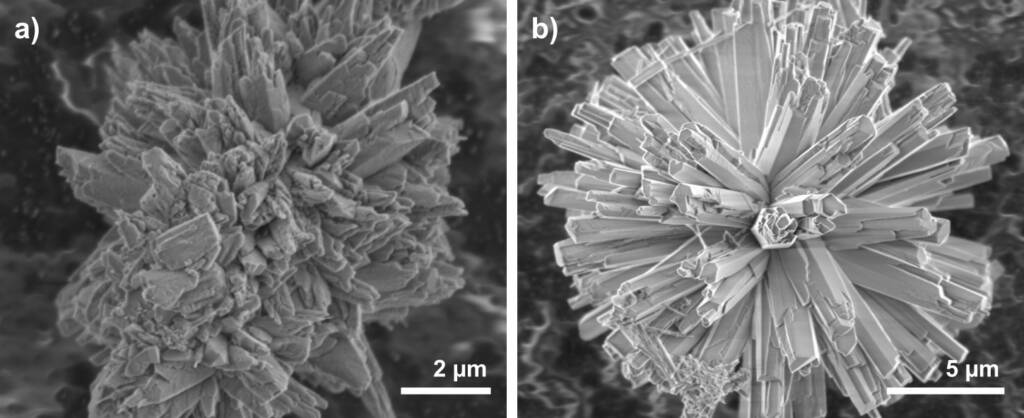
Figure 1. a) Foraminifera test, b) precipitation apparatus and c) recent data showing that both temperature and mineral growth rate (R) influence Mg incorporation (DMg/Ca) in the CaCO3 mineral aragonite5.,Figure 2. Morphology of synthetic aragonite precipitated at a) 15°C and b) 35°C. Trace elements are preferentially incorporated onto specific crystal faces of CaCO3 and variations in crystal habit (shape) influence trace element composition.
Methodology
We have developed an apparatus to precipitate CaCO3 from fluids which mimic organism calcification sites under tightly controlled conditions and to explore how fluid chemistry and biomolecules interact to influence solid chemistry (5,6). The apparatus has been used to synthesis amorphous calcium carbonate and aragonite (CaCO3 polymorphs) to determine controls on palaeoproxies in coral aragonite (Figure 1b,c). The student will conduct a unique series of experiments to synthesise calcite under conditions analogous to those of the calcification environment inferred to occur over glacial/interglacial time scales. In particular the student will explore how pH, DIC, [Mg2+], temperature and biomolecule composition interplay to affect calcite geochemistry. The student will characterise the test biomolecule compositions of modern and fossil foraminifera samples to determine how test biomolecules vary with temperature and over glacial-interglacial time scales. The student will conduct preliminary precipitations with biomolecules to refine the fluid concentrations of biomolecules to ensure that the concentrations incorporated in the precipitates are comparable to those of foraminifera calcite.
The student will characterise how pH, DIC, [Mg2+], temperature and biomolecules affect crystallisation dynamics and crystal morphology and structure at the nanoscale to further our understanding of the processes controlling carbonate geochemistry (Figure 2). Ultimately the student will ascertain how variations in biological precipitation environment over glacial-interglacial timescales and beyond affect trace element partitioning and isotope fractionation in calcite. The project will develop improved palaeothermometer calibrations for foraminiferal palaeoproxies which will be applied to compilations of fossil specimens e.g. (10) to generate more accurate estimates of past seawater temperatures. The calibrations will be powerful tools to reconstruct seawater temperatures in surface and deep ocean waters over modern and glacial-interglacial timescales.
Project Timeline
Year 1
Training in and generation of preliminary data from CaCO3 synthesis, biomolecule analysis of foraminifera tests and XRD and Raman spectroscopy.
Year 2
Calcite synthesis and trace element and isotope analysis, completion of first manuscript (biomolecule compositions of foraminifera calcite), attend Goldschmidt 2028, Tokyo Japan.
Year 3
Completion of calcite synthesis and analysis. Attend European Microbeam Analysis Society workshop 2029 for training in electron microscopy. Electron microscopy and completion of second manuscript (controls on calcite trace element chemistry). Derivation and application of palaeoproxy calibrations.
Year 3.5
Write up and examination of thesis and final manuscripts (controls on calcite d18O, application of calibrations to foraminifera data). Conference attendance.
Training
& Skills
The student will develop a multidisciplinary skillset in foraminifera biomineralisation and geochemistry. Techniques includes CaCO3 synthesis, dissolved inorganic carbon characterisation, XRD and Raman spectroscopy to characterise CaCO3 polymorph and structure, biomolecule analysis, scanning electron microscopy and palaeoclimate reconstruction. The student will be based in the School of Earth and Environmental Sciences at the University of St Andrews and will work with NERC-funded teams studying carbonate palaeoproxy development and biomineralisation at St Andrews (Allison group) and the University of Stirling (Bird group). In addition, the student will gain transferable skills in scientific writing, data analysis, statistics, problem solving and presenting. The student is expected to attend the European Microbeam Analysis workshop in 2029 (to develop electron microscopy skills) and to present at international conferences (Goldschmidt 2028, Tokyo, Japan) and national conferences. The student will be a member of the Marine Alliance for Science and Technology for Scotland (www.masts.ac.uk), enabling wider access to training and networking opportunities.
References & further reading
1. Nurnberg et al., Geochim. Cosmochim. Acta, https://doi.org/10.1016/0016-7037(95)00446-7, 1996.
2. Gaskell et al., Proc. Nat. Acad. Sci., https://doi.org/10.1073/pnas.2111332119, 2022.
3. Barker et al., Quat. Sci. Rev., https://doi.org/10.1016/j.quascirev.2004.07.016, 2005.
4. François et al., Commun. Earth Environ. https://doi.org/10.1038/s43247-026-03854-9, 2026.
5. Castillo Alvarez et al., Commun. Earth Env., https://doi.org/10.1038/s43247-025-02945-3, 2025.
6.Castillo-Alvarez et al., Geochim. Cosmochim. Acta, https://doi.org/10.1016/j.gca.2024.06.036, 2024.
7. Prada et al., Proc. Nat. Acad. Sci., https://doi.org/10.1073/pnas.2417845121, 2024.
8. Jantschke & Scholz, Elements, DOI: 10.2138/gselements.21.2.118, 2025.
9 Allison et al., Coral Reefs, https://doi.org/10.1007/s00338-024-02539-z, 2024.
10. Gray, PANGAEA, https://doi.org/10.1594/PANGAEA.932846, 2023.
