

IAP-26-128
Catalysing community assembly to accelerate woodland recovery
Background
The creation and restoration of natural habitats are increasingly promoted to address the global biodiversity and climate crises. Calls for large-scale action are now embedded within a raft of global and national initiatives, including the UN Decade on Ecosystem Restoration, the Bonn Challenge and the UK’s nature recovery programmes. To ensure these efforts reduce biodiversity decline and restore ecosystem functioning in the face of increasing anthropogenic pressures such as climate change, they need to be strategic.
Much restoration practice focuses on re-establishing reference ecosystems, but these may be neither achievable nor resilient to future environmental change, because they developed under different historical conditions (Bullock et al. 2021). Whatever their composition, restored ecosystems need to function (e.g. nutrient cycling, pollination) and to persist under environmental change. Function depends not only on which species are present but on how they interact, and the organisation of those interactions is thought to provide the mechanistic link between biodiversity and ecosystem multifunctionality (Eisenhauer et al. 2026). Whether, and how quickly, restored ecosystems develop these interaction networks depends on how their communities assemble. Understanding community assembly in restored ecosystems is therefore central to deciding where, how and when to intervene.
Community assembly over long time scales
A rich literature examines whether general principles, or assembly ‘rules’ (e.g. dispersal limitation, priority effects, environmental filtering; Belyea & Lancaster 1999), hold for communities following a perturbation or the creation of new habitat. Some of this work uses space-for-time approaches, in which sites of different ages stand in for change over time. However, relatively little is known about assembly across multiple taxa over long time scales. This matters most for ecosystems that develop over long periods, such as forests and woodland, where communities assemble over many decades or centuries. In such systems, substantial time lags between conservation action and species responses may suggest that an action has been ineffective when it simply needs more time. Setting milestones, or interim targets, is one way to account for time lags and check that policies, plans and actions are on course to meet longer-term targets (Watts et al. 2020; Fig. 1). To do this effectively, we need to understand better how communities assemble in these new habitats and which interventions help create functioning, resilient ecosystems in the long term.
In this PhD, the student will combine fieldwork with ecological modelling to test predictions about the patterns and processes driving community assembly in woodland creation sites.
The WrEN project
The main source of existing data for this studentship is the WrEN project (www.wren-project.com), a long-term ‘space-for-time’ large-scale natural experiment (Watts et al. 2016). It was designed to address the challenges of replicated experiments over large spatio-temporal scales. WrEN woodlands range from 10 to 160 years old (since planting on former agricultural land), and we now have records of more than 1400 species which have colonised these ~100 woodlands in England and Scotland. As a research platform, WrEN provides a unique framework for investigating the effects of historic woodland creation on current biodiversity (e.g. Fuentes-Montemayor et al. 2017, Whytock et al. 2018, Fuller et al. 2018).
Recent findings from WrEN (in review) show that structural heterogeneity (variation in tree size) at woodland creation sites is the most consistently positive predictor of abundance, activity and species richness across taxonomic groups. They suggest an urgent need to prioritise structural heterogeneity, alongside increasing patch size and strategic woodland placement, to maximise biodiversity benefits. Evidence on community composition suggests that, for vascular plants, some sites are starting to resemble ancient woodlands while others at a similar developmental stage differ substantially (Waddell et al. 2024). Similarly, a study of moth communities found that planted woodlands had similar abundance and richness to ancient woodlands of comparable size, but the species present differed (Fuentes-Montemayor et al. 2022).
Opportunities and caveats
Space-for-time studies such as WrEN have an important role in examining slow ecological processes, where there is a considerable lag between woodland creation and the response of woodland taxa. However, they assume that sites of different ages follow a common developmental trajectory under comparable conditions, so that spatial differences in age can stand in for change over time. In this PhD, WrEN sites first surveyed in 2013 will be resurveyed for key taxa, providing a longitudinal dataset that will let us examine changes in community composition over ~15 years and directly test predictions generated by our space-for-time approach. Focal taxa will be agreed with the student according to their expertise but will include vascular plants.
There will also be an opportunity to examine the very early stages of species colonisation and establishment (currently missing from WrEN) through the Large-scale Ecosystem Recovery Network (LERN), a pioneering manipulative research programme run by our CASE partner Forest Research (https://www.forestresearch.gov.uk/research/developing-the-large-scale-ecosystem-recovery-network-lern/). In addition, there may be opportunities to work with collaborators on a network of woodland creation sites in Denmark, to test whether patterns found in WrEN hold in a different region. This would involve travel and fieldwork in Denmark.
Using existing WrEN data and new data collected for a suite of taxa (at both WrEN and LERN sites), potential questions for this PhD include:
1. How do the processes structuring communities at woodland creation sites differ among taxa, and how does their relative importance change with woodland age, site characteristics and landscape context?
2. How well do predictions from space-for-time data (e.g. species composition and functional traits) match the change actually observed at the same sites over ~15 years, and what explains where they fail?
3. What governs the earliest stages of colonisation and establishment at newly created woodlands (LERN sites), and can this inform interventions to speed them up?
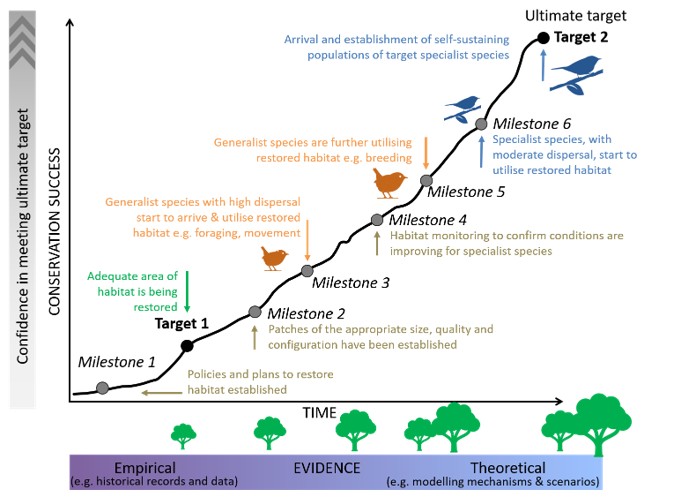
Click on an image to expand
Image Captions
Fig 1. Schematic representing key steps in the journey towards conservation success, and proposed milestones to assess progress. From Watts et al. (2020).
Methodology
This PhD will use a range of approaches and datasets, across temporal and spatial scales, to address questions on the process of community assembly within created woodlands. Since 2013 data on woodland characteristics, surrounding landscape, and biodiversity has been collated from over ~ 100 secondary broadleaf woodland sites in Scotland and England as part of the WrEN project. We now have data on a wide variety of taxa including birds, bats, rodents, larger mammals (including ungulates, carnivores), several invertebrate orders, lichens and vascular plants.
A variety of methods exist for predicting community assemblages from space-for-time studies including modelling the reconstruction of species interaction matrices using time series analysis; the most appropriate technique will be explored early on in the studentship. There is also scope for employing functional trait databases to understand how traits (as well as species interactions) change over time in developing woodlands.
Fieldwork will involve surveying WrEN sites in Scotland and England for woodland characteristics (e.g. tree density and species richness, diameter at breast height), and vascular plant surveys. Other taxa for resurvey will be agreed early on in the studentship, taking into account the preference and expertise of the student.
The PhD will be based at Stirling and the student will visit FR (likely Edinburgh and Bristol), Glasgow and Sheffield to meet with co-supervisors and other researchers for seminars and specific training. The CASE partner for this PhD, Forest Research, provides access to LERN sites and a route through which results from this work can be used to inform both policy and practice.
Project Timeline
Year 1
Literature review, PhD planning, training & fieldwork planning
Year 2
Fieldwork, data analysis & skills training
Year 3
Fieldwork, data analysis & skills training
Year 3.5
Data analysis, manuscript submission & thesis write-up
Training
& Skills
1) Field skills and experimental design. Training in the required field skills (e.g. habitat mapping, taxonomic surveying identification), and sampling design.
2) Numeracy, data analysis, ecological modelling. These skills will be gained through targeted training courses at the University of Stirling and within the Iapetus consortium (e.g. Programming and Analysis of Environmental Data in R, GIS & Remote Sensing for Environmental Managers). Additional training can be provided at Forest Research, the Universities of Glasgow and Sheffield, and/or through targetted training courses run by external organisations.
3) Land-use policy and management; the successful student will gain insights into understanding and formulating policy relevant research questions, skills for interdisciplinary research and the process of translating research into guidance and advice.
4) Complementary training in transferable skills. Training in core scientific skills (data management, analysis, presentations, paper writing).
Student Profile
We are looking for a student with a strong background in a discipline such as Ecology, Biological Sciences, Conservation Biology. The applicant should ideally have demonstratable experience in ecological fieldwork with strong numeracy and analytical skills (e.g. using R), although training will be provided. Evidence of an aptitude for scientific communication (i.e. writing, presentations) is desirable, as is a desire to work across disciplines including academia, policy and practice. A driving license is essential.
References & further reading
Belyea & Lancaster (1999). Assembly rules within a contingent ecology. Oikos 86, 402-416. https://doi.org/10.2307/3546646
Bullock et al. (2021). Future restoration should enhance ecological complexity and emergent properties at multiple scales. Ecography doi.org/10.1111/ecog.05780
Eisenhauer et al. (2026). From species richness to interaction architecture. Trends in Ecology & Evolution. 10.1016/j.tree.2026.09.008
Fuentes-Montemayor et al. (2022). Moth community responses to woodland creation: the influence of woodland age, patch characteristics and landscape attributes. Diversity & Distributions 28, 1993-2007; https://doi.org/10.1111/ddi.13599.
Fuller et al. (2018). Local-scale attributes determine the suitability of woodland creation sites for Diptera. Journal of Applied Ecology 55: 1173-1184. https://doi.org/10.1111/1365-2664.13035.
Waddell et al. (2024). Larger and structurally complex woodland creation sites provide greater benefits for woodland plants. Ecological Solutions & Evidence. Doi.org/10.1002/2688-8319.12339.
Watts et al. (2016). Using historic woodland creation to construct a long-term, large-scale natural experiment: The WrEN project. Ecology & Evolution https://doi.org/10.1002/ece3.2066.
Watts et al. (2020). Ecological time-lags and the journey towards conservation success. Nature Ecology & Evolution 4, 304-311. https://doi.org/10.1038/s41559-019-1087-8
Whytock et al. (2018). Bird community responses to habitat creation in a long-term, large-scale natural experiment. Conservation Biology 32: 345-354. https://doi.org/10.1111/cobi.12983.
