

IAP-26-067
Can Shrub Regeneration Alleviate Climate Change Impacts on Soil Biodiversity and Ecosystem Functioning?
Many ecosystems are experiencing regeneration of shrubs because of management interventions to facilitate nature recovery, e.g., rewilding, or by climate-driven shrubline advances. However, whether shrub regeneration could mitigate climate change impacts on soil biodiversity and ecosystem functioning, or potentially exacerbate them (Broadbent et al., 2024), remains largely unknown.
Climate change impacts co-occur alongside other global change factors, such as nitrogen (N) pollution, leading to unpredictable interactions that severely threaten soil biodiversity and functioning (Phillips et al., 2024; Rongstock et al., 2026). Given that soils harbour over half of Earth’s species (Anthony et al., 2023), and support many vital ecosystem functions (Delgado-Baquerizo et al., 2025), understanding how they will be affected by multiple global change factors is an urgent research priority. Moreover, determining whether shrub regeneration could buffer soils against co-occurring global change factors could inform policy decisions on nature restoration.
Ericaceous shrub expansion in grassland ecosystems leads to changes in soil microbial communities and functioning, including increases in ericoid mycorrhizal fungi (Broadbent et al., 2022). Whether this is accompanied by changes in soil fauna, such as mites (Acari), springtails (Collembola) and nematodes (Nematoda), remains largely untested. This PhD will start by testing the hypothesis that:
H1: Ericaceous shrub regeneration increases the abundances and diversity of key soil fauna, including fungal feeding mites, springtails and nematodes, but decreases the abundances and diversity of bacteria-feeding nematodes, resulting in a shift in community composition and net increase in diversity.
The next aim of the project will be to determine whether these shrub-associated soil fauna communities are more resistant to the interactive effects of climate warming and N-pollution – two widespread global change factors. This has not been tested before, but soil fungal communities are typically more resistant to these global change impacts than bacterial communities (Li et al., 2024), therefore fungal-feeding fauna may also be more resistant.
H2: Soil faunal composition and diversity associated with shrub regeneration are more resistant to climate warming, N-pollution and their interaction, than those of adjacent grassland communities.
Another major research challenge is to link soil fauna diversity to soil carbon (C)-cycling, under different global change scenarios (Angst et al., 2024). To do this, a suite of C-cycle processes will also be measured in the field, including litter decomposition and N loss rates, soil respiration, and soil fauna feeding activities. This will be done across different litter types (shrub and grass), soil fauna size classes (macro-, meso- and microfauna), and alongside microclimate monitoring. This will enable the PhD researcher to determine the importance of soil fauna in controlling critical C-cycle processes under shrub regeneration and global change.
H3: Shrub regeneration is associated with slower C-cycling, including slower litter decomposition and N-loss, lower soil respiration, and soil fauna feeding activity. These changes in C-cycling are more strongly related to shifts in soil fauna community composition, rather than changes in soil microclimate or litter quality.
H4: C-cycling functions associated with shrub regeneration are more resistant to climate warming, N-pollution and their interaction, than those of adjacent grassland communities.
The project will deliver novel findings at a critical research frontier. These discoveries will also have a strong applied value by informing policy makers how nature restoration, via shrub regeneration, could protect soils against climate change.
The PhD researcher will be based in the vibrant and welcoming research environment of the School of Life and Environmental Sciences, on the beautiful University of Stirling campus. The supervisory team consists of expert ecologists, who are based at leading research organisations with links to UK and European governments.


Click on an image to expand
Image Captions
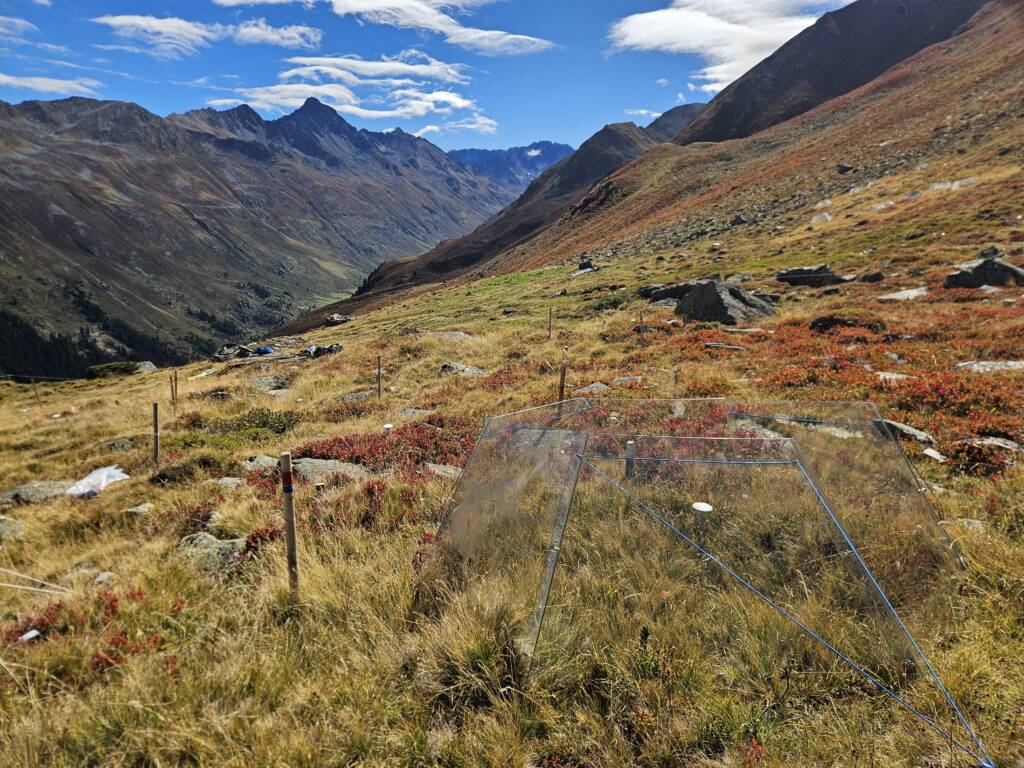
Field site in Austrian Alps showing climate warming treatments using open-top chambers.,Collembola species Calvatomina superba chilling on a mossy log (credit: Luca Davenport-Thomas),Field site in Swiss Alps showing climate warming treatments using open-top chambers.
Methodology
The project will involve substantial fieldwork in the European Alps (1-2 trips) and Scottish Highlands, alongside a considerable lab component.
Hypotheses 1 will be tested across a range of UK shrub regeneration sites and adjacent grasslands. Hypotheses 2-4 will be tested using a climate warming, N-addition, and shrub regeneration experiment at four sites in the Scottish Highlands and European Alps. This experiment was established by the lead supervisor, Dr. Broadbent, in 2025.
Characterisation of soil faunal communities will be carried out via two methods: traditional microscopy and eDNA metabarcoding. Training in these techniques will be provided via three research stays. 1) with Dr. Pravia at Forest Research, the CASE project partner, for 3-6 months to learn soil mite and collembola extraction and identification. 2) with Dr. Cordero at WSL, Zurich, for 2-3 weeks to receive training in nematode extraction and identification. 3) with Dr. Newbold at CEH Wallingford for 2-3 weeks to learn eDNA metabarcoding techniques.
Bioinformatics and multivariate statistics skills will be acquired via NERC-courses, with a portion of the RTSG set aside for this.
Soil function measurements will be learned in the soil biogeochemistry lab at the University of Stirling with support from the lead supervisor.
Project Timeline
Year 1
1. Literature review (Oct-Dec)
2. Experiment planning (Jan-Apr)
3. Fieldwork for study 1/H1 (May-June)
4. Lab work for study 1, including research stay at Forest Research (July-Sept)
Year 2
1. Finish lab work study 1 (Oct)
2. Data-analysis and writing of study 1 (Nov-Feb)
3. Further experiment planning (Mar-Apr)
4. Fieldwork for experiments 2 (H2), and 3 (H3-4) (May-Sept)
5. Lab work experiment 2, including research stay at WSL (July)
Year 3
1. Lab work experiment 2, including research stay at CEH (Oct-Dec)
2. Finish and submit manuscript (study 1) to peer-reviewed journal (Jan-Feb)
3. Data analysis experiment 2, including bioinformatics and statistics training (Feb-May)
4. Field and lab work for experiment 3 (May-July)
5. Data analysis experiment 3 (July-Sept)
Year 3.5
1. Writing-up experiments 2+3 (Oct-Feb)
2. Finish thesis and submit manuscript(s) for experiments 2 and 3 (Mar)
Training
& Skills
The PhD researcher will master state-of-the-art techniques for assessing soil biodiversity and ecosystem functioning. They will also develop strong transferrable skills, including critical thinking; project management and execution; and data synthesis and communication, which are all highly regarded throughout the life and environmental sciences sector. This comprehensive set of competencies and experience, along with ample networking opportunities, will serve the researcher very well in their future career.
References & further reading
Angst, G., et al. (2024). Conceptualizing soil fauna effects on labile and stabilized soil organic matter. Nature Communications 15(1) https://doi.org/10.1038/s41467-024-49240-x
Anthony, M. A., et al. (2023). Enumerating soil biodiversity. Proceedings of the National Academy of Sciences, 120(33).
Broadbent, A. A. D., et al. (2022). Shrub expansion modulates belowground impacts of changing snow conditions in alpine grasslands. Ecology Letters, 25(1).
Broadbent, A. A. D., et al. (2024). Climate change disrupts the seasonal coupling of plant and soil microbial nutrient cycling in an alpine ecosystem. Global Change Biology, 30(3).
Delgado-Baquerizo, M., et al. (2025). Soil biodiversity and function under global change. PLOS Biology, e3003093. https://doi.org/10.1371/JOURNAL.PBIO.3003093
Li, D., et al. (2024). Soil fungal community has higher network stability than bacterial community in response to warming and nitrogen addition in a subtropical primary forest. Applied and Environmental Microbiology, 90(6).
Phillips, H. R. P., et al. (2024). Global changes and their environmental stressors have a significant impact on soil biodiversity—A meta-analysis. IScience, 27(9). https://doi.org/10.1016/J.ISCI.2024.110540
Rongstock, R., et al. (2026). Global change factors differ in effect when acting alone and in a multi-factor background. Nature Communications, 17(1).
