

IAP-26-058
Development and application of multispecies capture-recapture models
Spatial capture-recapture (SCR; Borchers & Efford, 2008; Royle & Young, 2008) is a widely used framework for estimating animal density and distribution for data collected from a variety of ecological monitoring approaches, including camera trapping and acoustic surveys. SCR provides a formal statistical framework for testing hypotheses about spatiotemporal variation in density, species-habitat relationships, and landscape connectivity (Royle et al., 2013; Sutherland et al., 2015).
However, a critical technical gap exists: SCR methods for analysing data from multiple species simultaneously are not yet available, despite ecological monitoring programs routinely targeting whole communities. Increasingly, the focus of ecological interest and management has moved towards a whole-community understanding. There is an opportunity, and need, to move beyond analysing data from multiple species independently, and extend ecological inference to spatiotemporal species interactions and their drivers. Joint modelling could reveal patterns consistent with trophic, competitive, or mutualistic relationships between species, and improve inference about population density for any one species by using the detection data from other, ecologically associated species.
The development of multispecies SCR methods is particularly timely. Technological advancements in sensor hardware and AI-assisted image and acoustic classifications, along with falling costs of monitoring equipment, have led to ambitious, long-term monitoring programmes. These cover large spatial and temporal scales using devices such as acoustic recorders (e.g., Cretois et al., 2026) or camera traps (Visagie et al., in press). This convergence of advances routinely generates multispecies data that are well-suited to SCR. Although an initial multispecies SCR model allows avoidance between species (Diana et al., 2022), it does not flexibly accommodate positive and negative associations required for community analyses. Thus, a major gap remains: the analytical options for these data are largely restricted to analysing data from each species separately, even when data are collected together on the same survey, or by surveys conducted close together in space and time. Joint modelling would permit sharing of information across both species and surveys.
This project will close this methodological gap. The student will develop novel SCR methods that accommodate data from all species detected in a single SCR model. They will use simulation methods to evaluate when and why joint multispecies models outperform single-species analyses and apply them to real survey data to investigate spatiotemporal associations among species. The project will extend SCR from single populations to interacting communities, providing a new tool for understanding how species interactions shape the distribution and abundance of wildlife across landscapes.
This project will focus on developing statistical methods across a range of multispecies SCR scenarios:
1. Modelling spatial variation within a single extensive detector array, a design commonly used for camera-trap SCR surveys (e.g., Visagie et al, in press).
2. Modelling spatial variation between clusters of spatially separated detectors that are distributed across a wide region, a design commonly used for acoustic SCR surveys (e.g., Martin et al., 2024; McGrath et al., 2023).
3. Further extensions to spatiotemporal models, capable of inference into how population density, community composition, and species associations change over time.
Click on an image to expand
Image Captions
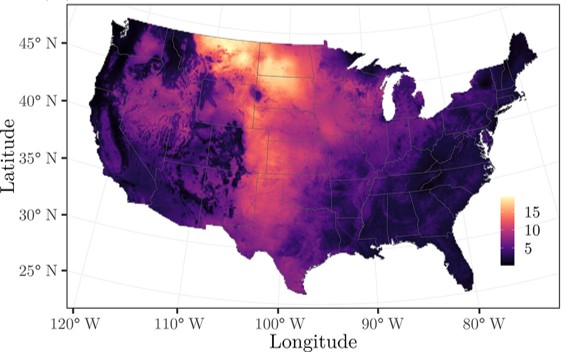
Predicted species richness from a spatial factor multispecies occupancy model (figure taken from Doser et al, 2023, in Ecology), a method we think can be extended to spatial capture-recapture.
Methodology
SCR data introduce the challenge of estimating population density and distribution from spatially correlated detections of individually identifiable animals, which are assigned an unobserved latent activity centre. Multispecies modelling introduces the further challenge of handling spatial dependence among activity centres of different species.
Although general-purpose multispecies modelling approaches have not yet been developed for SCR, there is a substantial history of development for other survey types. For example, advances in spatial latent-factor models (Thorson et al., 2015) and joint species distribution models (Ovaskainen et al., 2017; Doser et al., 2023) provide a rich source of ideas that could extend the appealing features of SCR (e.g., estimation of absolute density, connectivity, and resource selection) to depend on other co-occurring species – a formal framework that does not yet exist.
The student will evaluate how these ideas from other methodological families might be extended to SCR. In this project, the student will have the scope to explore various inferential frameworks to accommodate these spatial dependencies via latent structures, including likelihood-based and Bayesian methods.
This is an ecological statistics project, and, as such, would best suit someone with a statistics background interested in applying their skills in an ecological context, or someone with an ecology background with existing statistical skills that they wish to develop further.
Project Timeline
Year 1
• Literature review of existing multispecies and community modelling methods.
• Development of statistical methods for traditional multispecies SCR surveys.
Year 2
• Development of statistical methods for multispecies acoustic SCR surveys.
• Simulation studies to assess the performance of the methods, compared to single-species approaches.
• Application of the methods to existing data sets provided by collaborators.
• Complete draft of first chapter (multispecies methods for traditional SCR surveys).
• International conference attendance.
Year 3
• Extensions to spatiotemporal methods, capable of monitoring changes over time.
• Development of open-source software of the methods developed within the project.
• Complete draft of second chapter (multispecies methods for acoustic SCR surveys).
Year 3.5
• Complete draft of third chapter (spatiotemporal multispecies SCR methods).
• Finalise all chapters of the thesis for submission.
Training
& Skills
A needs assessment will be conducted with the student upon entry to establish which opportunities offer the greatest benefits to them. The skills audit will be reviewed annually to ensure that the skills needed for both the PhD and future employment are being development.
The student will benefit from two training schemes available to PhD students in Scotland: the Scottish Mathematical Sciences Training Centre (SMSTC; free to St Andrews students) and the UK’s Academy for PhD Training in Statistics (APTS; costs incurred from RTSG). Both SMSTC and APTS offer modules on a range of mathematical and statistical topics. Further training is available through the University of St Andrews GRADskills programme, covering a range of research skills for PhD students (e.g., academic writing, publishing, conferences and networking).
References & further reading
Borchers, D. L., and Efford, M. G. (2008) Spatially explicit maximum likelihood methods for capture-recapture studies. Biometrics, 64, 377-385.
Cretois, B., Rosten, C. M., Wiel, J., Cynthia, B., McEwen, B., Bernard, C., Boom, M. P., Bota, G., Brotons, L., Serrano-Davies, E., Glotin, H., Kissling, W. D., Marxer, R., Pérez-Granados, C., Stowell, D., Villero, D., van Zweden, J. S., and Sethi, S. (2026) TABMON: Design and deployment of a transnational passive acoustic monitoring network for European birds. Methods in Ecology and Evolution, 17, 1867-1879.
Diana, A., Matechou, E., Griffin, J. E., Jhala, Y., and Qureshi, Q. (2022) A vector of point processes for modelling interactions between and within species using capture-recapture data. Environmetrics, 33, e2781.
Doser, J. W., Finley, A. O., and Banerjee, S. (2023) Joint species distribution models with imperfect detection for high-dimensional spatial data. Ecology, 9, e4137.
Martin, L. H., Hepinstall-Cymerman, J. H., Chandler, R. B., Cooper, R. J., Parrish, M. C., Hao, L., and Stevenson, B. C. (2024) Estimating owl population density using acoustic spatial capture-recapture. Journal of Raptor Research, 58, 1-13.
Ovaskainen, O., Tikhonov, G., Norberg, A., Blanchet, F. G., Duan, L, Dunson, D., Roslin, T. and Abrego, N. (2017) How to make more out of community data? A conceptual framework and its implementation as models and software. Ecology Letters, 20, 561-576.
Thorson, J. T., Scheuerell, M. D., Shelton, A. O., See, K. E., Skaug, H. J., and Kristensen, K. (2015) Spatial factor analysis: A new tool for estimating joint species distributions and correlations in species range. Methods in Ecology and Evolution, 6, 627-637.
Visagie, M., Davis, R. S., Overton, E. K., and Venter, J. A. (in press) Estimating large carnivore populations in an arid fenced reserve using spatial capture-recapture modelling. Wildlife Biology.
